 By KHALED ABU TOAMEH A Hamas delegation headed by Mahmoud Zahar returned to the Gaza Strip over the weekend after holding talks in Cairo and Syria on a possible prisoner agreement exchange with Israel. Hamas legislator Salah Bardaweel cautioned against "excessive optimism," saying only limited progress has been achieved so far. The Islamist movement's leader, Damascus-based Khaled Mashaal, is scheduled to travel to Cairo late this week for additional talks on the case of kidnapped IDF soldier St.-Sgt. Gilad Schalit. On Friday, Mashaal arrived in Amman to attend the funeral of his 91-year-old father, who died last week. Mashaal was expelled from Jordan and the Hamas offices in the kingdom were closed down 10 years ago. Jordan's King Abdullah II gave Mashaal permission to visit the kingdom for only 48 hours to attend the funeral. He was barred from talking to reporters or making public statements during his stay in the kingdom. The Hamas delegation that returned to Gaza had met in Cairo with German security officials who were mediating between the Islamist movement and Israel, a Hamas representative in the Strip said on Saturday. Read more here,,,, Source: JPost 
 by Robert Spencer by Robert Spencer
"I want you to arrange a meeting with the heads of the Five Families. This war stops now."
Oh, the Sunnis hate the Shi'ites,
And the Iranians hate the Saudis,
And the Syrians hate the Iraqis,
And everybody hates the Jews. But during National Umma Week, National Umma Week,
It's National Everyone-smile-at-one-another-while-our-hearts-curse-them-umma Week.
Be nice to Nasbis and Rafidite dogs who
Are inferior to you.
It's only for a week, so have no fear.
Be grateful that it doesn't last all year! (Apologies to Tom Lehrer) "Iran calls for regional meeting on Iraq security," from Reuters, August 29 BAGHDAD, Aug 29 (Reuters) - The Iranian foreign minister on Saturday called for Iraq's neighbours to hold a meeting to discuss Iraqi security after Baghdad accused Syria of harbouring the planners of two massive bomb attacks. Separately, Turkey's foreign minister is to visit Iraq and Syria on Monday to try to soothe relations between the two. Since 2003, tensions -- prone to flare-ups since around the time Saddam came to power in 1979 -- have centred on charges from Iraq's U.S.-backed government that Syria, estranged from Washington, has allowed insurgents to stream into Iraq. Iraqi politicians have also lashed out at Saudi Arabia for inciting Sunni Islamist insurgents, a charge the kingdom denies. And while Baghdad's relations with Tehran are cordial, the U.S. military complains that Iran arms and trains Shi'ite militia. Meanwhile, Iraq's relations with Kuwait to the south are strained as Baghdad chafes at Kuwait's insistence it continue to pay billions of dollars in reparations for former Iraqi leader Saddam Hussein's 1990 invasion. Relations with western neighbour Jordan have been on the mend, and ties with Turkey have taken a noticeable turn for the better in the past year. "We hope to get the cooperation and approval of all neighbouring countries for this meeting," Iranian Foreign Minister Manouchehr Mottaki told reporters through a translator during a visit to Iraq. There have been several regional meetings on the conflict in Iraq since the U.S.-led ouster of Saddam in 2003, but Iraq's ties with its neighbours are fragile. Iraqi officials frequently blame neighbouring countries for the violence that continues to rock the country more than six years after the U.S.-led invasion. "Maintaining security and stability in Iraq, or losing it, has a direct impact on all of Iraq's neighbouring countries," Iraqi Prime Minister Nuri al-Maliki said in a statement. While sectarian slaughter between majority Shi'ites and once dominant Sunnis in Iraq has subsided, bombings attributed to Sunni Islamist groups such as al Qaeda continue as U.S. forces begin to gradually withdraw ahead of an end-2011 deadline. Many in Saudi Arabia, the birthplace of Islam which follows a strict brand of the Sunni faith called Wahhabism, see Persian Iran, a Shi'ite Muslim country, as their arch enemy. Clerics of Saudi Arabia's official hardline school of Islam view Shi'ites as heretics and the government fears Iraq is becoming a satellite of Shi'ite power Iran.... Source: JihadWatch
 It is a sign of the corrosiveness of the anti-Zionist agenda that even some of the most admirable and well-regarded of international luminaries feel no compunction these days about using the greatest crime against the Jewish people as a convenient weapon against the Jewish state. Holocaust inversion has now entered the mainstream. No-one, it seems, is immune from its temptations.Enter former anti-apartheid campaigner, Nobel laureate, and Archbishop Emeritus Desmond Tutu who has used an interview with the liberal-Left Israeli newspaper Haaretz today to make some typically ill considered remarks of his own: "The lesson that Israel must learn from the Holocaust is that it can never get security through fences, walls and guns,” he was quoted by the paper as saying. "... in South Africa, they tried to get security from the barrel of a gun. They never got it. They got security when the human rights of all were recognized and respected." This is crass even by Tutu’s standards when talking about Israel. But it was nothing compared to the truly disturbing comments made earlier this week by Virgin Atlantic boss and international NGO financier Richard Branson. Asked to draw on his business and public relations skills to advise Israel on how to improve its image, he said: "I think it’s something similar to what happened after 9/11. You know after 9/11 the world had enormous sympathy for America, and you know that sympathy was somehow lost. And obviously after the Second World War, the world had enormous sympathy for the Jewish people. Over a number of decades, that sympathy has been lost ... You’ve got a great country, but you’ve just got to hold the hands of your neighbors, and then you’ll get back on top again." I have remarked on a number of occasions on how submersion in the anti-Zionist agenda leads otherwise reasonable and sane individuals to say things which make them look ridiculous. But “you’ve just got to hold the hands of your neighbours, and then you’ll get back on top again.”? Don’t these people ever think about what they are saying? The mind boggles. Read more here ... Source: Robin Shepherd Desmond Tutu
Latest recipient of the Demented Priest Award

Richard Branson
Latest recipient of The Dhimmi Award

 Chechen rebels have today called for prominent separatist leader Akhmed Zakayev to be killed, saying he has abandoned Islam. Zakayev, who lives in London, represents the moderate wing of the separatist movement and has clashed with radical Islamic insurgents in Russia's southern republic of Chechnya. An Islamic rebel website said Zakayav had recognised the authority of Ramzan Kadyrov, the Kremlin-backed leader of the region. 'Public remarks show that he (Zakayev) has fallen away from Islam,' the website said, adding that Doku Umarov, Chechnya's most wanted separatist leader, was behind the order. 'The court has ruled that the killing of this apostate is a duty for Muslims.' It did not say what court had issued the ruling. Zakayev, 50, fought against Russia as a senior rebel commander in two wars with Moscow from 1994 to 2000.
After Russia regained control of the province, he fled to Europe and acted as an official rebel envoy until 2007. Russia has tried to extradite Zakayev for 13 alleged crimes including kidnapping and murder, but a British court rejected the request in 2003, causing a diplomatic row. Kadyrov said last month that he would welcome Zakayev's return and possibly offer him a job in the regional culture ministry. But there were no indications Russia was ready to drop charges against him. Kadyrov faces strong criticism from human rights bodies after kidnappings and killings of human rights and charity activists in Chechnya.
He denies any link to the killings. Source: Mail Online
H/T: JihadWatch
 Sept. 11 Plotter Cooperated After Waterboarding After enduring the CIA's harshest interrogation methods and spending more than a year in the agency's secret prisons, Khalid Sheik Mohammed stood before U.S. intelligence officers in a makeshift lecture hall, leading what they called "terrorist tutorials." In 2005 and 2006, the bearded, pudgy man who calls himself the mastermind of the Sept. 11, 2001, attacks discussed a wide variety of subjects, including Greek philosophy and al-Qaeda dogma. In one instance, he scolded a listener for poor note-taking and his inability to recall details of an earlier lecture. Speaking in English, Mohammed "seemed to relish the opportunity, sometimes for hours on end, to discuss the inner workings of al-Qaeda and the group's plans, ideology and operatives," said one of two sources who described the sessions, speaking on the condition of anonymity because much information about detainee confinement remains classified. "He'd even use a chalkboard at times." Read more here,,, Source: Washington Post
 The United Arab Emirates has seized a cargo of North Korean weapons being shipped to Iran, which would have violated a UN embargo on arms exports from the communist state, Western diplomats say. The UAE reported the incident, which occurred two weeks ago, to the Security Council sanctions committee on North Korea, diplomats said on Friday. The committee sent letters to Tehran and Pyongyang on August 25 informing them of the seizure and demanding a response within 15 days. The weapons seized on August 14 included rocket launchers, detonators, munitions and ammunition for rocket-propelled grenades, it said. The ship, called the ANL-Australia, was Australian-owned and flying a Bahamas flag. "Based on past experience ... we don't expect a very detailed response," one of the diplomats said on condition of anonymity.
The diplomats said the Australian firm whose ship was seized is controlled by a French conglomerate and the actual export was arranged by the Shanghai office of an Italian company. The diplomats did not name any of the firms involved. "The cargo was deceptively labelled," said a diplomat "The cargo manifest said that the ship contained oil boring machines. But then you opened it up and you found these arms." The UAE mission to the UN declined comment on the case.
Read more here,,, Source: Al Jazeera (English)
 Ethiopian troops have crossed into neighbouring Somalia and seized control of a town from Islamist fighters, witnesses say.
Hundreds of troops reportedly entered the strategically important town of Beledweyne on Saturday. Abdinur Ahmed Maow, a local resident, told The Associated Press news agency that the armed opposition fighters had left "without a single shot". Abdulahi Faramiliq, another resident of Beledweyne, said that the troops were cordoning off residential areas and going from house to house searching for weapons.
However, General Muqtar Hassan Afrah, the Somali military commander in the region, denied that any Ethiopian troops were in the region. Ethiopian forces withdrew from Somalia in January as part of a peace deal, more than two years after moving in to help the UN-backed interim government battle the Islamic Courts' Union, which had seized control of much of the south and centre of the country. Their presence was unpopular with the majority of Somalis and was used by local Islamist groups as a recruiting tool.
Rashid Abdi, a Kenya-based Somalia analyst with the International Crisis Group, said that it is unlikely that Ethiopia is planning to send a larger force across the border. "It's a strategic town for them," he said, referring to the Beledweyne's location near the border. "They want a buffer zone and they won't allow it to be in hostile hands."
There have been several reports of Ethiopian troops crossing the border in recent months, but the Somali government has not confirmed their presence.
Somalia's government is struggling to control the country, despite including several factions of the Islamic Courts' Union.
Fighters from al-Shabaab and Hizb ul-Islam groups have seized control of large areas of the country and have vowed to topple the administration of Sheikh Sharif Ahmed, the current president and former Islamic Courts leader. Source: Al Jazeera (English)

Aug. 20: Presidential candidate and current President Hamid Karzai casts his vote at a polling station in Kabul. KABUL — President Hamid Karzai widened his lead in Afghanistan's presidential race as new vote tallies were released Saturday, inching closer to the 50 percent threshold of votes he needs to avoid a run-off. As Afghanistan's Independent Election Commission slowly releases partial results from the Aug. 20 presidential election, accusations of fraud have poured into the Electoral Complaint Commission. Videos of alleged fraud have been posted on the Internet, and Karzai's top challenger, Abdullah Abdullah, has made multiple complaints of cheating. The allegations from Abdullah and other presidential candidates, along with low turnout in the violent south because of Taliban threats of violence, could strip the election of legitimacy in Afghan eyes. Security officials are monitoring tensions among Abdullah supporters for any signs that the election turmoil could ignite violence. The latest results show Karzai ahead with 46.2 percent of the votes already counted against Abdullah's 31.4 percent. The results are based on 35 percent of the country's polling stations, meaning they could still change dramatically. Karzai must win 50 percent of ballots cast to avoid a runoff. Final results will not be released until late September after the allegations of fraud have been investigated. Read more here,,,, Source: FoxNews
 By Pamela Geller The leftist/Islamic alliance is pulling out all the stops to blunt the impact of the word of a 17-year-old girl, Rifqa Bary -- who converted from Islam to Christianity and fled from her family after her father threatened to kill her. In Islam, apostasy carries the sentence of death. And -- according to Bary -- her father was intent on carrying it out. The Leftist/Islamic spin machine was slow on the uptake. They assumed that Rifqa would be sent back to Ohio at her jurisdiction hearing last Friday. But she wasn’t. The candor and integrity of this girl’s desperate plea set freedom-loving people alight. Emails, faxes, and phone calls from blog readers, talk radio listeners, etc., pleaded for this brave girl’s life. And thank G-d, she was saved. But now, the cultural jihadists are at work. The Orlando Sentinel is busy propagating the statements of Rifqa Bary’s devout Muslim family and the family’s lawyers. CAIR, according to the Jawa Report blog, has “instructed supporters to circulate rumors that Rifqa had been carousing with infidel boys and engaged in acts of immorality.” But it looks awfully bad to keep going after a little girl. So they’re also blaming the American people’s alleged “ignorance of Islam.” Ahmed M. Rehab, executive director of CAIR, wrote to the Sentinel complaining about the “public’s ignorance of Islamic history, culture and contemporary affairs,” and charging that “Rifqa’s parents are judged not by who they are but by what the pundits say they are.” Read more ...Source: Human Events
Strong Royal Family Vital to Keeping Saudi Arabia Progressive
Friday, August 28, 2009 11:21 AM - Tawfik Hamid Since 9/11, the role played by, and the link between, Saudi Arabia and radical Islam were topics of discussion among many intellectuals. Some voices blamed Saudi Arabia for all problems of radical Islam and demanded a weakening of its ruling regime or the royal family. Careful examination of the interplay of powers in Saudi Arabia reveals three fundamental forces: the progressives, the regressives, and the terrorists. The first power — the progressives — want to bring the country to the path of modernity. This group draws predominantly from the royal family and some progressive intellectuals. The progressives managed to allow women to reach the highest levels in education, to allow non-Shariah-compliant Western banking systems to work in the country, and to permit the installation of the Internet and satellite dishes that bring TV news and movies from all over the world directly to Saudi houses. This group was supported as a political power by the Wahhabi system, yet managed to bring those elements of modernity. But the progressives could not bring more change in the society, as they were resisted by the second group, the regressives. The regressives are primarily the Wahhabis and their allies. This group controls many areas in the education and legal systems, and promotes the following: · Subjugation of women to men.
· Suppression of religious freedom (which manifests itself as the killing of apostates).
· Prevention of non-Muslims from having their religious books or temples in the country.
· Cruel punishments, such as stoning to death, for having extramarital sexual relations.
· Violent jihad on the part of the Muslim nation against non-Muslim nations This group considers wars to spread Islam a responsibility of the Islamic umma (nation), rather than an individual responsibility. It does not condone terrorist acts, but teaches violent theological foundations. The third power-wielding group are the terrorists, who consider declaring war against non-Muslims as a personal responsibility, and thus conduct violent acts such as explosions and suicide bombings. This group — if it were to take power — will make Saudi Arabia like Afghanistan under the Taliban. It is fair to say that the Saudi royal family is not the Taliban. The Taliban does not allow women to have education, does not permit satellite TVs or any other sign of modernity. This difference between the Saudis and the Taliban is mainly due to the relentless efforts of the progressives, who managed to make progress in certain areas of Saudi society but could not make the same in other. The complexity of the issue makes solving this problem delicate. Weakening the royal family could deprive the country of the progressive voices that managed to take some positive steps to modernize the country. Weakening the current Saudi regime could simply allow the second and third groups to take over the country and make it more like a Taliban and al-Qaida model. On the contrary, supporting the enlightened elements within the royal family is pivotal to avoid a collapse into such a system. The progressives are not currently in full control and are opposed by the other two. mplementing uncalculated changes in Saudi Arabia could be disastrous. One issue is that Saudi Arabia is seen by its population and many other Muslims as the leader of the Islamic world. This puts the progressives in a difficult situation, as any change in the Saudi society toward modernity must be justified by the religion. This could be seen as bad news by many, but as good news by those who know how to give religious justification to values of liberty and modernity. Islamic texts can be understood in many ways. For example: The second Islamic ruler (or Caliph), Umar Ibn Al-Khatab (who is considered one of the closest disciples to Prophet Muhammad and one of the top 10 righteous people in Islam, who were given a “guarantee to enter the paradise”) banned the Islamic law of amputating the hands of thieves. This happened in the early history of Islam (“Aam Al-Ramada”) when poverty exceeded certain limits. Umar simply looked at the spirit of the religion of having mercy and justice, and gave this a priority over applying the literal text of the Quran. The progressive elements of the Saudi royal family can use such an approach (and others) as a model to bring religious justifications for changing the country gradually toward more modernity. The power interplay within Saudi Arabia necessitates a wise approach to bring the country toward modernity without creating instability. The enlightened elements in the royal family and in Saudi society managed to educate women, allow TV and Internet, and are starting interfaith dialogue via the outreach of king Abdullah. In addition, the progressives were recently trying to stop underage marriage, allow women to drive, and supported a Saudi TV Program (“Tash Ma Tash”) that is critical of some aspects within the Saudi society. One of the most controversial phrases used in this program to critique traditional education was “We speak about the Saudi person and you speak about the Muslim person.” The change in Saudi Arabia needs to be gradual to avoid instability, but progressive. It must have some element of religious justification in order to be effective. Islamic texts and history can allow this to happen. Dr. Tawfik Hamid is the author of "Inside Jihad." He was a former associate of Dr. al-Zawahiri (second in command of al-Qaida) and currently he is a reformer of Islam. To know more about Hamid please visit http://tawfikhamid.com/. Hamid's writings in this blog represent only his thoughts and not the views of the institute where he works.
© 2009 Newsmax. All rights reserved.
Source: http://www.newsmax.com/tawfik_hamid/saudi_islam_muslim/2009/08/28/253591.html
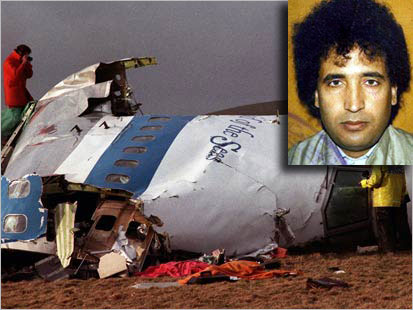 August 29THE man convicted of the Lockerbie bombing that killed 270 people said he would co-operate with a fresh public inquiry and provide documents he has.Former Libyan agent Abdel Basset al-Megrahi, the only person convicted of the bombing, told Scotland's Herald daily the victims' families deserved to know the truth about Pan Am flight 103, which crashed into the Scottish town of Lockerbie in 1988. Scotland freed Megrahi, 57, last week on compassionate grounds after eight years in jail because he is dying of cancer. His release, and his rapturous reception on his return to Tripoli, has dismayed the US Government which lost 189 citizens in the bombing. "I support the issue of a public inquiry if it can be agreed," Megrahi told the newspaper. "In my view, it is unfair to the victims' families that this has not been heard. It would help them to know the truth. As I said, the truth never dies. "If the UK guaranteed it, I would be very supportive. I would want to help Dr Swire and the others with the documents I hold." Read more here ...
 By Raymond Ibrahim | August 25 Recently, Cathy Lynn Grossman of USA Today wrote an article about Muslim zakat, wherein I was referenced as a "critic of Islam." She then followed up with another article titled " Critic questions the aims and ends of Islamic charity," dedicated to examining my views on zakat. While I appreciate Ms. Grossman's initiative, what especially interests me is that her response exemplifies the problems originally highlighted in my article, "The Dark Side of Zakat: Islamic Charity in Context," which Ms. Grossman takes to task. I had written: "From what American schoolchildren are being taught by their teachers to what Americans are being told by their presidents, concepts unique to Islam are nowadays almost always 'Westernized.'… [T]his phenomenon has resulted in epistemic (and thus endemic) failures, crippling Americans from objectively understanding some of Islam's more troublesome doctrines." It is, therefore, a bit ironic that Ms. Grossman's entire article is a testimony to this phenomenon. For starters, even though I indicated Muslims are actually forbidden from bestowing zakat onto non-Muslims, her opening sentence stubbornly describes zakat as a "mandate to be charitable." Surely "charity" that discriminates according to religion cannot be deemed all that "charitable," a word that, in a Western context, is connotative of universal beneficence. Ms. Grossman is also decided that Muslims engaged in that timeless Islamic phrase fi sabil Allah—most literally, "the path of Allah"—include "anyone from seminary students to imams to missionaries"; conversely, I supposedly read it "as a straight pipeline to violent jihadists." Fair enough. Unfortunately, however, when it comes to the significance of Islamic terminology, neither her opinion nor mine matters much; how Islam's authoritative schools of jurisprudence (specifically, the four madhahib) have interpreted fi sabil Allah is all that matters. And Islam's juridical rulings are such that fi sabil Allah is synonymous with the concept of violent jihad. For example, in its section on zakat, the Arabic-English edition of the standard legal text, 'Umdat as-Salik, translates fi sabil Allah as "those fighting for Allah." Next to the index entry for fi sabil Allah, it simply says "see jihad." The following zakat-related anecdote from Islamic history is further illuminating: After Muhammad's death in 632, several Arab tribes, while still identifying themselves as Muslims, refused to pay zakat, much of which was being used to fund ongoing military operations. Abu Bakr, the first "righteous" caliph, responded by launching the Apostasy Wars, which claimed the lives of tens of thousands of Arabs. In this context, neither the uses of zakat, nor Abu Bakr's murderous response, seem very "charitable." (Who ever heard of killing people for not being "charitable" enough?) Read more here ... Source: Middle East Forum
 |
|
|
Copyright Muslims Against Sharia 2008. All rights reserved.
E-mail: info AT ReformIslam.org
|
|
|


 Posts
Posts


