Some 25 countries involved in the US-led operation in Afghanistan have pledged to send an additional 7,000 troops, the Nato secretary-general has confirmed, meeting US expectations for added support. "At least 25 countries will send more forces to the mission in 2010," Anders Fogh Rasmussen said after a meeting with the military alliance and non-Nato members in Brussels on Friday. He did not name the nations pledging troops, but said further contributions from other allies could be made "in the coming weeks and months". "There is no doubt the going will be tough, no one should expect instant results. But it will not be a run for the exit," he said. His comments come after Hillary Clinton, the US secretary of state, said she was confident allies would support calls by Washington for more troops in Afghanistan.
Barack Obama, the US president, had called on other countries to come up with 5,000 to 7,000 troops to bolster an additional 30,000 forces from the US. Hillary Clinton, the US secretary of state, is spending Friday explaining US plans to step up the campaign against the Taliban. "There's an understanding about the importance of the mission that the president has described," she said before arriving at Friday's meeting, adding that the "response has been positive". Rasmussen said the coming year will bring "new momentum" to the Afghanistan mission, he said during a talk with Nato foreign ministers in Brussels. There are currently around 100,000 troops from 43 countries involved in the US-led operation in Afghanistan. David Miliband, the British foreign secretary - whose country has so far committed an additional 500 troops - said alliance members must "ask themselves whether they are doing the maximum possible". "We know the stakes are very high indeed. So this is the time for all of the international community to make sure it steps up to support the efforts of governance in Afghanistan and Pakistan to ensure stability in that crucial part of the world." Italy's government has approved sending 1,000 extra soldiers to Afghanistan next year, the defence and foreign ministers announced on Thursday. In addition to Italy, Britain, Georgia, Poland and Slovakia have all promised increased troop deployments, while key allies France and Germany appear to be leaning more toward providing trainers for Afghan forces. But the Netherlands and Canada plan to withdraw their respective combat forces of 2,100 and 2,800 over the next two years, reflecting public unease with the war. The US now has 71,000 troops in Afghanistan, while other Nato members and allies collectively have 38,000 service members there. With the added reinforcements, the international forces will swell to more than 140,000 soldiers. Clinton said the United States was seeking a range of help, including civilian assistance and military training, in order to prepare Afghanistan to take charge of its own destiny. "We've got to bring the Afghan security forces into the fight," she said. Al Jazeera
 Anders Fogh Rasmussen issued his warning just a day after Gordon Brown gave his clearest signal yet that he wants to begin the process of ending Britain’s Afghan mission within months. Mr Rasmussen said: “If we were to walk away and turn our backs on Afghanistan, al Qaida would be back in a flash.
They would have a sanctuary from which to launch their strategy of global jihad, a strategy that is directed first and foremost against us. Anyone who doubts the risk of a premature exit “is not living in the real world," he told a Nato conference in Edinburgh. Speaking to the same conference, David Miliband, the Foreign Secretary, said that British troops are fighting in Afghanistan not to defeat Taliban insurgents but to persuade them to lay down their arms and enter politics. Britain’s goal in Afghanistan is “not a fight to the death” but a political settlement, he said. Mr Rasmussen's intervention came as it emerged that a British soldier shot dead in Afghanistan on Sunday had complained before his death that new body armour had not been delivered. Rifleman Andrew Fentiman, 23, a Territorial Army soldier from Cambridge, wrote on the internet two weeks ago: "We are still waiting on these new body armour and helmets that were promised to us." A total of 234 British service personnel have died in Afghanistan since 2001, and public support for the 9,000-strong British mission there is flagging. To reassure wavering voters, the Prime Minister has begun to talk up the prospect of an exit from Afghanistan. On Monday, he proposed an international summit on Afghanistan that will set out a “timetable” for handing territory back to the Afghans starting next year. Mr Rasmussen backed that schedule, “where conditions permit”. However, Lord Robertson, a former Labour defence secretary, warned the Prime Minster not to be pushed into an early exit from Afghanistan, saying leaving too quickly would raise the terror threat to the West. He said: “Our people will never forgive this political generation if we were to walk away from the threat and horrors that we know would be the consequences of prematurely getting out of Afghanistan.” The Prime Minister’s new emphasis on a timetable for exit has also caused private concern among British commanders, who worry that any sign that Britain’s commitment to the Afghan mission is waning will encourage the Taliban. David Richards, the Chief of the General Staff, has said that it could be another five years before British troop numbers fall. Read more at the Telegraph 
 Britain's foreign secretary has suggested that senior Taliban figures be given positions in the Afghan government to bring an end to the violence in the country. At a meeting of Nato's parliamentary assembly in Edinburgh, Scotland on Tuesday, David Miliband said that history suggested many Taliban members could be persuaded to stop fighting. Miliband said the Afghan government would need to reach out to "high-level commanders that can be persuaded to renounce al-Qaeda and pursue their goals peacefully". "This will be far from straightforward. But the historical lessons are clear," he said. "Blood enemies from the Soviet period and the civil war now work together in government. Former Talibs already sit in the parliament. "It is essential that, when the time is right, members of the current insurgency are
encouraged to follow suit," he said. Marwan Bishara, Al Jazeera's senior political analyst, said there was nothing new about Miliband's proposal.
"It's kind of funny hearing foreign secretary Miliband speaking of this as if it is all new invention," he said.
"In fact, this has been tried since the 1950s. There's no counterinsurgency without a political programme.
"At the heart of it is winning the population. In fact, scaring the population into playing ball, if you will, with the occupier."
Miliband's comments came shortly after Anders Fogh Rasmussen, Nato secretary-general, said he expected the military alliance's member nations to pledge "substantially more forces" to Afghanistan. Rasmussen said the move would be part of a wider strategy of handing over security to Afghans. He said he expected the alliance to decide on "a counter-insurgency approach, with substantially more forces" in the coming weeks. "We can, and should, start next year to hand over more lead responsibility for security to Afghan forces. "We will do this in a co-ordinated way, where conditions permit, and this will allow us to progressively move into a support role." His comments reflected proposals by Gordon Brown, Britain's prime minister, who suggested on Monday that a timeframe for handing over security district by district could be drawn up in the new year. Read more at Al Jazeera (English)
 The top U.S. commander in Afghanistan, Gen. Stanley McChrystal, plans to address NATO defense ministers Friday about the next steps for the military strategy. The NATO meeting in Bratislava, Slovakia, comes as the United States wraps up a review of its own military strategy in Afghanistan. "As has been said in Washington, I think the analytical phase is coming to an end and probably over the next two or three weeks we're going to be considering specific options and teeing them up for decision by the president," U.S. Defense Secretary Robert Gates said Friday after the morning NATO session. McChrystal is pushing Washington to send 40,000 more U.S. troops to Afghanistan amid skepticism from some of President Barack Obama's top advisers. The general planned to address the NATO defense ministers at a Friday afternoon "working lunch" that will focus on the Afghanistan war strategy, Gates said. Afghan Defense Minister Abdul Rahim Wardak will also be present, he noted. A main focus of the meeting is how to transition power of security to Afghan forces. But that is still a long way off, NATO Secretary-General Anders Fogh Rasmussen said Friday. "We need to start thinking about and planning towards progressively handing over lead responsibility to the Afghan army and the Afghan police," Rasmussen said. "Now let me be clear: We have not agreed to start handing over the lead. The conditions are not yet right. The Afghan security forces are not yet strong enough." He stressed that when the transition happens, it "doesn't mean NATO forces leave. It means they go into a supporting role." NATO's International Security Assistance Force is made up of more than 71,000 forces from 43 contributing nations, including more than 34,000 from the United States. Source: CNN
 Nato troops will remain in Afghanistan for as long as is necessary to complete its mission, the secretary-general of the organisation has told the US president. Anders Fogh Rasmussen assured Barack Obama on Tuesday that soldiers from the military alliance will continue to support US forces in Afghanistan. "Our operation in Afghanistan is not America's responsibility or burden alone: it is and it will remain a team effort," Rasmussen said during a visit to Obama at the White House. Rasmussen said that he supported Obama's approach of "strategy first, then resources". "This alliance will stand united and we will stay in Afghanistan as long as it takes to finish our job," he said. Obama is due to hold talks on the strategy in Afghanistan with senior US military and government officials on Tuesday and Wednesday. The US president has said that he is yet to make a decision on whether to send more troops to Afghanistan. General Stanley McChrystal, the senior US and Nato commander in Afghanistan, has said that the military effort risks failure unless more troops are sent to the country as part of a revised strategy. McChrystal is expected to ask for an additional 30,000 to 40,000 troops for combat operations and training of Afghan forces. Bruce Riedel, a senior fellow at the Brookings Institute's Saban Centre for Middle East Policy, told Al Jazeera that Obama is considering the current strategy in place before committing to any increase in troops. "I think what the president is doing is the mature and correct thing – to take a hard look at this. The US embarked on a new strategy earlier this year; it has been six months … [but] I think at the end of the day, the president will decide to send in more troops."
Kai Eide, the United Nations' special representative to Afghanistan, on Tuesday called for more troops to help train Afghan security forces. "Decisions concerning procurement of equipment or weapons will have to be taken soon – more international troops for training and for mentoring will be required," he said. Eide said that 2009 had been the deadliest year for Afghan civilians in the eight-year war between the US-Nato alliance and fighters loyal to the Taliban and al-Qaeda. The apparent move by McChrystal to get more US troops sent to Afghanistan comes amid a dramatic rise in the number of US military deaths in the country. Support among the US public for the mission has dropped in recent weeks, while some Democrats say they are reluctant to support the sending of more soldiers. Some senior Democrats, including Robert Gates, the US defence secretary, have said that having too large a US military force in Afghanistan runs the risk of it being seen as an occupation force by Afghan civilians. Source: Al Jazeera (English)
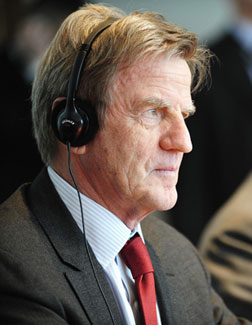 French Foreign Affairs Minister Bernard Kouchner By Christopher Hitchens | Monday, April 20 The most underreported story of the month must surely be the announcement by French Foreign Minister Bernard Kouchner that he no longer supports the accession of Turkey as a full member of the European Union. His reasoning was very simple and intelligible, and it has huge implications for the Barack Obama "make nice" school of diplomacy.
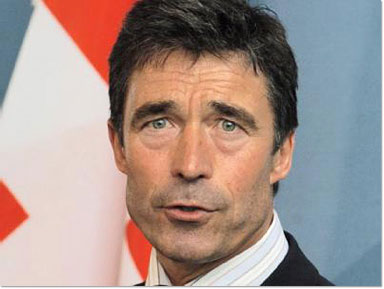 Anders Fogh Rasmussen KABUL (Reuters) - Afghanistan's Taliban insurgents say the incoming NATO chief is the "major enemy" of Muslims for defending the publication of cartoons depicting the Prophet Mohammad when prime minister of Denmark.
Anders Fogh Rasmussen, Danish premier until earlier this month, is due in August to become secretary general of NATO, which leads a 56,000-strong international force fighting the Taliban in Afghanistan.
The publication of the cartoons in a Danish newspaper in 2006 led to riots across the Muslim world, including bloody protests in Afghanistan in which several people were killed. Rasmussen had defended the publication of the cartoons on the grounds of free speech and refused to apologize to Muslim countries.
In an article posted on the Taliban's website (http://alemarah1.org/english/), the insurgent group said Rasmussen's appointment would "further strengthen the faith of the Muslims" to fight against NATO and would lead to "intensification of war" in Afghanistan. Source: Reuters H/T Jihad WatchAnders Fogh Rasmussen
Latest recipient of The MASH Award

 Thomas Landen | Journalist The new enemy of the West seems to be ideological Islam. If NATO wants to be a useful instrument in defending the West against this enemy it needs to accept a new member state - Israel - and stop groveling to Turkey. Last week, Bernard Kouchner, the powerful Minister of Foreign Affairs of France, announced that he is no longer in favor of admitting Turkey to the European Union. Mr. Kouchner changed his mind, he said, at the recent NATO summit in Strasbourg on April 4th. There, Ankara threatened to veto the appointment of Anders Fogh Rasmussen, the Danish Prime Minister, as NATO’s new Secretary-General. The Turks objected to Mr. Rasmussen they said because in 2005 he defended the freedom of expression of Danish cartoonists who had depicted the Muslim prophet Muhammad. Turkey is governed by the AKP, a popular Islamic party in Central and Eastern Anatolia. The AKP’s voters feel more strongly in favor of the Islamic law which prohibits depicting the Muslim prophet than about basic Western values such as freedom of expression.
These voters already feel “hurt” by the mere depiction of their prophet, which in Islam is blasphemy. The Turkish threats in Strasbourg jolted Mr. Kouchner into realizing what the future has in store for the European Union if Turkey becomes a member. “I was very shocked by the pressure that was brought on us,” Mr. Kouchner said. “Turkey’s evolution in, let’s say, a more religious direction, towards a less robust secularism, worries me.” Turkey only dropped its veto against the Danish politician after US President Barack Obama brokered a compromise. Mr. Rasmussen is obliged to have a Turkish deputy and to issue some sort of apology to the Islamic world. Lo and behold, within a week Mr. Rasmussen rushed to Istanbul where he declared: ... More »
THE love-in between Nicolas Sarkozy and Barack Obama proved shortlived after the French President warned his US counterpart yesterday to keep his nose out of the issue of Turkey's membership of the European Union. President Obama used his first EU/US summit, on the eve of his visit to Turkey, to encourage European leaders to embrace the Muslim country and "anchor it in Europe". However, Mr Sarkozy, a long-standing opponent of full membership for Turkey, rebuffed the US leader in language that seemed to sour the revival of Franco-US relations. Support for Turkey in joining the EU, a process it began formally in 2005 and hopes to complete before 2020, has long been an American foreign policy goal. Mr Obama, who flew to Turkey overnight, clearly wanted to leave on a positive note. He told EU leaders: "The United States and Europe must approach Muslims as our friends, neighbours and partners in fighting injustice, intolerance and violence. "Moving forward towards Turkish membership in the EU would be an important signal of your commitment to this agenda and ensure that we continue to anchor Turkey firmly in Europe." Mr Sarkozy, who has talked of offering Turkey a privileged partnership rather than membership, did not wait to hit back. "I have been working hand-in-hand with President Obama but when it comes to the European Union it is up to member states of the European Union to decide (on membership)," Mr Sarkozy said in an interview on French television. "I have always been opposed to this entry and I remain opposed." His comments laid bare the continuing EU split over Turkish membership, with France and Austria openly opposed and deep reservations in Germany and the Netherlands. Turkey would become the most populous EU country and Germany in particular is said to have concerns about the shift in power this would cause, with the largest number of MEPs coming from Turkey, along with strong voting rights in European Council decisions. Jose Manuel Barroso, the European Commission President, sought to paper over the cracks as he welcomed Mr Obama's comments. "We have started a process of negotiations with Turkey for membership of the European Union and that was a unanimous decision of the European Union, all 27 member states," Mr Barroso said. "Of course we have to go on with the negotiations and at the end, we have to see if Turkey is ready to join and if the European Union is ready to integrate Turkey." Recep Tayyip Erdogan, the Turkish Prime Minister, reiterated his country's desire to join the EU when he visited Brussels this year. Olli Rehn, the EU Enlargement Commissioner, last week called on Turkey to renew its focus on reforms to meet EU entry criteria for democracy and workers' rights. "The pace of negotiations depends on the pace and intensity of the reforms in your country," he said. The Turkish press said yesterday that the country had secured concessions for dropping its objections to Anders Fogh Rasmussen, the Danish Prime Minister, becoming the next secretary-general of Nato. Ankara had argued that Mr Rasmussen was not suitable because he did not offer an apology for cartoons of the Prophet Muhammad published in a Danish newspaper in 2005, which led to violent demonstrations across the Muslim world. Turkey expects to secure several key Nato posts, including that of assistant secretary-general. Mr Rasmussen insisted in the Danish media yesterday that he had not sacrificed his defence of freedom of expression in order to secure Turkey's support of his nomination. Turkey also objected to the hosting by a Danish satellite of a Kurdish television channel that is regarded by Ankara as a mouthpiece of the outlawed PKK (Kurdistan Workers' Party). Speaking to the Danish daily newspaper Jyllands-Posten, Mr Rasmussen added: "If it can be proven that Roj TV is participating in terrorist activities, then we will do what we can to close the television station ... within the framework of what Danish legislation allows." Source: The Australian
 |
|
|
Copyright Muslims Against Sharia 2008. All rights reserved.
E-mail: info AT ReformIslam.org
|
|
|


 Some 25 countries involved in the US-led operation in Afghanistan have pledged to send an additional 7,000 troops, the Nato secretary-general has confirmed, meeting US expectations for added support.


 Posts