By Jamie Glazov Frontpage Interview's guest today is Dr. Rachel Ehrenfeld, director of the American Center for the Democracy and author of Funding Evil: How Terrorism is Financed - and How to Stop It. She has written several other books and hundreds of articles. A frequent guest on radio and TV programs, she is the incentive for new legislation to protect Americans free speech rights from foreigners who sue them overseas, to silence them. Visit her site at acdemocracy.org. FP: Rachel Ehrenfeld, welcome to Frontpage Interview. RE: Thank you, Jamie. FP: We’re here today to discuss your success in getting "Rachel's Law" - The Libel Terrorism Protection Act - passed by the New York Legislature last May, and the Free Speech Protection Act, about to be introduced to Congress. In fact, Libel Tourism is the topic of a Congressional hearing being held this week by Rep. Steve Cohen (D-TN). Please remind us what Libel Tourism is. Read more ...Source: FrontPage Magazine
 By Dr. Rachel Ehrenfeld Most Americans take their freedom for granted. Coming from the Middle East and working all over the world, I know better. Elsewhere, free speech and a free press are regarded as privileges, not a sacred right. Take England for example: in January 2004 I was sued in London, by Saudi billionaire and terror-financier, Khalid bin Mahfouz, former banker to the Saudi royal family and owner of the largest bank in the Middle East. Mahfouz bristled at my book Funding Evil; How Terrorism is Financed - and How to Stop It which investigated heavily documented allegations of his terror financing. Mahfouz sued me in England where libel law favors plaintiffs, and permits foreigners to sue other foreigners if allegedly defamatory words somehow reached British shores. The U.N. Human Rights Commission recently criticized Britain's libel laws for serving "to discourage critical media reporting on matters of serious public interest, adversely affecting the ability of scholars and journalists to publish their work, including through the phenomenon known as libel tourism." In my case, Mahfouz alleged that twenty-three copies of Funding Evil, published only in the U.S., were purchased in England via the Internet. The identity of those purchasers was never revealed. Read more ...Source: American Center for Democracy
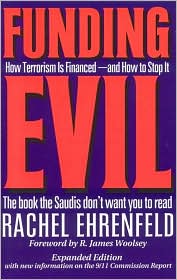 By Deborah Weiss There are many forms of terrorism, and violence is just one of them. The non-violent, incremental strategies used to achieve the Muslim Brotherhood’s goal to “sabotage the west from within” are more insidious and more likely to be successful than violence. Though non-violent radicalism takes many forms, one of the most dangerous forms is the effort to stifle free speech through the use of foreign defamation law suits. A main case in point is that of Rachel Ehrenfeld. She is an Israeli-American counter-terrorism expert, and is internationally recognized. In 2003, she authored the book, Funding Evil: How Terrorism is Financed and How to Stop it. In it, she asserted that Khalid bin Mahfouz, a Saudi banker and billionaire helped finance Al Qaeda. To support her claim, she cited official government documents from France, Britain, and the United States. Rachel’s book was written, published, and distributed in America, and was targeting an American audience. However, through the Internet, approximately 23 books were sold in the United Kingdom. This was sufficient for British courts to acknowledge jurisdiction when Mahfouz decided to sue Rachel for defamation in the British courts. Read more ...Source: FrontPage Magazine
U.S House Takes First Step to Protect Free Speech Against "Libel Tourists" Washington, DC – The U.S. House of Representatives today passed H.R. 6146, crucial legislation that will protect American citizens from foreign libel judgments that undermine their fundamental First Amendment free speech rights. Dr. Ehrenfeld knows first-hand the effects of this destructive practice of forum shopping. She was sued in Britain, where the libel laws are plaintiff friendly, by Saudi billionaire Khalid Salim bin Mahfouz for alleging in her book Funding Evil: How Terrorism Is Financed and How to Stop It, that he funded al-Qaeda.
Rep. Peter King, who initiated the federal legislation agrees with Dr. Ehrenfeld, stating that although he supports H.R. 6146, “this bill does not go far enough nor does it resolve the problem of “libel tourism.” Even Rep. Cohen, the author of H.R. 6146, acknowledged his bill is not enough to “ address libel tourism,” and stated on the floor of the House that he is “committed to working with Mr. King to push for a public hearing… which advances additional measures to address libel tourism.”
Indeed, the ACLU, the American Library Association, the Association of American Publishers, the PEN American Center, the Families of the 9/11 victims, and many others support the Free Speech Protection Act, 2008, sponsored by Senators Arlen Specter, Joseph Lieberman and Chuck Schumer, and Rep. Peter King. Source: Shariah Finance Watch
 By Adam Cohen When Rachel Ehrenfeld wrote "Funding Evil: How Terrorism Is Financed and How to Stop It," she assumed she would be protected by the First Amendment. She was in the United States. But a wealthy Saudi businessman she accused in the book of being a funder of terrorism, Khalid bin Mahfouz, sued in Britain, where the libel laws are heavily weighted against journalists, and won a sizable amount of money. The lawsuit is a case of what legal experts are calling "libel tourism." Ms. Ehrenfeld is an American, and "Funding Evil" was never published in Britain. But at least 23 copies of the book were sold online, opening the door for the lawsuit. When Ms. Ehrenfeld decided not to defend the suit in Britain, Mr. bin Mahfouz won a default judgment and is now free to sue to collect in the United States. The upshot is a First Amendment loophole. In the Internet age, almost every American book can be bought in Britain. That means American authors are subject to being sued under British libel law, which in some cases puts the initial burden on the defendant to prove the truth of what she has written. British libel law is so tilted against writers that the United Nations Human Rights Committee criticized it last month for discouraging discussion of important matters of public interest. Read more ...Source: The New York Times
  The undersigned organizations express their strong support for the Free Speech Protection Act of 2008 (S. 2977). Libel suits filed in foreign countries pose a grave danger to the free speech rights of American authors, journalists, publishers, and readers. S. 2977 provides authors with the weapons they need to protect their right to express themselves freely and ensures that the libel laws of countries that provide less protection for free speech will not undermine American laws or chill protected speech. Increasingly in recent years, individuals who challenge the accuracy of published materials have attempted to strike back at their authors by filing lawsuits in foreign countries, most commonly England. U.S. law requires the party alleging libel to prove that the statements objected to are actually false. To avoid this burden, libel plaintiffs have engaged in forum shopping - filing lawsuits in countries with either different burdens of proof or different definitions of libel. The most notorious recent example of this libel tourism is the lawsuit filed by Saudi billionaire Khalid Salim bin Mahfouz, who sued Dr. Rachel Ehrenfeld, an American expert on terrorism, over statements in her book, Funding Evil: How Terrorism is Financed and How to Stop It. Despite the fact that the book was never published in England and that a mere 23 copies had been sold there by online booksellers, Bin Mafouz brought suit in an English court. Under British law, the burden of proof in the first instance is on the defendant to prove the truth of any allegedly libelous statement. Faced with enormous legal costs to satisfy this requirement, Ehrenfeld refused to defend the suit. The English court entered a default judgment, enjoined further distribution of the book in the United Kingdom and awarded substantial damages and legal fees. Bin Mafouz's English lawsuit had the predictable effect of chilling Ehrenfeld’s free speech rights and effectively silencing anyone else who might consider publishing similar statements. It sent the message that he is willing and able to challenge any investigation of his family’s, and the Saudi royal family’s alleged ties to the funding of terrorism. He has refused to disclaim an intention to attempt to enforce the judgment in the United States, further reinforcing its chilling effect. Read more ...Source: Shariah Finance Watch
Legislature Passes Libel Terrorism Protection Act To Protect American Journalists and Authors From Overseas Defamation Lawsuits  Albany, NY (March 31, 2008) – The New York State Legislature today unanimously passed the “Libel Terrorism Protection Act” (S.6687/A.9652), sponsored by Assemblyman Rory Lancman (D-Queens) and Senate Deputy Majority Leader Dean G. Skelos (R-Rockville Centre). When signed into law by Governor David Paterson, this legislation will protect American journalists and authors from foreign lawsuits that infringe on their First Amendment rights. In Ehrenfeld v. Mahout, New York State’s highest court held that it would not protect Dr. Ehrenfeld from a British lawsuit filed by Saudi billionaire Khalid Salim Bin Mahfouz, where she was ordered to pay over $225,000 in damages and legal fees to Bin Mahfouz, as well as apologize and destroy existing copies of her books. Dr. Ehrenfeld sought a court order in November of 2006 to protect her constitutional rights, but in a ruling with national First Amendment implications which sent legal shockwaves throughout newsrooms across America, as well as potentially undermining our ability to expose terrorism’s financial and logistical support networks, the New York Court of Appeals ruled that it does not have jurisdiction to protect Americans – on U.S. soil – from foreign defamation judgments, which contradict the First Amendment to the United States Constitution. The Libel Terrorism Protection Act declares overseas defamation judgments unenforceable in New York unless the foreign defamation law provides, in substance and application, the same free speech protections guaranteed under our own constitution, and it gives New York residents and publishers the opportunity to have their day in court here in New York. “This is a great day for free speech and freedom of the press, and I urge Governor Paterson to quickly sign this legislation into law. This law will protect our journalists and authors from trumped up libel charges in kangaroo courts in overseas jurisdictions which don’t share our commitment to free speech and freedom of the press,” said Lancman. “This law will give New York's journalists, authors and press the protection and tools they need to continue to fearlessly expose the truth about terrorism and its enablers, and to maintain New York's place as the free speech capitol of the world,” Lancman concluded. Lancman’s remarks on the Assembly floor are viewable here. “The truth is a critically-important component in the War on Terror,” said Senator Skelos. “This important new law will protect American authors and journalists who expose terrorist networks and their financiers. In its decision, the Court of Appeals called upon the State Legislature to revise the law. Today, we made clear that New York State will safeguard the First Amendment and these courageous writers.” Source: American Center For Democracy
 |
|
|
Copyright Muslims Against Sharia 2008. All rights reserved.
E-mail: info AT ReformIslam.org
|
|
|


 Posts
Posts


