Gingrich: "Where In The Muslim World Have We Seen Any Battle Cry ... To Condemn? Where Is The Condemnation? At What Point Do You Have To Say 'Enough?" Everyone must watch this! I think this may be the best speech I have ever seen, by any politician, on the threat we face from Islam.
Former Republican congressional leader Newt Gingrich discusses the war on terror at the National Press Club. Still very much applicable.
 The Washington Post reports that the Obama administration secured China's cooperation in dealing with Iran by holding out the specter of an Israeli attack on Iran's nuclear facilities. According to the Post, two senior officials on the National Security Council - Jeffrey Bader and the ubiquitous Dennis Ross - told China that if it did not help the U.S. on the issue of Iranian nukes, Israel might well bomb Iran. This, in turn, would lead to a crisis in the Persian Gulf that would diminish China's access to oil, Bader and Ross warned. Following this warning, China said it would support what the Post describes as "a toughly worded U.S.-backed statement criticizing the Islamic republic for flouting U.N. resolutions by constructing a secret uranium-enrichment plant." What should we make of this? First, the perception that Israel is willing to strike Iran constitutes the best weapon the Obama administration has when it comes to rallying key elements of the international community to take steps aimed at dealing with the Iranian threat. So this option needs to be on the table. Second, even so, the best the Obama administration seems able to produce is a "toughly worded statement" criticizing something Iran has already done. What's the next step, an angry letter to the New York Times? Third, China's overriding interest in the Middle East is access to oil, and the same is true for all, or nearly all, key players. While this fact may, thanks to Israel, be useful when it comes to generating "tough" statements, it suggests that ultimately Iran may hold the trump card when it comes to more meaningful action. Powerline
 Russia and China, countries which have heretofore supported Iran's nuclear program, have joined up with the United States, Britain, France, and Germany in preparing a resolution critical of it. The resolution to be presented at the next International Atomic Energy Agency (IAEA) meeting, is meant to confront Iran's approach to global concerns about their nuclear program.
It will likely call on Iran to be more transparent in the building and use of nuclear reactors, and to desist from enriching uranium, in accordance with the orders of the UN Security Council. Under a new UN plan, Iran would not enrich its own uranium, but rather export it to Russia and France, where it would be made into fuel rods (which can not be turned into weapons-grade material) and returned to Iran. This would deplete Iran of its uranium stockpile and decrease the ability of the nation to build a nuclear warhead. Iran has rejected the plan. It insists that the uranium exchange take place on its own soil. Iran says it distrusts the West, believing countries will not hold up their end of an agreement or provide Iran with technology. On its end, the United States and European countries accuse Iran of lying about its enrichment of uranium for military purposes. Reportedly, Iran currently has enough low-enriched uranium for up to two nuclear weapons. INN

 The U.N. says that satellite photos show that Iran began constructing the recently-disclosed nuclear site at Qom in 2002. Iran maintains that construction began in 2007 in response to U.S. threats. The Los Angeles Times explains the significance of this lie: “The discrepancy in dates is a significant measure of Iran’s sincerity. Iran has long argued that because its parliament refused to ratify the Additional Protocol to the Nuclear Nonproliferation Treaty, it doesn’t have to disclose new sites to international inspectors until six months before introducing nuclear material to them, a point strenuously disputed by the West and departing IAEA chief Mohamed ElBaradei. But from December 2003 to February 2006, Iran was adhering to the Additional Protocol, obliging it to declare new sites immediately.” The IAEA says that they are concerned that Iran may have other hidden sites, and that Iran needs to clarify its explanation about the purpose, design and chronology of the site–which in diplomatic terms means, “Stop hiding the truth.” The UN also has questions about stocks of plutonium: “In addition, inspectors found 600 barrels of heavy water at a nuclear facility in Esfahan. The plutonium in the spent fuel of heavy-water nuclear reactors can be used for nuclear bombs.
The IAEA asked Iran this month for information on the barrels’ origin, since Iran’s heavy-water production plant near Arak is apparently not operating.” World Threats
 BRUSSELS — The United States and five other world powers will meet Friday in Brussels to discuss what measures can be taken to punish Tehran for its refusal to halt its nuclear enrichment program. Diplomats in Vienna, meanwhile, said International Atomic Energy Agency inspectors paid a second visit to Iran's recently revealed Fordo uranium enrichment facility on Thursday. Iran acknowledged Fordo's existence in September in a confidential letter to the U.N. watchdog, then faced sharp criticism from the U.S., Britain and France for hiding the facility for years. Iran says it is building the fortified facility as a backup in case its main plant at Natanz is attacked. The diplomats spoke on condition of anonymity in exchange for divulging confidential information. The United States and other nations fear Iran wants to build nuclear arms, but Tehran insists its nuclear program is peaceful. Friday's meeting will include the U.N. Security Council's permanent members — Britain, China, France, Russia and the U.S. — plus Germany, EU foreign affairs spokeswoman Cristina Gallach said Thursday. She said it would bring together political directors — foreign ministry officials below the ministerial level — from the six nations "to take stock of the situation." Iran announced Wednesday it would not export its enriched uranium for further processing, effectively rejecting the latest plan brokered by the IAEA. That plan aimed to delay Tehran's ability to build a nuclear weapon by sending most of the uranium needed for that out of the country. More at FoxNews
 RIYADH: President Nicolas Sarkozy arrived here yesterday for a visit meant to deepen French political and economic ties with Saudi Arabia as part of his administration’s efforts to raise France’s profile in the oil-rich Gulf. The one-day visit – Mr Sarkozy’s third to the kingdom in less than two years – is both low-key and high-intensity. Billed on both sides as more personal than public, there are no plans for announcements or unveilings of joint agreements during the visit.
At the same time, Mr Sarkozy will stay overnight at Janadriya, King Abdullah bin Abdul Aziz’s desert ranch on Riyadh’s northern outskirts. There, the two leaders will have the opportunity to engage in candid, heart-to-heart conversations mostly by themselves without large entourages on either side. The agenda for their discussions has not been disclosed but four topics undoubtedly will have high priority, starting with their mutual concern over the impasse in Israeli-Palestinian negotiations and the perception that the US president Barack Obama has backed away from pressuring the Israeli government into halting settlement expansion. “The deadlock … is extremely worrying” because it “plays into the hands of extremists and each day the chance of peace is slipping away a little”, the French president said in an interview published yesterday in Al Riyadh newspaper. “The priority is to restart as soon as possible the peace process.”
King Abdullah and Mr Sarkozy are also likely to discuss Iran’s nuclear weapons programme, as well as Saudi concerns about Iran’s ambitions to become the Gulf’s dominant power.
Those concerns have deepened in recent days with growing signs that Tehran is seeking to take advantage of the two-week-old conflict between Saudi military forces and Yemeni rebels on the kingdom’s southern border with Yemen. Read more at the National
 Can anything else possibly go wrong for the Obama administration's Middle East policy?
In the past ten days, Secretary of State Hillary Clinton has twice reversed herself publicly on her attitude toward the Israeli settlements.
Palestinians have refused her direct request to rejoin peace talks with Israel, and Palestinian Authority president Abbas has said he will not run for reelection. U.S.-Israel relations are in a state of frozen mistrust. The New York Times and Washington Post, among others, are calling Obama's policy a complete failure--in news stories as well as editorials. The only thing missing is a plague of locusts. The policy is indeed a complete failure.
In ten months the administration has managed to offend and demoralize Israelis and Palestinians, lose the support of Arab governments, and reduce previously excellent relations with the government of Israel to levels unmatched since the James Baker days. Meanwhile, George Mitchell's trips to the region are increasingly reminiscent of the Colin Powell visits in 2002 and 2003--producing little but embarrassment. The Israeli "100 percent settlement freeze" and the Arab outreach to Israel, early goals of the Obama team, are now forgotten, as is an early resumption of serious Israeli-Palestinian peace talks. These disasters are mostly the product of an ignorant and belligerent attitude toward Israel and especially its prime minister. The ignorance was most evident in the administration's view that a total construction freeze could be imposed not only in every settlement but in Jerusalem itself. But the U.S. policy was worse: We demanded a freeze that would apply to construction by Jews, but not by Arabs; could any Israeli leader be expected to support such a position?
One does not need to be a member of the Knesset to understand that such a freeze was impossible for Benjamin Netanyahu and his coalition as it would have been for any Israeli prime minister--but apparently this fact was beyond the understanding of Mitchell, Rahm Emanuel, and all the other "experts" on the Obama team. The belligerence toward Netanyahu has been evident all along, but is best shown by the refusal to tell Israel's prime minister whether or not the president will see him this coming week when Netanyahu (like the president) addresses the United Jewish Communities annual general assembly in Washington. The Israelis gave the White House weeks of notice that Netanyahu had agreed to speak, would be in town, and hoped to see Obama. The White House reaction has been to keep him twisting in the wind, with news stories several days before his arrival saying the president had not decided yet whether to see Netanyahu. Think of it: Our closest ally in the region, critical issues at stake (from Iran's nuclear program and the recent Israeli seizure of an Iranian arms shipment meant for Hezbollah to Abbas's announcement), yet the Israelis get no answer. Obama and his "experts" may think they are reminding Netanyahu who is boss, but they are in fact reminding all of us why Israelis no longer trust Obama--and making closer cooperation between the two governments that much harder. Read more here,,,, Source: Weekly Standard
 Prime Minister Binyamin Netanyahu left the White House after a one-hour and 40-minute meeting with U.S. President Barack Obama Monday night without speaking to reporters -- a rare occurrence. The meeting had been grudgingly scheduled early Sunday morning by the White House just a few hours before Netanyahu was to leave for the U.S. to speak at the 2009 General Assembly of the Jewish Federations of North America.
The ninth-hour appointment was a clear sign that relations between Washington and Jerusalem remain strained; Netanyahu had requested the meeting weeks ago. Also in attendance for part of the meeting was Defense Minister Ehud Barak, National Security Council head Uzi Arad, Ambassador Michael Oren and Netanyahu adviser Yitzchak Molcho. U.S. officials included National Security Adviser General (ret.) Jim Jones, White House Chief of Staff Rahm Emanuel, Special Middle East Envoy George Mitchell and National Security Council Director for Near Eastern Affairs Dan Shapiro. On the agenda was the issue of Iran's galloping nuclear technology development, as well as the current paralysis in talks between Israel and the Palestinian Authority, and the claim by PA Chairman Mahmoud Abbas that he is resigning in January. All three matters are being taken "very seriously" by the Prime Minister's Office, said a spokesman. Netanyahu had reportedly been planning to tell the president that Israel was willing to be "generous" in scaling back Jewish construction in Judea and Samaria, and "means business" about rejuvenating talks with the PA. But the brief statement issued by the White House following the talks said simply that the two leaders discussed "how to move forward on Middle East peace." The White House spokesman added, "The president reaffirmed our strong commitment to Israel's security, and discussed security cooperation on a range of issues." Netanyahu declined to comment on his conversation with the president, and cancelled a briefing with the media he had scheduled for the next day. The prime minister departed for Paris on Tuesday morning without speaking to reporters. According to State Department spokesman Ian Kelly, special Middle East envoy George Mitchell is not planning to return to the region anytime soon to pressure either of the parties toward further talks. It is possible that Mitchell has decided to wait until after the PA elections on January 24, when the question of who is actually leading the Palestinian Authority may be clarified. Source: YNet
 UN inspectors found "nothing to be worried about" in a first look at a previously secret uranium enrichment site in Iran last month, the International Atomic Energy chief said in remarks published on Thursday. Mohamed ElBaradei also told the New York Times that he was examining possible compromises to unblock a draft nuclear cooperation deal between Iran and three major powers that has foundered over Iranian objections. The nuclear site, which Iran revealed in September three years after diplomats said Western spies first detected it, added to Western fears of covert Iranian efforts to develop atom bombs. Iran says it is enriching uranium only for electricity. ElBaradei was quoted in a New York Times interview as saying his inspectors' initial findings at the fortified site beneath a desert mountain near the Shi'ite holy city of Qom were "nothing to be worried about". "The idea was to use it as a bunker under the mountain to protect things," ElBaradei, alluding to Tehran's references to the site as a fallback for its nuclear program in case its larger Natanz enrichment plant were bombed by a foe like Israel. "It's a hole in a mountain," he said. The IAEA has declined to comment on whether the inspectors came across anything surprising or were able to obtain all the documentation and on-site access they had wanted at the remote spot about 160 km (100 miles) south of Tehran. Details are expected to be included in the next IAEA report on Iran's disputed nuclear activity due in mid-November. The inspectors' goal was to compare engineering designs to be provided by Iran with the actual look of the facility, interview scientists and other employees, and take soil samples to check for any traces of activity oriented to making bombs.
 Two important stories to follow: - Iran is increasing its efforts to mine uranium at Gchine mine near Bandar Abbas. The report says the mine can provide enough uranium for two nuclear weapons annually. Iran is not allowing the IAEA to inspect the site.
- The NCRI opposition group is asking the IAEA to investigate a site they claim is being used to build the detonation mechanisms for nuclear weapons. The NCRI says the site is in tunnels underneath a tunnel in eastern Tehran, located beneath the Research Center for the Technology of Explosion and Impact.
 WASHINGTON – German Chancellor Angela Merkel spoke before the US Congress on Tuesday and said that the Iranian threat to Israel was "a threat to the free world. Anyone threatening Israel threatens us all. The safety of the State of Israel is nonnegotiable. It never was and it never will be." In a speech marking the 20th anniversary to the fall of the Berlin Wall, Merkel said that Iran must understand that the West is not willing to compromise on its atom program: "We must show zero tolerance to the possibility of Iran getting hold of nuclear weapons. It threatens us all," she said, to roaring applause. Addressing Iran's stalled response to the West's and the International Atomic Energy Agency's draft proposal, meant to regulate its nuclear program, Merkel said that "Iran knows the specifics of our proposal and it should also know where we will draw our red line. "A nuclear weapon at the hands of an Iranian president who denies the Holocaust, threatens Israel and negates its right to exist is simply unacceptable." Prior to addressing the congress, Merkel met with US President Barack Obama. The two reportedly discussed Iran, the war in Afghanistan and various climate issues. Merkel also spoke of the need to formulate an international treaty to replace the Kyoto Protocol – the United Nations' framework to battle global warming.
 UNITED NATIONS — Israel is concerned that Iran will use the current climate of international goodwill as a cover to pursue its goal of becoming a nuclear power, an Israeli minister said Friday. Vice Prime Minister Silvan Shalom made the comment on the day that Iran announced it was still studying a U.N.-drafted plan to ship much of its uranium to Russia and France for further enrichment, a move seen as a way to delay the country's ability to build a nuclear weapon.
Iran's envoy to the U.N. nuclear agency said the government will respond to the offer next week. Shalom, who is also the minister for regional development, said he discussed Iran's nuclear ambitions with U.N. Secretary-General Ban Ki-moon during a discussion that also included Israeli-Palestinian peace prospects and Lebanon. "I told the secretary-general that we were very concerned that Iran will use the goodwill of the international community to continue to develop their real intentions — and it is toward nuclear power on the one end but on the other end to try to change the types of the regimes within the Middle East," he said. The six world powers trying to ensure that Iran's nuclear program remains peaceful held talks earlier this month with Iranian diplomats, despite a spike in tensions over September's revelations by Iran that it had been secretly building a new uranium enrichment plant near the holy city of Qom. The meeting — and tentative agreement on the plan to ship out much of Iran's low-enriched uranium — indicated a willingness on both sides to talk. But Israel, which has been threatened with annihilation by Iran's President Mahmoud Ahmadinejad, is clearly unhappy. "We believe that Iran will never abandon their dream to become a nuclear power," Shalom said. "They hide their real intentions in the past, and they will do it in the future." He singled out the recent disclosure about the nuclear facility at Qom. Read more here,,,, Source: FoxNews
 By Dick Morris Secretary of State Hillary Clinton has fallen for Iran’s line that it is not developing nuclear weapons, but only wants the ability to develop one to achieve its place in the sun among the great nations of the earth. In an interview on a Sunday show and in a leak in The New York Times that seems to have come from her (since it uses the same language), she notes that “there’s a small space for doubt (about Iran’s intention to build a bomb) because there are some contrary indicators. There is no doubt in my mind that they want nuclear energy and nuclear power, which they are entitled to, to be able to use it for peaceful purposes. The real problem is once you do that and you get what’s called a breakout capacity, it’s not long before you could do the other (build a bomb). So that’s why this is so important to address now.” Pressed to comment on a report by the International Atomic Energy Agency (IAEA) that it was clear that Iran was headed toward building a bomb, Hillary demurred. Read more ...Source: FPMHillary Clinton
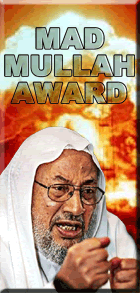
Latest recipient of The Dhimmi Award

 VIENNA: Iranian negotiators last night agreed to consider a draft deal that - if accepted by the Tehran leadership - would delay its ability to make nuclear weapons by sending most of the material it would need to Russia for processing. International Atomic Energy Agency chief Mohamed ElBaradei confirmed that representatives of Iran and its three interlocutors -- the US, Russia and France -- had accepted the draft, which still has to be finalised by the four nations' capitals. He hoped that would occur by tomorrow night. "I have circulated a draft agreement that in my judgment reflects a balanced approach to how to move forward," he told reporters, suggesting that all four parties had worked hard to overcome differences exacerbated by suspicions that Iran may be interested in nuclear weapons. Tehran insists its activities are peaceful and meant only to generate energy. "Everybody who participated at the meeting was trying to look at the future, not at the past, trying to heal the wounds," Dr ElBaradei said. "I very much hope that people see the big picture, see that this agreement could open the way for a complete normalisation of relations between Iran and the international community." He gave no details of what was in the package. But diplomats said it was essentially the original proposal drawn up by the IAEA that would commit Tehran to shipping 75 per cent of its enriched uranium stockpile to Russia for further enrichment. After that material is turned into metal fuel rods, it would be shipped back to Iran to power its small research reactor in Tehran. While essentially technical, such a deal would have significant political and strategic ramifications. It would commit Iran to turn over more than 1200kg of low-enriched uranium. That would ease fears about Iran's nuclear program, since 1000kg is the amount of low-enriched uranium needed to produce weapons-grade uranium. Meanwhile, Newsweek journalist Maziar Bahari, who was detained for nearly four months in Iran, has been released to rejoin his pregnant wife. Bahari, 43, was one of hundreds arrested on June 21 during the crackdown that followed the country's disputed presidential election. Source: The Australian
 Iran signaled to the West on Monday that it will not allow its enriched uranium to be moved out of the country, in spite of international demands. Iranian state-run Press TV cited unnamed officials in Tehran as saying the Islamic Republic was looking to hold on to its low-enriched uranium and buying what it needed for the Tehran reactor abroad. The report indicated that Iran will not meet terms the West said it agreed to — including transferring most of its stock of enriched uranium, the potential base for fissile warhead material. Tehran says it needs enriched uranium for nuclear fuel. "Buying nuclear fuel from abroad does not mean Iran will stop its uranium enrichment activities inside the country," Ali Shirzadian, spokesman for Iran's Atomic Energy Organization, told Iran's official IRNA news agency. "If the talks do not bring about Iran's desired result ... we will start to make 19.7 percent enriched uranium ourselves," Shirzadian told Reuters a few hours before the talks were due to start. The U.S. says Iran is now one to six years away from being able to make such arms, should it choose to. Meanwhile, the head of the U.N. nuclear agency says talks with Iran's International Atomic Energy Agency delegation were off to a"good start" in Vienna. Mohamed El Baradei, who heads the International Atomic Energy Agency, attended the first day of talks Monday. He spoke of "quite a constructive meeting." "We are off to a good start," Baradei said. Even if Tehran agrees, it could still try to resist pressure to hand over most of its stock in one batch, insisting instead on sending small amounts out of the country. Iran still has enough fuel for the Tehran reactor to last until mid-2011. Monday's Vienna talks between Tehran and the U.S., Russia and France, focused on the technical issue with huge strategic ramifications. Progress would strengthen confidence on the part of the U.S. and five other big powers trying to persuade Iran to dispel fears about its nuclear program that this time Tehran is serious about reducing tensions and ready to build on Oct. 1 Geneva talks with six world powers. Read more here,,,, Source: FoxNew
 The first and most important thing to understand about Obama's Iran policy is that it is driven primarily by the concerns of Saudi Arabia, not Israel, as the media and diplomats would have you believe.
While Israel is most visibly in Iran's nuclear sights, it is commonly understood in the Middle East that the path to leadership of the Arab, and by extension Muslim world, lies through the destruction of Israel.
The consensus of the Sunni Muslim powers, who had lost several wars to Israel, was to limit themselves to proxy wars through the sponsorship of terrorists such as the PLO.
In essence like Obama, Sunni Muslims had committed themselves to the use of "Soft Power" against Israel, backing terrorists who would murder Israelis and use them as leverage to force concessions from the Israeli government.
Iran's Shiite Muslim regime however has not only hijacked the terrorist strategy, sidelining the PLO and backing Hamas instead, but its aggressive development of a nuclear bomb rapidly approaches an endgame for the region.
The Sunni Muslim powers who had committed to avoiding any direct confrontation with Israel face the unpleasant prospect of being sidelined and humiliated by a Shiite Muslim victory over Israel.
Should Iran succeed in destroying Israel, the Saudi royal family understands that their brief celebration would quickly give way to falling under Iranian dominion... because this would confirm Iran's role as the regional leader and demonstrate American impotence.
No American administration, no matter how much it might be in the Saudi's back pocket, would go to war with a nuclear armed Iran that had already demonstrated a willingness to kill millions to protect the Saudi royal family.
And while attacking Israel to get to Mecca might seem convoluted, it is worth remembering that Al Queda attacked America in order to get at the Saudi royal family.
Muslim holy wars that are fought against other Muslims are often indirect.
Hamas spent a generation fighting Israel before finally making a move against Fatah. Osama bin Laden attacked America in order to rally the Jihadis for a power bid in the Middle East. Sunnis and Shiites fighting each other in Iraq repeatedly insist that they are really fighting against the United States. When Saddam wanted to legitimize his seizure of Kuwait against US intervention, he began bombing Israel.
One of the delusions that Muslims hold dear is that their beloved Jihadis do not kill fellow Muslims, except as a means of killing infidels or pawns of the infidels. This naturally structures Muslim holy wars in a way that kills far more infidels than Muslims, which is why just like a dog fight, it is more dangerous to be in the vicinity of a Muslim civil war, than anywhere else.
And the Sunni powers in the Middle East understand that when Ahmadinejad talks about destroying Israel, he only means destroying Israel first, and them second. H/T: gramfan
 The defection of General Ali Asgari in 2007 took everyone in Iran by surprise. He was a former Deputy Defense Minister and a senior member of the Islamic Revolutionary Guards Corp (IRGC). After completing a trip to Syria, he crossed by land to Turkey and defected to the West. Some believe that his defection was handled by the CIA. This angered Iranian authorities greatly, as such defections are political, and—more importantly—an intelligence blow. And now there are more stories circulating about two other mystery defectors. The first is Shahram Amiri, who has gone missing in Saudi Arabia. According to the Sharq Al Wasat newspaper, he was a nuclear scientist who worked at the recently exposed nuclear site in Qom.
He took refuge in Saudi Arabia after a recent pilgrimage to the country in July this year. According to the article, no connection has been made between his disappearance and the recent discovery of the nuclear site in Qom. Meanwhile, the spokesman for Iran's Foreign Ministry, Hassan Ghashghavi, called on Saudi Authorities to help find Mr. Amiri. Ghashghavi denied that Amiri worked at Iran's Atomic Energy Organization, referring to him instead as a 'civil servant.'
However, suspicions were raised due to the attention given by Iranian authorities to Amiri's case. Every year, thousands of Iranians travel to Saudi Arabia. There are many cases of missing persons and Iranian Foreign Ministry does not address most of them. In fact, many people in Iran complain about the poor job the Foreign Ministry does in protecting their interests in Saudi Arabia. In this case, it is possible that after the Sharq Al Wasat report it felt compelled to act. However, the possibility that Amiri was more than a Civil Servant cannot be ruled out either. Read more here,,,, Source: RealClearWorld
 United Nations inspectors will visit Iran's recently disclosed nuclear power plant on October 25, the head of the International Atomic Energy Agency announced Sunday from Tehran, Iran "It is important for us to send out inspectors to do comprehensive verification ... to assure ourselves that it is ... fit for peaceful purposes," Mohamed ElBaradei said. Iran sent shock waves through the international community recently when Tehran wrote a letter to the IAEA revealing the existence of a nuclear enrichment facility near the city of Qom. Iran said its nuclear program is only for peaceful purposes, but the United States, among others, fears the country aims to build nuclear weapons. The New York Times reported Sunday that IAEA experts "have concluded in a confidential analysis that Iran has acquired 'sufficient information to be able to design and produce a workable' atom bomb." Citing senior European officials, the report said that the conclusions are tentative, but "go well beyond the public positions taken by several governments, including the United States." CNN could not immediately confirm the Times' report. Speaking to CNN, U.S. national security adviser Jim Jones rejected the idea that Iran may be closer to a bomb than the U.S. government has said. "No, we stand by the reports that we've put out," Jones, a retired Marine Corps general, said on CNN's "State of the Union." He added that there will be "a lot of speculation, one way or the other." Susan Rice, U.S. ambassador to the United Nations, said, "I'm not going to get into characterizing the substance of a confidential report or our own intelligence. But suffice it to say, our whole approach is predicated on an urgent need to prevent Iran from obtaining a nuclear weapons capacity." Speaking to NBC's "Meet the Press," she added, "There are various assessments and they don't all align." But, Rice said, key players are on the same page about what to do. "This is a very serious process where we are together aligned with the P5+1 -- that's Russia, China, France, Britain, Germany and the United States -- presenting Iran with a very stark choice: Either they give up their nuclear weapons program conclusively to our satisfaction, or they will face additional pressure," Rice said, adding: "We're very much in a period of intense negotiations now." And while "Russia and China have resisted sanctions," Rice said, "we are united in presenting this choice to Iran." Read more here,,,, Source: CNN

But while even Russia seems to think that some punishment is inevitable if Iran does not change course, the purpose of sanctions becomes less clear as time passes.
Even if both the Russians and the Chinese agree to tough measures, analysts do not believe they would stop Tehran completing a nuclear device should it wish to do so.
North Korea, an economically far more isolated regime, has managed to test plutonium-based weapons and claims to be on the way to developing a uranium-based one too.
"Sanctions won't really work for two to three years, and that's all they need to become a nuclear power," said Mustafa Alani, a regional specialist at the Gulf Research Centre in Dubai.
Far more likely are sanctions which Russia and China approve but water down from American demands enough to avoid doing real damage to Iran, and especially its oil industry.
Iran is China's third largest source of oil, and has done energy deals worth an estimated $100 billion with Beijing in the last five years.
Sun Bigan, a former Chinese ambassador to Iran, even argues in a current strategy that it is in China's interest to prevent the Iranian leadership becoming pro-American.
That could lead to China's oil supplies being drastically curtailed as America, even under President Barack Obama, strove to maintain its "global goals and dominance", he wrote.
Read More: www.telegraph.co.uk
 TEHRAN: President Mahmoud Ahmadinejad lashed out at world leaders last night for demanding access to Iran's newly disclosed uranium enrichment plant near the central holy city of Qom. "The leaders of these countries made a historic mistake with their comments about the new plant.
After this they also said Iran must give access to the facility as quickly as possible," state television quoted him as saying. "Who are you to tell the (International Atomic Energy Agency) and Iran what to do?" Mr Ahmadinejad said Iran would not be "harmed", whatever happened at today's talks with the major powers in Geneva aimed at resolving the crisis over its atomic program. "The negotiators can definitely adopt any policy that they want, but we will not be harmed," he said. "Iran has prepared itself for any condition and our nation has learnt over the past 30 years to stand on its feet and change any circumstance to its benefit." Mr Ahmadinejad said the talks were an "exceptional opportunity for US and a few European countries to correct the way they interact with other world nations". IAEA chief Mohamed ElBaradei said Iran had flouted the law by concealing the plant. "Iran has been on the wrong side of the law in so far as the IAEA regulation to inform the agency at an earlier date," he told India's CNN-IBN last night. "Iran was supposed to inform us on the day it was decided to construct the facility. They have not done that." Iran's atomic energy chief Ali Akbar Salehi had said he was ready to discuss world concerns about the plant, but ruled out bargaining about Iran's right to master the nuclear fuel cycle. Foreign Minister Manouchehr Mottaki has told UN Secretary General Ban Ki-moon Tehran would not give up its "right" to nuclear technology. The UN Security Council has imposed three sets of sanctions against Iran over its failure to heed repeated ultimatums to suspend enrichment. Source: The Australian
 |
|
|
Copyright Muslims Against Sharia 2008. All rights reserved.
E-mail: info AT ReformIslam.org
|
|
|


 Posts