Hizb ut-Tahrir espouses the replacement of republican governments in the West with Sharia states, and the establishment of a global caliphate. "LSE's Hizb ut-Tahrir teacher Reza Pankhurst and the secretive 'Brothers' Circle,'" from The Times, January 16
An Islamist radical whose teaching role at a leading university was exposed yesterday by The Times led a secretive "Brothers' Circle" at which he espoused his hardline views.
Reza Pankhurst, a senior figure in the hardline group Hizb ut-Tahrir, gathered a group of male members of the London School of Economics (LSE) Islamic Society for private talks.
Mr Pankhurst, whose party advocates the creation of an Islamic state governed by Sharia, is a research student employed as a teacher in the LSE's government department.
He is due to teach undergraduate classes this term in three topics covering nationalism and revolution in the Arab world.
Mr Pankhurst retained his position in the Islamic Society and the college despite a number of students raising concerns last year about the overt political content of his sermons at Friday prayers.
The Students' Union confirmed that it had reported those concerns to the Islamic Society and raised them "informally" with academics.
Hizb ut-Tahrir is banned in Germany for anti-Semitism and covered by the National Union of Students' policy of "no platform" for racist and fascist views....
Islamic finance and Islamic banking, which are among the fastest growing financial industries in the world, are best understood in their political and cultural contexts, and by what formed their theoretical origins.
To begin with, Islamic banks are based on a corpus of doctrines called “Islamic economics,” which claims to be based on the Quran, but is actually the creation of the Islamist thinker Abu’l-A’la Mawdudi (1903-1979).
Mawdudi is both the father of Islamic economics and (together with Hassan al-Banna, founder of the Muslim Brotherhood) the father of modern political Islam. His crucial contribution to the development of Islamism has been highlighted by Seyyed Vali Reza Nasr in “Mawdudi and the Making of Islamic Revivalism,” while his role in the birth of Islamic economics has been studied by Timur Kuran in “The Genesis of Islamic Economics.”
Mawdudi, the founder in 1941 of the Islamist party, Jamaat-e-Islami, in Pakistan, was persuaded that it was necessary for Muslims to bring all aspects of life into the practice of “Islam” and submission to the will of Allah. Therefore, both the spheres of politics and economics could not be autonomous from the Quranic revelation and the Islamic tradition (sunna).
In the political field, Mawdudi asserted the need for the establishment of an Islam in which all sovereignty belongs only to Allah; thus, popular sovereignty would a usurpation of his rights. According to Mawdudi, the proclamation of faith, in which the Muslim believer affirms that “there is no God but Allah,” implies that “one should recognise no sovereign, nor accept any government, nor yet obey any law, or that one should refuse to accept the jurisdiction of any court and to carry out the command of anyone” except from Allah.
For Mawdudi, the duty of his party, the Jamaat-e-Islami, was to form an army of “Allah’s troopers,” with the goal of establishing an Islamic state where shari’a (Islamic law) could be enforced. The creation of an Islamic state was, however, just the first step: he writes, “Islam does not want to bring about this revolution in one country or a few countries. It wants to spread it to the entire world. Although it is the duty of the ‘Muslim party’ to bring this revolution first to its own nation, its ultimate goal is world revolution.”
Mawdudi, studying the French, Russian and National Socialist revolutions, was of the opinion that Islamic revolutions should have learned from them. Like Lenin, Mawdudi affirms the need for a vanguard of Allah’s army; like Trotsky, he calls for exporting the revolution worldwide.
The spread of the Islamic revolution also had to follow the example set by the Prophet Muhammad. Mawdudi affirms that:
“When every method of persuasion had failed, the Prophet took to the sword. That sword removed evil mischief, the impurities of evil and the filth of the soul. The sword did something more – it removed their blindness so that they could see the light of truth, and also cured them of their arrogance; arrogance which prevents people from accepting the truth, stiff necks and proud heads bowed with humility. As in Arabia and other countries, Islam’s expansion was so fast that within a century a quarter of the world accepted it. This conversion took place because the sword of Islam tore away the veils which had covered men’s hearts.”
To purify society from non Islamic influences (“the veils which cover our hearts”), Mawdudi also advocated the restoration of a classic tenet of Islam: the death penalty for apostasy (ridda). Mawdudi further states that such a punishment should not just be reserved for those who consciously refuse Islam, but also for all the non-practising Muslims:
“Whenever the death penalty for apostasy is enforced in a new Islamic state, then Muslims are kept within Islam’s fold. But there is a danger that a large number of hypocrites will live alongside them. They will always pose a danger of treason. My solution to the problem is this. That whenever an Islamic revolution takes place, all non-practising Muslims should, within one year, declare their turning away from Islam and get out of Muslim society. After one year all born Muslims will be considered Muslim. All Islamic laws will be enforced upon them. They will be forced to practice all the fara’id and wajibat [duties and obligations] of their religion and, if anyone then wishes to leave Islam, he will be executed.”
Advocating the necessity of emancipating knowledge from the influence of the West to give birth to a true Islamic polity, Mawdudi goes on to state: “Islam is the very antithesis of secular Western democracy.” Not only does society have to be purged from non- Islamic contaminations, but also science and knowledge. Islamic society and Islamic culture have to be pure:
From time to time, readers will email us asking for a list of Shariah-Compliant companies. A complete version of such a list is extremely difficult to come by.
Some of the better sources for such a listing would be the annual and semi-annual reports of the various Shariah-Compliant investment funds. These reports usually include portfolio listings, i.e. the companies in which the fund invests.
Nevertheless, as a subject for this posting, we have decided to post some of these companies. We came across this listing on the Javelin Shariah Compliant Exchange Traded Fund web site.
The proper name for this fund is the JETS Dow Jones Islamic Market International Index Fund. It is “an Exchange-Traded Fund (ETF) that seeks performance results which, before fees and expenses, correspond generally to the price and yield performance of a benchmark index that measures the investment return of Shari’ah compliant securities.”
Long time readers of SFW may recall that the Dow Jones Islamic Market Index has a checkered past. For years Dow Jones employed the Jihadist Mufti Taqi Usmani as the chair of the Shariah Advisory Board to the Index, despite the fact that they knew of his ties to militants and extremists. It wasn’t until rival Investor’s Business Daily started publishing details that they quietly severed relations with Usmani, who can only be described as a horrible person.
But this wasn’t all. The advisor to the fund was the North American Islamic Trust (NAIT), which also owns title to a large percentage of the mosques in the USA. The problem for Dow Jones became two-fold. NAIT was unmasked as a Muslim Brotherhood front group in the Holy Land Foundation terrorism financing trial and was also named an unindicted co-conspirator in that trial. It was only in the face of adverse publicity that Dow Jones decided to sever relations with NAIT.
Nevertheless, despite its suspicious past, the fund has survived, in a new form. For our readers who have asked, here are some of the largest holdings in its portfolio:
TOTAL SA
SIEMENS AG
BP PLC
NOVARTIS AG
BHP BILLITON LIMITED
ROCHE HOLDING
GLAXOSMITHKLINE PLC
TAIWAN SEMICONDUCTOR
PETROLEO BRASILEIRO
SAMSUNG ELECT
Followers of terror-free investing may recognize the top two names on this list: Total SA and Siemens. These are simply two of the worst companies on the planet and have made themselves infamous for their billions of dollars in operations which give corporate life support to the terrorist-sponsoring, genocidal maniacs in Iran.
Readers of SFW may wish to consider the activities and policies of these companies which make them Shariah Compliant when making your own investment decisions.
Islamic finance and Islamic banking, which are among the fastest growing financial industries in the world, are best understood in their political and cultural contexts, and by what formed their theoretical origins.
To begin with, Islamic banks are based on a corpus of doctrines called “Islamic economics,” which claims to be based on the Quran, but is actually the creation of the Islamist thinker Abu’l-A’la Mawdudi (1903-1979).
Mawdudi is both the father of Islamic economics and (together with Hassan al-Banna, founder of the Muslim Brotherhood) the father of modern political Islam.
DUBAI (Reuters) – Abu Dhabi stepped in to help fellow United Arab Emirates member Dubai with a $10 billion injection, of which $4.1 billion was allocated to troubled state-owned conglomerate Dubai World to pay immediate obligations, Dubai
said on Monday.
The move was the least expected of all options Dubai had on the table after requesting a standstill on $26 billion in Dubai World debt on November 25, alarming markets and shaking the image of the emirate as a regional business hub.
"The government of Abu Dhabi has agreed to fund $10 billion to the Dubai Financial Support Fund that will be used to satisfy a series of upcoming obligations on Dubai World," the chairman of the Dubai Supreme Fiscal Committee said in a statement.
"As a first action for the new fund, the government of Dubai has authorized $4.1 billion to be used to pay the sukuk obligations that are due today."
The yen fell sharply against other currencies on the news, while the dollar shot up to 88.90 yen and the euro also jumped to 130.43 yen.
S&P futures jumped to be up 0.7 percent, reversing early losses and pushing Treasury futures to session lows. Hong Kong's Hang Seng index shot up 300 points in the last minutes of morning trade to finish in positive territory, while other markets across Asia also pushed higher.
Abu Dhabi is the largest member of the United Arab Emirates federation and a big oil exporter.
"We are here today to reassure investors, financial and trade creditors, employees, and our citizens that our government will act at all times in accordance with market principles and internationally accepted business practices," Sheikh Ahmed bin Saaed al-Maktoum said in the statement.
"Dubai is, and will continue to be, a strong and vibrant global financial center. Our best days are yet to come."
Excess funds would be used to cater to Dubai Worlds needs up until the end of April 2010, the statement said.
Dubai has announced a bankruptcy law that it said could be used in case Dubai World and creditors failed to reach an agreement on debt maturing in the future.
"Dubai will announce a comprehensive reorganization law, a framework that is based upon internationally accepted standards for transparency and creditor protection," Sheikh Ahmed said.
"This law will be available should Dubai World and its subsidiaries be unable to achieve an acceptable restructuring of its remaining obligations."
Dubai World could still meet the December 14 deadline on the US$4 billion (Dh14.69bn) payment of a sukuk from Nakheel under one option being considered by advisers to the conglomerate.
Repayment on schedule is one of four alternatives being considered by Dubai World, which announced on Wednesday it would seek a freeze on billions of dollars in debt repayments to bondholders and creditors.
The options are still being pondered by Aidan Birkett of Deloitte, the new chief restructuring officer of Dubai World. He was appointed to oversee its reorganisation, along with the investment bank Rothschild and the US corporate specialists AlixPartners.
If Dubai World pays back the sukuk, it would solve a problem for the company and its bondholders, and leave open the option of rescheduling bank debt and other liabilities, including bills owed to international contractors.
Other options being considered include a scheme to offer bondholders 80 per cent redemption of the value of their holdings, with a similar offer made to bankers.
Alternatively, Dubai World may move forward with the plan to seek a general “debt holiday” under the terms of last week’s standstill proposal, by which payments would be frozen until May 30 next year with a view to negotiating a rescheduling of all its debts.
In the most drastic scenario, Dubai World might embark on a general liquidation of assets in response to legal action by creditors. But this is thought to be a remote possibility, as it is likely to impair the value of Dubai World assets, leaving everyone worse off.
Legally speaking, creditors who lent to Dubai World during the boom years were fully aware that they were lending to government-related entities (GRE) and that the bonds were not guaranteed by the sovereign, advisers to Dubai believe.
“The Dubai Government has no legal obligations in respect of GRE indebtedness,” according to the prospectus of Dubai Government bonds sold earlier this year.
Dubai's move to suspend payments on its Dubai World conglomerate's debt was "carefully planned" and done in full knowledge of how the markets would react, the chairman of the Supreme Fiscal Committee said on Thursday.
"Our intervention in Dubai World was carefully planned and reflects its specific financial position," Sheikh Ahmed bin Saeed al-Maktoum said in a statement.
"The government is spearheading the restructuring of this commercial operation in the full knowledge of how the markets would react. We understand the concerns of the market and the creditors in particular.
"However we have had to intervene because of the need to take decisive action to address its particular debt burden."
However, Sheikh Ahmed insisted that "unprecedented growth, in Dubai and across the (United Arab Emirates), over the past decade has helped lay the foundation for what is now a broad-based sustainable economy beyond just natural resources."
A DEFAULT by Dubai will put the world of Islamic finance to the test at a time when hard questions are being asked by bankers and lawyers about the protection afforded by financial instruments that are Shariah compliant.
The bond that lies at the heart of the threat of default and financial ignominy for Dubai is a sukuk, an instrument invented by bankers and Islamic scholars to comply with a Shariah (Islamic law) prohibition against the payment of interest on money.
Islamic finance has five pillars: a ban on interest, a ban on speculation, a ban on haram (forbidden) investments, such as pork or gambling, the requirement of partnership or sharing of profit and loss and the requirement of asset backing. Getting round the ban on interest is the problem and opportunity of Islamic finance.
A bond that doesn't (in theory) pay interest sounds unattractive but in the Gulf and Malaysia, Islamic finance has flourished over the past decade.
Typically, interest is expressed as a share in a profit, such as the rent paid for use of a property or asset. According to estimates by HSBC Amanah, the Islamic arm of the British bank, outstanding Islamic finance debt is worth $US822 billion ($902 billion).
Even Western investors have been persuaded to dip their toes in the exotic financial tool, tempted by the deep pool of petrodollars available in the Gulf.
Only days before Dubai revealed its bombshell - a threat of possible default on Nakheel's $US4 billion sukuk - GE Capital, the American financial services group, issued the first sukuk by a Western company, raising $US500 million.
The underpinning of a sukuk with assets makes it attractive for use in property lending or asset leasing. The sukuk issued by GE this week was a loan for aircraft leasing.
GE's decision to use the Islamic finance market for funds reflected renewed confidence in a market that had almost collapsed after expansion in 2007 when the Gulf was awash with money fuelled by high oil prices.
Demand shrivelled after the collapse of Lehman Brothers with only $US16 billion issued last year. More importantly, fears surfaced that sukuk failed to provide the same legal protection as conventional bonds. To date, the legal structure of sukuk has never been tested in a court.
There have been high-profile defaults, including the Saudi Arabian Saad Group and Investment Dar, a Kuwaiti Islamic Investment Fund. Investment Dar owns half of Aston Martin, the luxury British car company, and the fund failed to make a payment in April on a $US100 million sukuk issue. In June, Golden Belt, a $US650 million issue by Saad Group, the investment house controlled by Maan al-Sanea, was downgraded to default status.
The concern is that sukuk creditors may not be protected. According to Neale Downes, a Bahrain-resident partner at Trowers & Hamlins, the law firm, it is not clear how creditors will rank in an insolvency.
In some cases, he said that investors have found themselves competing against other creditors, rather than being able to enforce their claim on the underlying asset supporting the sukuk.
But the repeated declarations of support by Dubai's ruler gave the market confidence that the sovereign would stand behind its debts. Only a month before the Nakheel shock, Dubai raised $US2 billion in sukuk issues.
TEHRAN - Iran has gained $5 billion through its policy of shifting away from the U.S. currency in favour of the euro, state television reported on Monday, citing Central Bank Governor Mahmoud Bahmani.
Since 2007, Iran has received 85 percent of its oil income in currencies other than the U.S. dollar, Iran's English-language Press TV reported on its web site.
"Iran has considerably reduced the total of U.S. dollars in its currency basket," Bahmani said.
Press TV did not give additional detail on how Iran has benefited from reducing the role of the U.S. unit in its transactions.
Iran, the world's fifth-largest oil exporter, says a weak U.S. currency is eroding its purchasing power. The Islamic state is under U.S. and U.N. sanctions over its disputed nuclear programme.
Iranian President Mahmoud Ahmadinejad has called the U.S. currency a "worthless piece of paper".
At a 2007 heads of state summit of the Organization of the Petroleum Exporting Countries (OPEC), Iran suggested oil should be priced in a basket of currencies rather than dollars, but it failed to win over other member states except Venezuela.
The Iranian central bank has said it has been diversifying its reserves away from the dollar.
“The Gulf single currency is not happening tomorrow or the day after,” says Kuwait’s Finance Minister Mustafa al-Shamali. “Sufficient time” is needed to prepare for such a move the minister told the Kuwaiti parliament last week.
Al-Shamali’s statement is startling in how matter-of-factly it reveals the intent of the Gulf states to abandon the dollar.
Last month, veteran British journalist Robert Fisk filed a story titled “The Demise of the Dollar” in which he claimed that the Gulf countries were secretly working to set up a new currency to be used for oil trade. The report shook the markets and provoked a furor across the globe with many accusing Fisk of posting sensational stories based on obscure sources.
It turns out that Fisk was right. If anything his article understated how far along the Gulf countries had come in their quest to replace the dollar. So much so that they had set the beginning of the next year as the start of the new monetary regime. And even though they will not be able to meet the ambitious deadline, its very existence underscores the earnestness of those countries to decouple themselves from the dollar framework.
Such a move would have devastating repercussions for the United States, because it would deal a major blow to the dollar’s status as the world’s reserve currency. Once the dollar loses that special standing foreign central banks and investors will no longer be willing to continue purchasing Treasury bonds at low interest.
Deprived of the ability to borrow cheaply from abroad, the American government would be forced to monetize portions of its debt in order to obtain cash for its expenditures. This would lead, among other things, to runaway inflation.
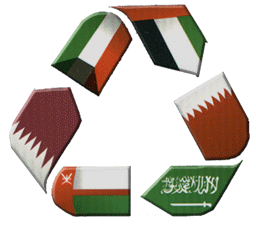
Perhaps the most telling thing about the ongoing effort of the Gulf states to drop the greenback is that none of them is an outright enemy of America. The United Arab Emirates, Kuwait, Bahrain, Qatar and Saudi Arabia maintain – for the most part – friendly relations with the United States.
Their effort is thus not driven by some insidious desire to harm the US, but by the reckless monetary and fiscal policies of our own government.
NAKHEEL, Dubai's leading property company and owner of the Palm development, offshore of the Gulf city, is in talks with Dubai World, its heavily indebted parent, over the repayment of a $US3.5 billion ($3.76 billion) Islamic bond.
Dubai World, which also owns DP World, the world's third biggest port operator, is guarantor of the Nakheel bond, which is being watched closely by Islamic investors as a bellwether for the shaky finances of the city-state and the health of Islamic finance, generally.
Dubai World is the investment holding company of a clutch of emirate-related businesses that have huge debts. Dubai has to refinance $US50 billion of maturing borrowings by 2013. Dubai World is believed to owe $US60 billion.
In an effort to keep the State's business ventures afloat, the Dubai Government this year raised an emergency $US10billion loan from the central bank of the United Arab Emirates.
Talks over Nakheel's sukuk, an Islamic financial bond, which matures next month, are taking place as Dubai's ruler castigates the Emirate's critics. They point to strained relations with Abu Dhabi, its richer, but more conservative, neighbour, which has been forced to step in, using its vast oil wealth to guarantee Dubai's huge property debts.
Sheikh Mohammed bin Rashid al-Maktoum insisted this week that there was no tension between the two emirates. "There is no Dubai and Abu Dhabi, we are one ... I want to tell those people who who nag about Dubai and Abu Dhabi to shut up," he said.
Dubai's bubble economy of property and hotels came a cropper in last year's financial crash. Speculators and migrant workers fled the emirate, many abandoning cars, flats and credit card debts in a rush to escape punitive bankruptcy laws. In November last year, the United Arab Emirates Government, backed by the oil wealth of Abu Dhabi, stepped into the breach, promising to stand behind Dubai's borrowings that exceed the state's GDP. In the wake of the financial crash, concern is now mounting over the region's trillion-dollar market in Islamic bonds.
Troubled investments and a series of defaults, including Saad Group and Investment Dar, a Kuwaiti Islamic investment fund, in April, have focused attention on the obscure and untested legal structure of Islamic bonds.
The Gulf's oil, property and finance boom helped to launch the market in sukuk, a form of bond that complies with Sharia (Islamic law) strictures that prohibit the payment of interest on money. Islamic financial institutions have devised a variety of structures using techniques, such as sale-and-leaseback, to get round the prohibition.
Typically, Islamic banking seeks to structure interest as a profit-sharing venture but, according to Neale Downes, a partner at Trowers & Hamlin, the law firm, in Bahrain, there is confusion over the legal protection offered to holders of sukuk.
In some cases where sukuk issuers have become insolvent, Mr Downes said that "investors have found themselves unexpectedly competing with the general body of creditors, rather than simply enforcing against or taking possession of assets supporting their sukuk".
The outcome of negotiations over the Nakheel sukuk will be key to the future of the Islamic bond market, which has been rocked by a series of defaults.
Investment Dar, which owns half of Aston Martin, the British luxury car company, failed to make an interest payment in April on a $US100million sukuk issue. Investment Dar's default followed one at Global Investment House, another Kuwaiti investor.
In June, $US650million of Islamic bonds issued by Saad Group, the investment company controlled by Maan al-Sanea, which owns a stake in HSBC, were downgraded to default status.
A SHIEKH from the United Arab Emirates is likely to take over Christian Lacroix, the loss-making French fashion house, tomorrow when his 100 million euros ($163m) rescue deal goes before the Paris Commercial Court.
Sheikh Hassan bin Ali al-Nuaimi, a nephew of the ruler of Ajman, the smallest member of the UAE, has emerged as a clear favourite to become owner of the designer.
Lacroix's house went into administration in May after filing for protection from creditors as the global crisis hit its already weak finances.
Rival offers have been submitted by Bernard Krief Consulting, of France, and the Financiere Saint-Germain, a holding company that owns Daum and Lalique, the crystalware makers.
The proposition from a sheikh with few international investments surprised observers in France. But Regis Valliot, the administrator, said that "it fulfils perfectly all the necessary criteria. It is the fantastic solution we dared not hope for."
Borletti Group, the Italian owner of the La Rinascente retail chain and Lacroix's first choice as a partner, dropped out of the race after the sheikh's move.
His offer includes an injection of €70m into the business and a pledge to take on all 124 employees, with debts of €14m to suppliers and part of €30m that it owes to the Falic Group, Lacroix's Florida-based owner.
The overall sum injected by the sheikh will be about €100m, according to Mr Valliot.
"On the face of it, there seems to be little suspense," industry insiders in Paris said. "The sheikh's offer is by far the most solid."
Mr Nuaimi said that he wanted to diversify the business. "The idea is not to focus on fashion by itself,” he said.
“We are discussing different activities in leisure ... private jets, hotels, high-quality yachts, palaces and interior decoration. We will focus on very exclusive areas and don't want to sell his name cheap in the market.
“Christian Lacroix is one of the lords of fashion design in the world ... but, on another side, as a businessman he has a lot of problems. We will run it better commercially."
Lacroix himself would become a minority shareholder in the house under the terms of the deal. Despite a glowing reputation and widespread admiration for his colourful, often baroque style, Lacroix has never made a profit in 22 years of trading.
Last year, losses reached €10m on sales of €30m.Falic, an American duty free retailer that bought Christian Lacroix from LVMH, the French luxury goods group, in 2005, has put forward a restructuring plan, which involves shedding the haute couture line and cutting the workforce to 12.
The plan provoked fury in France, when Frederic Mitterrand, the Culture Minister, said that the loss of the fashion label would be a "cultural disaster".
Christian Estrosi, the Industry Minister, also promised backing for a designer whom he described as a "flagship for haute couture", which had "contributed to fame of French elegance and skill".
Ajman has followed Dubai with a huge real estate development program, which includes shopping centres, hotels and residential areas. But, like Dubai, it has suffered from the economic slowdown this year.
ISTANBUL: Big oil producing nations denied on Tuesday a newspaper report that Gulf Arab states were in secret talks with Russia, China, Japan and France to replace the U.S. dollar with a basket of currencies in trading oil.
The U.S. dollar eased in response to the report, which was written by The Independent's Middle East correspondent Robert Fisk and cited unidentified sources in Gulf Arab states and Chinese banking sources in Hong Kong.
It said the proposal was for trade in crude oil to move over nine years to a basket of currencies including the Japanese yen, the Chinese yuan, the euro, gold and a new, unified currency planned for nations in the Gulf Co-operation Council, which includes Saudi Arabia and Kuwait.
But top officials of Saudia Arabia and Russia, speaking on the sidelines of International Monetary Fund meetings in Istanbul, denied there were such talks.
Asked by reporters about the newspaper story, Saudi Arabia's central bank chief Muhammad al-Jasser said: "Absolutely incorrect." He repeated the same response when asked whether Saudi Arabia was in such talks.
Russia's deputy finance minister Dmitry Pankin said: "We did not discuss this at all."
Algerian Finance Minister Karim Djoudi told Reuters: "Oil producing countries need to stabilise revenues but...I don't see a need for oil trade to be denominated differently.
"But we are at the IMF conference where all sorts of subjects are raised and discussed," he added.
Arab investors have lost 2.5 trillion dollars from the credit crunch, Kuwaiti Foreign Minister Sheikh Mohammad al-Sabah, whose country hosts an Arab economic summit next week, said on Friday.
"The Arab world has lost 2.5 trillion dollars in the past four months" as a result of the global financial crisis, Sheikh Mohammad told a press conference following a joint meeting of Arab foreign and finance ministers in Kuwait.
He also said that about 60 percent of development projects "have either been postponed or cancelled" by the six-nation Gulf Cooperation Council (GCC) states because of the global meltdown.
Arab leaders who hold their first ever economic summit on January 19-20 will discuss the impact of the worldwide economic meltdown on the 22 Arab countries.
The biggest loss was an estimated 40 percent drop in the value of Arab investments abroad, which previously totalled around 2.5 trillion dollars.
Falls on stock markets contributed more than 600 billion dollars to the losses, while Arab investors were further affected by a sharp decline in oil revenues, the declining value of property investments and other repercussions of the global downturn.
Next week's summit will also discuss the Gaza war but leaders are still intent on agreeing a joint response to the financial crisis.
Note: majority of users who have posting privileges on MASH blog are not MASH members.
Comments are slightly moderated. MASH does not necessarily endorse every opinion posted on this blog.


 Hizb ut-Tahrir espouses the replacement of republican governments in the West with Sharia states, and the establishment of a global caliphate. "LSE's Hizb ut-Tahrir teacher Reza Pankhurst and the secretive 'Brothers' Circle,'" from The Times, January 16




 Posts
Posts


