 Dubai is set to open the world's tallest skyscraper Monday amid the Gulf emirate’s financial woes. Dubai is set to open the world's tallest skyscraper Monday amid the Gulf emirate’s financial woes. The Burj Dubai tower contains 57 elevators, 1,044 apartments, 49 floors of office space and a hotel. It can be seen from as far as 59 miles away and is estimated to have cost one billion dollars. While the exact height of the building is under wraps, Emaar, the firm that developed the property, says it exceeds 2,640 feet, putting it far higher than Taiwan's Taipei 101 tower. "We thought that it would be slightly taller than the existing tallest tower of Taipei 101. (Emaar) kept on asking us to go higher but we didn't know how high we could go," Bill Baker, a partner in Skidmore, Owings and Merrill (SOM), which designed the tower, told the AFP. "We were able to tune the building like we tune a music instrument. As we went higher and higher and higher, we discovered that by doing that process... we were able to reach heights much higher than we ever thought we could.” With a new title holder, the tallest building in the United States would drop to fifth place in the world. That would be the Willis Tower, formerly the Sears Tower, in Chicago at 1,389 feet. The Freedom Tower, planned for the former site of the World Trade Center's Twin Towers in New York City, is expected to rise 1,776 feet. It is due to be completed in 2013. Property prices in Dubai have dived over 50 percent over the past year and some believe the skyscrpaer will be the last of the giant projects that have brought global fame to Dubai. FoxNews 
 Abu Dhabi is moving to bail out on a selective basis the state-owned Dubai World, whose debt default led to a sharp drop in global markets, a senior official has said. Abu Dhabi is moving to bail out on a selective basis the state-owned Dubai World, whose debt default led to a sharp drop in global markets, a senior official has said.
The unnamed official told news agencies on Saturday that the United Arab Emirates' wealthy capital would "pick and choose" how to assist its debt-laden neighbour.
"We will look at Dubai's commitments and approach them on a case-by-case basis," the official told the Reuters news agency by telephone, adding: "It does not mean that Abu Dhabi will underwrite all of their debts." Dubai's crisis exploded on Wednesday when the emirate, known for opulent lifestyles and the world's tallest building, said it would delay payment on debt issued by Dubai World, triggering panic among investors and driving global markets down. Abu Dhabi's selective assistance for companies in "Dubai Inc", a network of quasi-sovereign industries, instead of blanket assistance, is likely to disappoint many investors who assumed the city would provide a safety net for its neighbour.
The official, who declined to be identified because he is not authorised to speak to the media, said: "Some of Dubai's entities are commercial, semi-government ones. Abu Dhabi will pick and choose when and where to assist."
At stake is the $59bn in debt held by Dubai World, the holding company, and Nakheel, its property arm, known for building palm-shaped islands for wealthy celebrities.
On Friday, stocks from Tokyo to Mumbai reacted badly to news of lenders' exposure in the firms that built artificial island housing developments in the Gulf emirate.
Banks in Asia and Europe were quick to distance themselves from Dubai, and shares on the Hang Seng Index in Hong Kong plunged 3.45 per cent after the morning session, down 765.28 points to 21,445.13 as a result of the panic.
European stocks fell to lows not seen since May and bonds jumped after the restructuring was announced. Dubai, part of the oil-exporting UAE, said on Wednesday it would ask Dubai World creditors and Nakheel to agree to a standstill on billions of dollars of debt as a first step towards restructuring. Alia Moubayed, a senior economist at Barclays Capital in London and author of the Dubai Debt Problem report, said the "challenges Dubai is facing are considerable".
"The sources of financing, however, at this stage are ... the extent of the Abu Dhabi support that's likely to come through," she told Al Jazeera. More at Al Jazeera
 DUBAI World says it is in talks with banks to restructure about $US26 billion ($28bn) in debt, easing concerns that the government-owned investment arm will default on all of its $US60 billion in total liabilities. DUBAI World says it is in talks with banks to restructure about $US26 billion ($28bn) in debt, easing concerns that the government-owned investment arm will default on all of its $US60 billion in total liabilities. The restructuring will comprise several phases, and Dubai World says it is considering alternatives to its debt obligations. About $US6bn of the restructuring is related to its property unit, Nakheel World. Dubai World, a conglomerate spanning real estate, ports and leisure interests, was seeking a debt standstill, a move that weighed heavily on investor confidence worldwide. "Following a detailed review of the group's liquidity and capital structure, Dubai World has concluded that it should immediately consider alternatives in respect of the debt obligations of certain entities within the group," it said. "The proposed restructuring process will only relate to Dubai World and certain of its subsidiaries, including Nakheel World and Limitless World." Global jitters about a potential default caused stocks to plunge late last week on concerns about a potential new phase of the financial crisis. The announcement that banks are in talks about restructuring triggered a rally in US markets just ahead of the close. Investors were rattled earlier in the session after the Dubai government said it would not automatically rescue the investment vehicle. Moelis & Co has been appointed to advise on the restructuring, and Rothschild will remain a financial adviser. Dubai World says the restructuring will relate to only some of its subsidiaries, including Nakheel and Limitless World. The process will not include Infinity World Holding, Istithmar World, and Ports & Free Zone World, all of which are on "a stable financial footing," according to Dubai World. Separately, law firm Ashurst says it is representing a group of creditors, who account for about a quarter of the nominal value of a $US3.5bn Islamic bond due next month, issued by Dubai World's Nakheel property unit. The Australian
 Thousands of Palestinian workers in Dubai may lose their jobs due to the financial crisis there, economists project.
Over the past few months, thousands of the estimated 100,000 Palestinian laborers working in Dubai have lost their jobs.
The Gulf state's economy is grinding to a halt, due to the huge international debts the country took on to drive its breakneck expansion coupled with the global economic crisis.
Last week, the Dubai government announced its flagship conglomerate needed a six-month halt to interest payments on $59 billion worth of debt.
Arab financial analysts said the crisis in the Gulf states, compounded by debts and falling oil prices, will affect the economy in the Palestinian Territories, where many families depend on money from relatives working in Dubai, primarily in construction.
Other Palestinians work as engineers, instructors and in technology-related professions in Dubai. Some have started construction businesses there, such as Arab-Tech, which was among the country's first victims of the financial crisis.
This recession resulted in the cancelation of building contracts and projects and sent the industry into a freeze, prompting many Palestinians to leave Dubai for neighboring Qatar - which last month injected $6 billion in fresh capital into its banking system to "restore confidence" in its own economy - and in Saudi Arabia. Some have returned to the West Bank.
One Dubai-based Palestinian businessman said Palestinians working in Dubai were generally "highly skilled personnel with long years of experience in their respective fields."
"Many West Bank families are losing their sources of income, as these people are no longer sending much money," he told Haaretz.
The sheikdom of Dubai, ruled by the Makhtoum family, has staked its future on plans to become the tourist, transport and finance hub of the Middle East, encouraging outsiders to buy apartments in the plethora of new tower blocks sprouting like poplars across the sand.
But the international financial conglomerate Citigroup warned has warned that several Dubai developers have been caught in a severe squeeze, and their projects are increasingly unlikely to be finished.
 by Vasko Kohlmayer by Vasko Kohlmayer “The Gulf single currency is not happening tomorrow or the day after,” says Kuwait’s Finance Minister Mustafa al-Shamali. “Sufficient time” is needed to prepare for such a move the minister told the Kuwaiti parliament last week. Al-Shamali’s statement is startling in how matter-of-factly it reveals the intent of the Gulf states to abandon the dollar. Last month, veteran British journalist Robert Fisk filed a story titled “The Demise of the Dollar” in which he claimed that the Gulf countries were secretly working to set up a new currency to be used for oil trade. The report shook the markets and provoked a furor across the globe with many accusing Fisk of posting sensational stories based on obscure sources. It turns out that Fisk was right. If anything his article understated how far along the Gulf countries had come in their quest to replace the dollar. So much so that they had set the beginning of the next year as the start of the new monetary regime. And even though they will not be able to meet the ambitious deadline, its very existence underscores the earnestness of those countries to decouple themselves from the dollar framework. Such a move would have devastating repercussions for the United States, because it would deal a major blow to the dollar’s status as the world’s reserve currency. Once the dollar loses that special standing foreign central banks and investors will no longer be willing to continue purchasing Treasury bonds at low interest. Deprived of the ability to borrow cheaply from abroad, the American government would be forced to monetize portions of its debt in order to obtain cash for its expenditures. This would lead, among other things, to runaway inflation. Perhaps the most telling thing about the ongoing effort of the Gulf states to drop the greenback is that none of them is an outright enemy of America. The United Arab Emirates, Kuwait, Bahrain, Qatar and Saudi Arabia maintain – for the most part – friendly relations with the United States.
Their effort is thus not driven by some insidious desire to harm the US, but by the reckless monetary and fiscal policies of our own government. More at FrontPage Magazine
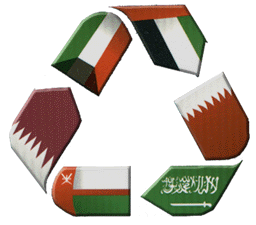 Arab investors have lost 2.5 trillion dollars from the credit crunch, Kuwaiti Foreign Minister Sheikh Mohammad al-Sabah, whose country hosts an Arab economic summit next week, said on Friday.
"The Arab world has lost 2.5 trillion dollars in the past four months" as a result of the global financial crisis, Sheikh Mohammad told a press conference following a joint meeting of Arab foreign and finance ministers in Kuwait.
He also said that about 60 percent of development projects "have either been postponed or cancelled" by the six-nation Gulf Cooperation Council (GCC) states because of the global meltdown.
Arab leaders who hold their first ever economic summit on January 19-20 will discuss the impact of the worldwide economic meltdown on the 22 Arab countries.
The biggest loss was an estimated 40 percent drop in the value of Arab investments abroad, which previously totalled around 2.5 trillion dollars.
Falls on stock markets contributed more than 600 billion dollars to the losses, while Arab investors were further affected by a sharp decline in oil revenues, the declining value of property investments and other repercussions of the global downturn.
Next week's summit will also discuss the Gaza war but leaders are still intent on agreeing a joint response to the financial crisis.
Source: Breitbart
 |
|
|
Copyright Muslims Against Sharia 2008. All rights reserved.
E-mail: info AT ReformIslam.org
|
|
|


 Dubai is set to open the world's tallest skyscraper Monday amid the Gulf emirate’s financial woes.


 Posts
Posts


