There were meant to be 7,000 polling booths but insecurity fuelled by Taliban inspired violence has plagued these elections (see BBC video here). Excuse me if I am slightly cynical about the elections. It is not that I doubt the intent and the impartiality of the polls. But what exactly will the new President govern? The country has no bureaucratic infrastructure to implement any policies. The state apparatus has no revenue of its own and is almost entirely dependent on foreign sources to meet even basic operating costs. Security is primarily provided by foreign troops. It is said that the Taliban now operate a parallel judiciary in Kandahar, Afghanistan's second largest city. If a road needs is being built then the work crew requires NATO protection, foreign aid money paid to foreign contractors. Nevertheless, it is the local Afghanis being paid subsistence wages who must brave the Taliban threats to actually build the road – when they are not being kidnapped or killed.
The poor have no choice but to scratch out a living. Joining the Taliban or becoming opium farmers suddenly seems attractive. What are some options that are available to improve the complex situation in the battle scarred nation? Afghanistan has never been a unitary state. It has been a confederation comprising the various tribes and ethnic groups that inhabit the region. The Pashtuns (aka Pathans or Pakhtuns), which straddle both sides of the Pak-Afghan border, are the largest single group. The Pashtun tribes and their leaders must be supported politically through direct access to funds and development assistance. The tribal leaders are responsive to their own constituencies – members of their tribes. They have a vested interest in seeing roads, schools and markets built in their hamlets and villages. More importantly, if the tribes are consulted and included in the development process they will take ownership of the infrastructure, i.e. they will physically defend the improvements to their neighbourhood.
Central military force is important in the context of providing a security umbrella to the friendly and 'borderline' tribes. Military force effectively used will make the cost of joining the Taliban prohibitive. Becoming a Taliban fighter should not be seen as an easy way to earn a living by disaffected Pashtuns. Potential fighters must think twice and consider the price (death) before joining. But the primary weapon is to negotiate, using a combination of threats and bribes, the nominal loyalty of tribes away from the Taliban. There will always be an element of the Taliban who will not give up arms until either the foreigners have left or their austere version of Islamic law has been implemented. The impact of the extreme element on the mainstream can be minimized through social marginalization. A second necessary condition is the inclusion of the Pashtuns in the Kabul political establishment. Since the fall of the Taliban an attempt has been made to placate Pashtun sensitivities by pointing to current President Hamid Karzai as their representative. Karzai has no tribal constituency. He spent the Soviet occupation years in exile in Quetta, Pakistan. His impotence as a political deal maker became clear to the Pashtuns when the first post Taliban cabinet appointed Northern Alliance leaders in every key ministerial post. The Pashtuns were marginalized and the effect was to strengthen their sympathies towards the Taliban. NATO / US pressure on the Kabul elite to bring in key Pashtun leaders with important tribal constituencies into the regime will go a long way in reducing the pull of the Taliban. There are several members of the Taliban who are (or already have) renounced violence and joined the political mainstream. Some are even running for President in these elections. Afghanistan is not a nation state in the same mould as European or Latin American nations. Even in the best of times, Afghanistan has been a loose confederation with some control exercised by political authorities in Kabul over the larger urban areas and road infrastructure. The loyalty and pacification of tribes through judicious use of cash and intimidation is what appears to have worked in the past.
To try and impose a 'top-down' unitary state is failure writ large. Instead, a return to the loose tribal based arrangement of the past is the best bet to restore stability to a nation destroyed by 30 years of fighting. But for now, the Presidential elections give the international community a productive reason to spend their generous budgets and NATO troops some ballot boxes to protect. Imran Ahmed is a Singaporean freelance writer. He writes frequently on subjects of relevance to Muslims in modern society. He writes on his blog, The Grand Moofti Speaks. This article first appeared on his blog on August 18, 2009.
From correspondents in Kabul | August 21,
The head of Afghan President Hamid Karzai's re-election campaign said the incumbent was decisively leading the count and there would be no need for a second-round run-off.
"From what we have obtained so far, we can claim that there is no need for a run-off and we can claim that we're in the lead," campaign chief Din Mohammmad said.
"We have got this figure from our observers at the (voting) sites," he added.
 Security was tight after the Taliban threatened
to attack voters and polling stationsVote counting in Afghanistan's second-ever direct presidential election is under way after polls closed following an hour-long extension, officials have said. The vote on Thursday was marred by a series of attacks across the country that left at least 26 people killed. Hanif Atmar, the Afghan interior minister, and Abdul Rahim Wardak, the defence minister, told a news conference that nine civilians, nine policemen and eight soldiers were killed in 135 incidents on Thursday. Atmar said that 28 other soldiers had been wounded and that security forces thwarted five suicide attacks. Hamid Karzai, the Afghan president, said the election was conducted "successfully" throughout the country despite Taliban attacks that resulted in deaths of Afghan security forces and civilians. "The Afghan people defied rockets, bombs and intimidation and came out to vote, that is great," Karzai - the frontrunner of the 30 candidates - told a news conference in his fortified palace. "Despite problems and intimidation, the elections ended successfully," the president said, adding that armed groups conducted attacks in 15 of Afghanistan's 34 provinces. Read more here ... Source: Al Jazeera(English)
 The threat, in leaflets distributed across southern Afghanistan and authenticated by a Taliban spokesman, is bad news for the President, who faces a last-minute poll surge by his closest presidential rival and former foreign minister, Abdullah Abdullah. "This is to inform respected residents that you must not participate in the elections so as not to become a victim of our operations, because we will use new tactics," said one leaflet posted in the Taliban stronghold of Kandahar. All voters were allies of the Afghan government and foreign forces and therefore enemies of Islam, it added. "We are using new tactics targeting election centres. If anyone is harmed in and around election centres, they will be responsible because we have informed them in advance," Taliban spokesman Qari Yousuf Ahmadi said. While Mr Karzai remains the frontrunner in Afghanistan's second presidential elections this Thursday, his campaign has been marred by security threats amid an escalating Taliban campaign to derail and discredit the elections. Late last month, the Taliban ordered voters to boycott the polls and join them in waging holy war to "liberate" Afghanistan. Taliban militants have also been holding community shuras (meetings) across the conservative Pashtun-dominated south - Mr Karzai's voter heartland - to appeal for support. But the latest warnings mark the first direct Taliban threat to attack polling sites. The soaring insurgent attacks have raised concerns that voters will stay away from the polling centres on Thursday, jeopardising the legitimacy of the elections. A massive suicide bombing on Saturday morning in the heart of Kabul's embassy district has heightened those fears. Read more here ... Source: The Australian
Mahmoud Saikal | August 14 NEXT Thursday's presidential and provincial elections in Afghanistan have the potential to strengthen the nation's democratic institutions, provide a fresh mandate for the fight against terrorism and extremism, and help improve the living conditions of Afghans. Moreover, judging from the large and enthusiastic crowds at the leading candidates' election rallies, the elections may bring to office a new president, a new government and younger provincial members. Although a US-funded survey released this week shows the incumbent, President Hamid Karzai, has 36per cent support among voters, some of his rivals, in particular former foreign minister Abdullah Abdullah, are gaining ground and there is the strong possibility of a run-off, especially if local strongmen are unable to mobilise blocs of supporters in favour of the status quo. Yet, far from being destabilising, a change, if handled wisely by the Afghan elite and its international partners, would strengthen democracy. Unfortunately, there are signs that opponents of the election are determined to disrupt it. Read more here ... Mahmoud Saikal has served as Afghanistan's deputy foreign minister (2005-06) and ambassador to Australia (2002-05). He is a visiting fellow at the Australian National University's Asia-Pacific College of Diplomacy. This article reflects his personal views. Source: The Australian
 
Paul L. Williams, Ph.D. A dog returneth to its vomit. So reads Proverbs 26:11. Any doubt of this truth should be put to rest by recent developments in southeastern Afghanistan where the U.S. Marines have launched a massive offensive. The purpose of the mission – dubbed Operation Khanjar or “Strike of the Sword” – is to rout out the Taliban forces before the August 20th election to ensure the re-election of Afghan President Hamid Karzai. The Marines are encountering stiff resistance from the Taliban, who have been newly energized under the leadership of Abdul Qayum Zakir, also known as Abdullah Ghulam Rasoul, and several of his friends from the detention facility at Guantanamo Bay (GITMO), including Mohammed Nayim Farouq, and Abdul Rahman These insurgents were released from GITMO to the custody of Afghan President Hamid Karzai, who promptly freed them in an effort to gain the widespread support for his re-election bid. The Karzai tactic backfired. The released GITMO prisoners have assumed command of the Taliban army, and have succeeded in making July 2009 the bloodiest month in the eight year old Afghan war. Several terrorists who rejoined the Taliban after spending some time at GITMO have bit the dust and are presently enjoying their 72 virgins in seventh heaven. More here,,, FamilySecurityMatters.org Contributing Editor Paul L. Williams is the author of The Day of Islam: The Annihilation of America and the Western World, The Al Qaeda Connection, and other best-selling books. He is a frequent guest on such national news networks as ABC News, CBS News, Fox News, MSNBC, and NPR. Visit his website at http://thelastcrusade.org. Source: Faith Freedom
Eight years after the Taliban were toppled, Janine di Giovanni returns to Afghanistan and sees how a proposed law is instilling fear in its women 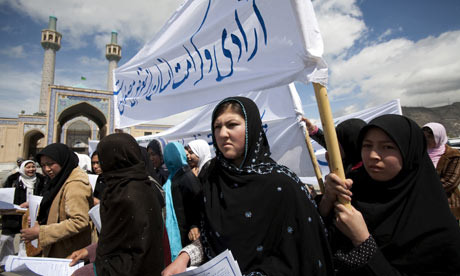 Afghan women protest at the proposed new family law Photograph: Robert Nickelsberg A few days after the Taliban were toppled in 2001 I was in Kabul. The city was jubilant and full of hope for the future, and I remember talking to some laughing teenage girls in the street. One was excited because she could now go back to school. Another sang terrible disco songs and showed me dance steps she had been practising for five years in secret. A third debated whether to take off her burka. "Is it safe enough yet?" she asked me. "For five years, I lived inside this prison." Eight years later I returned, but the Afghanistan I found was far from jubilant. Despite the money poured into reconstruction and development, it is one of the five poorest countries in the world. There is 40% unemployment – nearly 80% in some parts of the country. A third of children under five are malnourished. Life expectancy is 43 – and it is one of only three countries in the world where women die earlier than men. I arrived to meet women before the presidential elections next month and to talk about a new law, which if brought in, could have drastic repercussions for women. The Shia Family Planning law was signed last March by President Hamid Karzai in an attempt, many believe, to appease powerful mullahs. The Afghan constitution allows Shias to have a separate family law from the Sunni majority based on traditional Shia jurisprudence, and some think the law is linked to the August elections and the Shia electorate who would have to abide by it (they could form up to 20% of the electorate). The proposed law led to furious protests from women's groups. It sanctioned marital rape and brought back Taliban-era restrictions on women by outlining when a woman could leave her house and the circumstances in which she has to have sex with her husband; Shia woman would be allowed to leave home alone "for a legitimate purpose" only which the law does not define, and could refuse sex with their husbands only when ill or menstruating. Following international outrage, Karzai backtracked and said the law would be reviewed. This month it was amended and re-signed by the president, but has not yet been ratified by parliament. Human rights groups say it is unclear how much the amendments have done to improve the law. And the law has already achieved its aim – instilling fear and insecurity among an already traumatised female population. Soraya Sobhrang, a human rights activist I meet in her Kabul office, says, "The law will affect all women if it goes through. It opens the door for other repressive laws to be passed, for Sunni Muslims as well as Shia." A young doctor friend, Najeeb Shawal, says he is seeing more female patients who were depressed since news of the law emerged. "They have the kind of hopelessness that comes with knowing your life is incredibly repressed.
And might become more so." Read more here... Source: The Guardian
WASHINGTON (CNN) — President Barack Obama said Wednesday that the leaders of Afghanistan, Pakistan, and the United States are meeting “as three sovereign nations joined by a common goal: to disrupt, dismantle, and defeat” al Qaeda and the Taliban. To do so, Obama said, the three nations have to deny extremists the space necessary to operate, and bring a better life to the people of Afghanistan and Pakistan. Obama, in remarks delivered with Afghan President Hamid Karzai and Pakistani President Asif Ali Zardari at the White House, stated that the security of Afghanistan, of Pakistan, and of the United States are linked. Al Qaeda and its allies are responsible for killing innocent civilians and challenging the democratically elected governments in the nations, he said. Source: CNN Wire
KABUL - Responding to criticism from around the world, Afghan President Hamid Karzai said Saturday that a new law that critics say makes it legal for men to rape their wives will be studied and possibly sent back to parliament for review.Karzai said he ordered the Justice Ministry to review the law, and if anything in it contravenes the country's constitution or Shariah law, "measures will be taken." The law, signed by Karzai last month, is intended to regulate family life inside Afghanistan's Shiite community, which makes up 10 percent to 20 percent of the country's 30 million people. But the United Nations Development Fund for Women has said the law "legalizes the rape of a wife by her husband." The United States has urged Karzai to review the law, and Karzai said he has spoken with U.S. Secretary of State Hillary Rodham Clinton about it. Canadian officials have also criticized the legislation. One of the law's most controversial articles legislates the frequency of sexual relations between Shiite husbands and wives. Article 132 says the husband has a right to sex every fourth night unless the wife is ill. Read more ... Source: AP
Hamid Karzai has been accused of trying to win votes in Afghanistan's presidential election by backing a law the UN says legalises rape within marriage and bans wives from stepping outside their homes without their husbands' permission. The Afghan president signed the law earlier this month, despite condemnation by human rights activists and some MPs that it flouts the constitution's equal rights provisions. The final document has not been published, but the law is believed to contain articles that rule women cannot leave the house without their husbands' permission, that they can only seek work, education or visit the doctor with their husbands' permission, and that they cannot refuse their husband sex. Read more ...Source: Muslim Debate
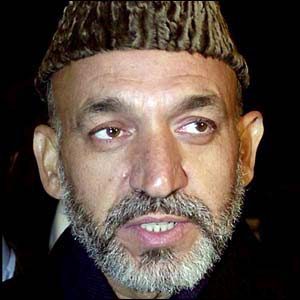 Hamid Karzai By Jerome Starkey and Kim Sengupta in Kabul
Friday, 23 January 2009
Barack Obama's arrival in the White House and the wind of change sweeping through Washington could lead to the ousting from power of Hamid Karzai, President of Afghanistan, The Independent has learnt.
International support for Mr Karzai, who was once the darling of the West, has waned spectacularly, amid worsening violence, endemic corruption and weak leadership. But until very recently, diplomats insisted there were no viable alternatives even as fighting has intensified and the Taliban insurgency in the south has grown. But four key figures believed to be challenging Mr Karzai have arrived in Washington for meetings with Obama administration officials this week. There is now talk of a "dream ticket" that would see the main challengers run together to unite the country's various ethnic groups and wrest control away from Mr Karzai.
"The Americans aren't going to determine the outcome of the election, but they could suggest to people they put their differences aside and form a dream ticket," said a senior US analyst in Kabul.
Mr Obama has already started getting to grips with the challenge of Afghanistan; he received a briefing on the coming American troop "surge" from General David Petraeus on Wednesday, his first full day in the Oval Office. Last night, Mr Obama appointed the veteran US diplomat, Richard Holbrooke, as his new special envoy for Afghanistan and Pakistan.
The unofficial delegation to Washington was made up of three ex-ministers and a serving governor. Dr Abdullah Abdullah was the foreign minister, Dr Ashraf Ghani served as finance minister, Ali Ahmad Jalali was interior minister and Gul Agha Sherzai is the governor of the eastern province of Nangahar, where US troops are based. When Mr Obama visited Afghanistan in July he met Governor Sherzai in Jalalabad, even before he saw President Karzai in Kabul. "They are not going to blindly back President Karzai like the Bush administration did for so long," said John Dempsey, head of the United States Institute of Peace in Kabul. On the ground in Afghanistan, Camp Bastion in Helmand province is already becoming the symbol of the Americanisation of the war in the south. US forces have started arriving and will be joined by many more. Airfields are to be built to bring in transport and warplanes in preparation for a coming offensive with the dispatch of 30,000 additional troops to Afghanistan.
Karzai officials had hoped Hillary Clinton, now the US Secretary of State, would prove their ally in White House. But those hopes were dashed last week when she branded Afghanistan a "narco-state" with a government "plagued by limited capacity and widespread corruption" during her confirmation hearing.
Ahmed Wali Karzai, the Afghan president's brother, was named last October in leaked US intelligence reports as a major narco-trafficker. The allegations, vigorously denied by both men, are widespread in Afghanistan but, until then, Western officials had refused to corroborate them. But the leak was seen as a shot across Mr Karzai's bows from the Bush administration, to make him clean up his act and rein in his brother. The flurry of criticism suggests the international community is less than happy with his response. Mrs Clinton's remarks coincided with stinging criticism from Nato's secretary general, Jaap de Hoop Scheffer, who said corrupt and inefficient government was as much to blame for instability as the insurgents. Writing in The Washington Post, he said: "The basic problem in Afghanistan is not too much Taliban; it's too little good governance."
Individually, Mr Karzai's rivals risk splitting their support base. Together, diplomats are optimistic they could win the election, expected next summer, and reinvigorate a jaded population. "We need to create a new momentum, like in 2001," said Haroun Mir, co-founder of the Afghanistan Centre for Research and Policy Studies. "Change will bring hope, because right now the momentum is with the Taliban."
The planning for new policies on Afghanistan has been going on for months by Pentagon and State Department staff in anticipation of Mr Obama's inauguration. One official said: "We have to come up with fresh innovative ideas on counter-insurgency, counter-narcotics, governance, development. Now they are drafting in people from other departments. There is no doubt we neglected Afghanistan after the Taliban fell but there is a worry that we may be trying to do too much, too fast now."
A slew of initiatives are on the way. They include the arming of local groups to fight the Taliban, in the way Sunni militias were used against insurgents by General Petraeus in Iraq.
US, British and Nato forces will also play a much more direct role in counter-narcotics operations in an effort to tackle Afghanistan's heroin trade which provides 93 per cent of the world's supply of the drug.
Some policy analysts insist it is impossible to blame the Afghan president for all his country's ills. They say the international community has been ineffective, often divided and international military effort was focused on catching terrorists, not quelling an insurgency for far too long.
British soldiers complain that they are being forced to share hospital facilities in Afghanistan with Taliban fighters. Enemy combatants are treated at the Camp Bastion Field Hospital in line with the Geneva Convention. But personnel are objecting to the traditional war-time practice. "My friends... were waking up in the hospital to find Taliban in the bed next to them," one soldier said. "The last thing they want to see when they come round is the Taliban on the same ward. It's just not right."
The Ministry of Defence said it had not received any complaints.
The challengers: Who might replace Karzai?
Gul Agha Sherzai
A veteran of the wars against the Soviets, Mr Sherzai (whose name means "son of a lion") is a former governor of Kandahar criticised for human rights abuses. He escaped assassination in 2006.
Dr Abdullah Abdullah
Although half Pashtun, he is considered a leader of Afghanistan's Tajik population. He was appointed Minister of Foreign Affairs in 2001 and served until 2006.
Ali Ahmad Jalali
An ethnic Pashtun and former colonel, Jalali joined the anti-Soviet resistance after the Russians invaded Afghanistan in 1979. He took US citizenship and spent 20 years broadcasting for Voice of America.
Dr Ashraf Ghani
An ethnic Pashtun, he studied in America, at Colombia University. He worked at the World Bank from 1991 to 2001, when he returned to Afghanistan for the first time in 24 years. From 2002-04 he was Finance Minister and oversaw the successful transition to Afghanistan's new currency.
Source: The Independent
 Sayed Pervez Kambaksh's sentence
has generated much controversyBy Alastair Leithead In Kabul's grim and crowded central prison, a 23-year-old student from northern Afghanistan spends each day wondering if and when he will be put to death. Sayed Pervez Kambaksh was sentenced in January, in five minutes, at a local court in Mazar-e-Sharif, with no legal representation to defend charges of blasphemy after reports he had downloaded from the internet un-Islamic material on women's rights. "I don't know what will happen to me," he said from the prison office where we were allowed half an hour to interview him. "My trial was unfair from the beginning. From day one, they have been treating me very harshly as a criminal, not a suspect, and I don't know who has done this to me.  President Karzai has to approve
any death sentence"My case has been politicised - my lawyer has been threatened. I have lost nine months of my life now in four prisons," he said. 'Deviated from religion'There is an appeals process but his family have little faith in it - there have been many delays and little information. The international community has raised the issue and asked for Sayed Pervez Kambaksh to be pardoned or released, but the case is a glaring example of the conflict between conservative Islam and the liberal Western views of Afghanistan's international backers. "Kambaksh has deviated from religion, and Islam orders that he must be executed," said Enayatullah Baleegh, a member of the Islamic ulema council and a popular and well-respected Muslim scholar. Read more ...Source: BBCH/T: Shariah Finance Watch
 August 20, 2008
KABUL: French President Nicolas Sarkozy has arrived in Afghanistan, vowing to pursue France's mission after 10 of its troops died in the deadliest attack yet on international forces there.
Mr Sarkozy was flying in with his Defence Minister Herve Morin for a visit in which he was expected to meet some of the 21 French soldiers also wounded in the fighting this week, French officials said.
The French President was also likely to meet his Afghan counterpart Hamid Karzai before returning home.
Mr Sarkozy announced he would travel to Afghanistan as soon as the news broke yesterday of the fighting 50km east of the capital Kabul.
The visit was to show the troops that “France is at their side,” he said.
“In its struggle against terrorism, France has just been hard hit,” Mr Sarkozy said.
It was the deadliest attack on international forces fighting extremists in Afghanistan since the US-led war which ousted the hardline Taliban regime in 2001.
It was also the deadliest on French soldiers since a 1983 assault in Beirut in which 58 paratroopers were killed.
But Mr Sarkozy insisted France would not be deterred from its Afghan mission, for which it has 3000 soldiers serving in a NATO-led International Security Assistance Force of more than 40,000 troops from nearly 40 nations.
“My determination is intact. France is committed to pursuing the struggle against terrorism, for democracy and for freedom,” he said in a statement from his holiday residence in the French Riviera.
“This is a just cause, it is an honour for France and for its army to defend it.”
US forces provided air support in the battle, after which the Taliban said it had destroyed several military vehicles.
“Serious measures, notably in the air, were taken to support and extricate our men caught in an extremely violent ambush,” Mr Sarkozy said.
Mr Morin estimated casualties on the Taliban side at 30 dead and 30 wounded.
The French losses drew sympathy from other countries which have suffered heavy losses in Afghanistan, where extremist violence has grown every year with more foreign and Al-Qa'ida-linked fighters believed involved.
US President George W. Bush offered his condolences, as did the leaders of Britain and Canada, other key contributors to the ISAF deployment.
The European Union's foreign policy chief, Javier Solana, said the attack was “a disgraceful and barbaric act”. Source: The Australian
 An Afghan policeman checks a taxi in Kandahar, Afghanistan, on Sunday. By Jason Straziuso KABUL, Afghanistan | Afghan President Hamid Karzai threatened Sunday to send Afghan troops after notorious Taliban leaders inside Pakistan in an angry warning to his eastern neighbor that he will no longer tolerate cross-border attacks. The threat - the first time Mr. Karzai has said he would send forces into Pakistan - comes only days after a sophisticated Taliban assault on Kandahar's prison freed at least 870 prisoners, and six weeks after Mr. Karzai survived his fourth assassination attempt. Mr. Karzai has long pleaded with Pakistan and the international community to confront tribal-area safe havens, and U.S. officials have increased their warnings in recent weeks that the sanctuaries in Pakistan must be dealt with. Read more ...Source: AP
Muslims Against Sharia condemn the murderers responsible for Afghan bombing that left dozens dead. Our prayers are with the victims of this atrocity. We send our condolences to their loved ones. May the homicide bomber rot in hell for eternity. May his accomplices join him soon! Source: AP
 |
|
|
Copyright Muslims Against Sharia 2008. All rights reserved.
E-mail: info AT ReformIslam.org
|
|
|


 Posts


