 January 11, 2009
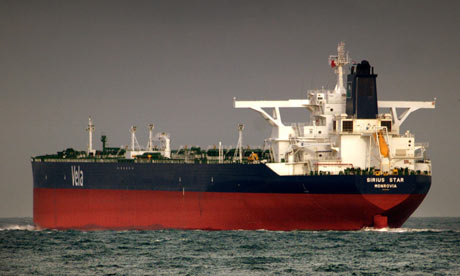
SIX Somali pirates who hijacked a Saudi supertanker drowned with their share of the ransom when their boat capsized as it left the vessel, their leader said yesterday.
Four others were missing with their share of the $3m payoff, which been parachuted on to the tanker on Friday, Mohamed Said said by phone from the port of Harardhere.
"The small boat that was carrying those killed and eight who survived was overloaded ... they were afraid of a chase from outsiders (foreign navies of the combined maritime forces)," he said.
Mohamud Aden, a resident of the port off which the tanker had been anchored watched by the warships, said: "The capsize was an accident. The pirates were full of joy and partially frightened by the presence of foreign war machines and were speeding.
That was a tragedy for the pirates." In all, several dozen raiders had held the ship and its 25-member crew, including two Britons, to ransom.
They were well-armed and disciplined but as soon as they got the ransom a shootout nearly broke out, it was reported. The 1,080ft Sirius Star, owned by Aramco, is the largest vessel hijacked by the Somali pirates.
It was seized in November in the Indian Ocean, well outside the raiders' usual operating area. The tanker was carrying 2m barrels of oil, more than a quarter of Saudi Arabia's daily output and worth an estimated $100m.
Its capture was seen as a dramatic demonstration of the pirates' ability to strike hundreds of miles offshore. The tanker's crew included second officer Jim Grady, from Renfrewshire, and chief engineer Peter French, from Co Durham.
Yesterday they were looking forward to coming home, though latest reports said the ship was still anchored off Harardhere. More than 100 ships were attacked off the Horn of Africa last year and maritime officials said the problem was out of control.
The pirates were said to have raked in $120m and still hold some 14 merchant ships and 300 crew.
The Sirius Star's release came as the US Fifth Fleet announced that a taskforce targeting piracy would be launching later this month. Nato and the European Union have warships in the Gulf and the Chinese navy has said it will assist. Source: The Australian Drowned Somali Pirates
Latest recipients of the Evil Dumbass Award

  China will send two navy destroyers and a supply vessel to the Gulf of Aden to protect merchant ships from attacks by Somali pirates, state media have said.
Chinese defence ministry spokesman Hu Changming told the Xinhua news agency that the three ships would set sail from the port of Sanya on 26 December.
Several countries have sent forces to combat the pirates, who have attacked more than 100 ships this year.
Among those still held is a Saudi oil tanker and a Ukrainian ship with tanks.
They are among 15 vessels the pirates hold for ransom.
The three Chinese ships, part of the country's South Sea Fleet, will leave Sanya on Friday for the Gulf of Aden and the waters off Somalia, Mr Hu said.
Their main mission would be to protect the safety of Chinese vessels and their crews in the region, as well as protecting vessels delivering humanitarian aid international organisations, he added.
The defence ministry spokesman said the ships would abide strictly to the relevant UN Security Council resolutions and international law, and would be willing to co-operate with other convoy protection ships from concerned countries.
They will also participate in humanitarian assistance missions.
At a news conference on Thursday, foreign ministry spokesman Liu Jianchao said 20% of Chinese ships passing through the region between January and November this year had been attacked by Somali pirates.
Correspondents say the deployment will be the first of its kind for a country that has traditionally followed a doctrine of non-interference in other nations' affairs.
But world leaders have called for greater action to deal with the problem and last week, the UN approved a resolution allowing foreign troops to pursue pirates on land in Somalia.
The Chinese taskforce will join warships from the EU, US, India, Russia, Malaysia and others which are already patrolling in the area.
Earlier, an Iranian warship began patrolling in the gulf, where two Iranian vessels have been hijacked recently, state radio reported. Source: BBC
From correspondents in Nairobi | November 19, 2008
SOMALI pirates today released a Hong Kong-flagged ship and its 25 crew seized two months ago, a Kenyan maritime official said.
The MV Great Creation, with 24 Chinese and one Sri Lankan crew, was seized on September 18.
"The pirates released the Great Creation this morning and it is currently sailing to Abu Dhabi," said Andrew Mwangura of the East African Seafarers Association, which monitors shipping in the region and the activities of Somali pirates. Source: AFP
 By Abdi Sheikh in Mogadishu | November 19, 2008
AN Indian warship destroyed a pirate ship in the Gulf of Aden and gunmen from Somalia seized two more vessels despite a large international naval presence off their lawless country.
The buccaneers have taken a Thai fishing boat, a Greek bulk carrier and a Hong Kong-flagged ship heading to Iran since Saturday's spectacular capture of a Saudi supertanker carrying $100 million of oil, the biggest ship hijacked in history.
The explosion of piracy off Somalia this year has driven up insurance costs, made some shipping companies divert around South Africa and prompted an unprecedented military response from NATO, the European Union and others.
"The pirates are sending out a message to the world that 'we can do what we want, we can think the unthinkable, do the unexpected'," Andrew Mwangura, coordinator of the East African Seafarers' Assistance Program, said.
The International Maritime Bureau said pirates from the Horn of Africa nation had hijacked a Thai fishing boat with 16 crew. That followed the capture of a Hong Kong-flagged ship carrying grain bound for Iran.
Mwangura's group said a Greek bulk carrier had also been seized, but an official at Greece's Merchant Marine Ministry said that no such incident had been recorded.
The sharp increase in attacks at sea this year off the poor and chaotic country has been fuelled by a growing Islamist insurgency onshore - gun battles broke out again in Mogadishu on Wednesday - and the lure of multi-million-dollar ransoms.
No ransom has been demanded so far for the Saudi supertanker Sirius Star, which the pirates seized after dodging international naval patrols in their boldest strike yet.
A spokesman for the owners, Saudi Aramco, said the company hoped to hear from the hijackers later on Wednesday. One Somali website said the attackers were demanding $250 million.
The Sirius Star was seized 450 nautical miles southeast of Mombasa, far beyond the gangs' usual area of operations. It was believed to be anchored near Eyl, a former Somali fishing village that is now a well-defended pirate base. Source: The Australian from Reuters
 Catherine Philp | November 19, 2008
SOMALI pirates struck again overnight, seizing an Iranian cargo ship holding 30,000 tonnes of grain, as the world's governments and navies pronounced themselves powerless against this new threat to global trade.
Saudi pirates have captured the fully laden Saudi oil tanker the Sirius Star.
Admiral Michael Mullen, the US military chief, pronounced himself stunned by the pirates' reach after their capture of the supertanker Sirius Star and its $US100 million ($154 million) cargo.
Commanders from the US Fifth Fleet and from NATO warships in the area said that they would not intervene to retake the vessel.
The Foreign Minister of Saudi Arabia, the owner of the ship, condemned the hijacking as an "outrageous act" that required international action.
"Piracy, like terrorism, is a disease which is against everybody, and everybody must address it together," Prince Saud al-Faisal said. Arab diplomats would meet in Cairo tomorrow to discuss what could be done in response, Yemeni officials said.
Analysts said, however, that the seizure of the Sirius Star exposed the use of foreign warships as "a sticking plaster" that would not solve the problem.
"Maritime security operations in that area are addressing the symptoms not the causes," said Jason Alderwick, a maritime defence analyst at the International Institute for Strategic Studies.
Roger Middleton, a Horn of Africa specialist at the Chatham House think-tank, said that the capture was a crucial escalation. "Now that they have shown they are able to seize an enormous ship like this, it is beyond a military solution. You won't fix this without a political solution."
Pirates pulled the 333m supertanker yesterday to a mooring point off Harardhere, on the Somali coast. Farther north, Italian, Greek, Turkish, British, American and Russian frigates and warships were patrolling the Gulf of Aden under a UN mandate.
Even there, pirates hijacked a Hong Kong-registered freighter, the Delight, as it carried 36,000 tonnes of wheat to Bandar Abbas. The hijack, the seventh in 12 days, took place near the Yemeni coast, underscoring the new tactic of evading foreign warships by simply sailing beyond their area of operation.
Operations undertaken by the coalition fleet are fraught with legal difficulties, ranging from restrictive rules of engagement to rights of habeas corpus, as the British Navy discovered when it detained eight pirates after a shootout last week.
Yesterday the detainees were passed on to Kenya, where efforts to prosecute them will be closely watched for precedent.
The limitations of naval action are refocusing international attention on the conflict within Somalia, where the rule of warlords, the lack of a functioning government and resulting anarchy have spawned the piracy epidemic.
The Somali President admitted this weekend that his Western-backed transitional Government was on the brink of collapse, with fighters from the ousted Islamic Courts regime bearing down on Mogadishu.
Pirate attacks have also driven up insurance costs, meaning that consumers will have to pay more to buy goods shipped across the world's seas.
The lawlessness and anarchy that has marked Somalia since the fall of the old Cold War dictator Siad Barre in 1991 proved fertile ground in which a crime almost forgotten in the West has found a new lease of life.
The vast sums involved - pirates holding the Ukrainian arms ship Faina are demanding $US20 million for its return - bring a plentiful supply of cash in the form of illegal taxes and kickbacks for the warring parties to spend on arms.
Analysts say that the Sirius Star is a double-edged sword to its captors: on the one hand, its high-value cargo means that they can demand a massive ransom; on the other, its political and economic importance put them in greater danger of being intercepted.
The pirates are banking on the ship's owners to handle this as a business transaction rather than a geopolitical crisis. Vela International, the ship's operator, has begun negotiations. Source: The Australian
 Catherine Philp | November 18, 2008
PIRATES have seized the biggest booty ever taken on the high seas, capturing a fully-laden Saudi oil supertanker and its multinational crew, among them two British merchant seamen.
The Sirius Star - three times the size of an aircraft carrier and carrying its full complement of two million barrels of crude oil worth at least $US100 million ($154 million) - was hijacked in the early hours of Sunday 450 nautical miles southeast of Mombasa in Kenya, according to the US Fifth Fleet.
"This is unprecedented," Lieutenant Nathan Christensen, spokesman for the fleet said yesterday. "It's the largest ship that we've seen pirated."
Last night the Sirius Star was heading towards Eyl, a notorious pirate haven on the Somali coast, raising fears of an environmental catastrophe if the pirates run aground in waters far too shallow for the vast supertanker.
Shipping analysts said the cost of sending freight around the world would rise following the attack as a result of higher insurance premiums and an increase in charter rates.
The Sirius Star is the latest of more than 60 vessels to be captured off the Somali coast this year, but the first supertanker. Jitters over the ease with which pirates seized crude equivalent to a quarter of Saudi Arabia's daily output sent falling oil prices into reverse. They finished up one dollar per barrel.
Odfjell, one of the largest shipping groups in the world, responded to the attack by suspending its routes through the Gulf of Aden in favour of the longer journey around the Cape of Good Hope at the tip of South Africa, raising the prospect that one of the world's busiest trade routes could be sidelined unless global action is taken to combat the pirate menace.
Britain leads a multi-national task force in the area. Last week the Royal Navy was drawn into a shoot-out with a gang attempting to hijack a cargo ship, killing two of the pirates.
But the capture of the Sirius Star hundreds of miles to the south in the Indian Ocean, as it was heading to the US via the Cape of Good Hope, suggests that the Gulf pirates are simply moving into unpatrolled waters or that other pirate groups, recently dormant, have been reawakened.
The supertanker had avoided the Gulf of Aden and the Suez Canal because it is too big to pass through the canal. It is not only the largest ship to be captured but the farthest from the Somali shoreline.
The US Fifth Fleet declined to say whether military action was being considered to rescue the tanker, which is manned by 23 crew from Croatia, the Philippines, Poland and Saudi Arabia in addition to the two Britons.
Shipping experts said a rescue attempt was unlikely because of the extreme danger both to the crew and the ship. Vela International, which operates the tanker for the Saudi state oil company, Saudi Aramco, said it had set up a negotiating team to deal with ransom demands.
"All 25 crew members on board are reported to be safe," the company said. "Vela response teams have been established and are working to ensure the safe release of the crew members and the vessel."
Somalia has lacked a functioning government since the outbreak of civil war in 1991. But the lawlessness that has prevailed since the ousting of the Islamic Courts government in 2007 has spawned the epidemic of piracy.
The gangs' methods vary little, even when taking a 320,000-tonne monster like the Sirius Star. Gunmen typically approach on small speedboats, opening fire on the bridge until the ship's captain submits and allows them on board, usually throwing down a ladder. The average reaction time between spotting the pirates and being boarded is 15 minutes.
Crews are strictly instructed not to resist attack once arms have been employed. Once captured, violence against crew members is rare.
In recent months the pirates' arsenal has grown more deadly, with rocket-propelled grenade-launchers and possibly shoulder-mounted missiles used to threaten the crew.
Pirate groups have hugely extended their reach from the coast with the use of "mother ships", larger vessels from which they launch speedboats after they have identified their prey. While some known mother ships have been identified, other attacks are launched from ordinary dhows, traditional sailing boats hijacked from fishermen.
Negotiations with ships' owners can go on for several months and are clouded in secrecy. At least 12 ships with more than 250 crew members are being held as negotiations continue. Among them is the Ukrainian arms ship Faina, which was captured in August with a cargo of 33 battle tanks, hundreds of crates of Kalashnikovs and ammunition.
Shipping companies have noticed a pattern in which new hijacks occur within days of a ransom settlement, suggesting that the gangs move from one hijack to another as soon as the last is resolved.
"There are never less than 10-12 ships being held," said Giles Knowles, head of maritime security for the Baltic and International Maritime Council, which represents more than 2,700 of the world's shipping companies.
The last week saw the resolution of three ransom settlements, he said, with three more hijacks promptly taking place since Friday. "It would seem there is a cycle."
Terje Storeng, chief executive of Odfjell, said: "We will no longer expose our crew to the risk of being hijacked and held for ransom by pirates in the Gulf of Aden.
"The rerouting will entail extra sailing days and later cargo deliveries. This will incur significant extra cost, but we expect our customers' support and contribution."
Mr Knowles said several companies had already consulted Bimco - an independent international shipping association of shipowners, managers, brokers and agents - on moving to the Cape route, extending the average journey by three weeks, and that he expected more to take Odfjell's lead.
Bimco has called on foreign governments to send more warships in the short term to work under a United Nations mandate to police the Somali coast. In the longer term, it would like a permanent UN coastguard force.
But as long as anarchy reins onshore, little will change at sea. "Historically you've never defeated piracy at sea," Mr Knowles said. "The resolution lies ashore - in Somalia." Source: The Australian
 |
|
|
Copyright Muslims Against Sharia 2008. All rights reserved.
E-mail: info AT ReformIslam.org
|
|
|


 Posts
Posts


