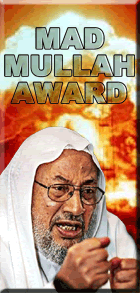
In "A Nobel Prize...for Ignorance of Islam?" at the History News Network, December 11, recovering college professor Timothy R. Furnish exposes some of the falsehoods about Islam and jihad that Obama retailed in his acceptance speech for his Nobel Peace Prize for Nothing: Toward the end of his speech the President lapsed into banalities that bordered on intentional misrepresentations. His line about "those who have distorted and defiled the great religion of Islam" has become boilerplate on the Left, invoked like a talisman every time Islam is mentioned.
But it is nonetheless pure fantasy. As I and other commentators (Ray Ibrahim, Robert Spencer, Andrew Bostom, among others) have pointed out numerous times, those who perpetrate violence in the name of Islam and Muhammad are in no wise "distorting" or "defiling" the world's second-largest religion--they are, rather, simply taking literally the violence enshrined in the Qur'an and emulating the historical example of Muhammad himself.
Obama then followed with the second axiom of American liberals when discussing Islam--be sure to adduce the Crusades: "these [Islamic] extremists are not the first to kill in the name of God; the cruelties of the Crusades are amply recorded." Why, yes they are, Mr. President. But there are thousands of years of human history preceding the Crusades, many also amply recorded, and wars in the name of God long pre-date what the medieval Catholic Christians did.
In fact, one only has to go back a few hundred years prior to the First Crusade of the 11th century to see that Muslim armies violently overran Christian lands in Egypt, Anatolia, North Africa and Spain--all in the name of Allah. But of course Muslims and Islam can never be held to account, according to our President's worldview, for their invocation of Allah to kill, conquer and enslave. Those depredations must have been carried out by just a few "extremists," no doubt embittered by something one of George Bush's ancestors had done. Obama's final bit of pro-Muslim propaganda was a line he also employed in his Cairo address earlier this year, his ahistorical claim that "one rule that lies at the heart of every major religion is that we do unto others as we would have them do unto us." This line is actually said by Jesus in Matthew 7:12: "In everything, therefore, treat people the same way you want them to treat you, for this is the Law and the Prophets" (NASB)." Christianity, obviously, teaches this; so too does rabbinical Judaism and, in a more negative form ("don't do to others what you would not have them do to you"), Buddhism. But Islam teaches no such doctrine! A loving attitude toward others is simply not one of the (alleged) revelations given by Allah to Muhammad in the Qur'an. And this is far more than merely some abstruse point of theology, akin to how many jinn can dance on the head of a pin.
This matters, for if our Commander-in-Chief and those who take their cue from him--miliary leaders, diplomats, intelligence analysts--get such a basic point of Islamic theology and history wrong, how on earth can we expect to win not just the military conflict but, more importantly, the ideological one against Islam? With thanks to JihadWatch 
 President Obama's speech in accepting the Nobel Peace Prize showed great growth in his development as a leader. He courageously set forth the principles of just war before those who had assembled to give him a peace prize. The president boldly acknowledged America's very real enemy, Al Qaeda, in a move rarely heard from him prior in public addresses. His remarks also rectified his failure to mention any leaders besides himself in his remarks for the anniversary of the fall of the Berlin Wall. In doing so, President Obama exhibited humility and grace as he noted the achievements of leaders like Ronald Reagan, Richard Nixon, Pope John Paul II, and Lech Walesa in his Nobel address. President Obama failed in just one key area in his otherwise impressive address. Once again, he proved himself ignorant of history and embarrassingly sycophantic when it comes to the history and nature of Islam. In the very same week in which five American Muslim men were apprehended in Pakistan for intent to wage jihad, President Obama offered these words that so often sprinkle his messages:
“Most dangerously, we see it in the way that religion is used to justify the murder of innocents by those who have distorted and defiled the great religion of Islam, and who attacked my country from Afghanistan. These extremists are not the first to kill in the name of God; the cruelties of the Crusades are amply recorded.” President Obama loves to reference the Crusades as his one Christian parallel for the modern-day Islam of massive religiously-inspired violence. He could not be more wrong. Were Obama to read distinguished Cambridge historian Jonathan Riley-Smith's The Crusades, Christianity, and Islam, he would find an excellent account of what happens when Islam expands it reach and what is required to thwart it. Riley-Smith helpfully counters the modern misconception that Christians attacked Muslims in the Crusades without provocation to seize their lands and forcibly convert them.
All the Crusades met the very criteria of the just wars in which President Obama sought to ground his Nobel speech. They came about in reaction to attacks against Christians or the Church. The First Crusade was called in 1095 to defend against the recent Turksih conquest of Christian Asia Minor as well as the earlier Arab conquest of what until then had been the Christian Holy Land.
The second Crusade developed as a response to the Muslim conquest of Edessa in 1144. The third resulted from the Muslim conquest of Jerusalem and a number of other Christian lands in 1187. In each case, Christians went to war to defend Christians, to combat the attackers, and to rectify egregious wrongs. President Obama continues to show a lack of history education as he likens the Crusaders to the Muslim jihadists. That ignorance is unacceptable. One would hope that in an Ivy League education that included undergraduate years at Columbia and law school at Harvard, the President would have had access to a non-politically correct reading of history. It appears not. More at Townhall
 Obama's Nobel "lecture" offers critics the usual cornucopia of opportunities for criticism but I shall focus on just two statements: "I am the Commander-in-Chief of a nation in the midst of two wars."
And here I thought there were three wars. Obama's two are Iraq and Afghanistan; missing is what George W. Bush termed the "war on terror" and I call the "war on radical Islam." Obama apparently reduces that third one to Al-Qaeda and counts it as just part of the Afghan war. His mistake has real consequences; long after American troops have left Iraq and Afghanistan, Islamists will be attacking and subverting us. If we don't see their efforts as a war, we lose. "Religion is used to justify the murder of innocents by those who have distorted and defiled the great religion of Islam."
Here, Obama follows his predecessor in presenting himself as an interpreter of Islam.
I ridiculed "Imam Bush" for telling Muslims about true Islam and its distortion, and now I must ridicule "Sheikh Obama" for the same. He's a politician, not a theologian. He's now a Christian, not a Muslim.
He should steer completely clear from the topic of who are good or bad Muslims. Daniel Pipes
 Once again, the courageous people of Iran have been demonstrating that, despite arrests, imprisonment, beatings, torture and state murder their spirit remains unbroken. Once again, there were protests against the regime yesterday at universities throughout Iran. Potkin Azarmehr reports: The most predominant chant was specifically directed against the Supreme Leader. It was amazing the regime had gone out of its way to prevent any information from coming out of Iran. Apart from the usual tricks, they had banned the press permits for all foreign correspondents for three days and even the public phone boxes around the universities were wrapped in black plastic bags to stop eyewitnesses reporting from the scene, yet once again they failed miserably. As Moussavi aptly said ‘They are trying to put up a barbed wire to stop a flood’. A translated report from Die Tageszeitung, published by Planet Iran, observes: Once again the Iranian opposition showed on Monday that it is not willing to give up the resistance against the clerical dictatorship. Thousands of arrests, torture and rape in prisons, which has claimed so far seventy-nine deaths caused by the long prison sentences, many show trials and forced confessions; the whole apparatus of repression has had its effect. The critics however cannot be intimidated. The regime in Tehran has largely lost its base. All propaganda attempts to attacks ‘foreign enemies’, appealing to so-called nationalist sentiment among the masses remain without response. The balance of power in the Islamic state, which so far despite the rivalries and conflicting opinions always acted consistently against ‘internal and external enemies’, no longer works. Not only the reformers have long since turned away from the governance, also formed in the conservative camp, a new front against the Ahmadinejad administration and especially against the supreme leader Ali Khamenei. In other words, the resistance of the people is continuing to weaken the Iranian regime.
The Iranian people are therefore still the west’s best hope of toppling that regime. As I have said before, it is therefore not just appalling but incomprehensible that western leaders do not support the Iranian people in this heroic resistance. In the Wall Street Journal today, Emanuele Ottolenghi makes a very sharp suggestion for what Obama should do with his Nobel Peace Prize which he receives in Oslo this week: he should give his medal to a far worthier recipient, Shirin Ebadi, the 2003 Nobel Prize laureate and Iran’s foremost human rights advocate who was recently robbed of her medal, alongside several other prizes (including the French Legion d'honneur) by order of Tehran’s Revolutionary Court. Ottolenghi writes: President Obama is the leader of the free world—though his tepid support for Iran's beleaguered pro-democracy movement may suggest he is uncomfortable with this role. Ms. Ebadi is the symbol of defiance against a liberticidal regime, which, to use the President's own words, represents a ‘common challenge of the 21st century,’ and one which the president still must confront.
They have the Nobel Prize in common. Let it be a way to bridge the gap between the president’s ill-fated efforts to engage Ms. Ebadi’s oppressors, and America’s historic commitment to liberty abroad. And let it be a way to turn the Nobel Prize Committee's choice into a powerful message in the service of peace—for the best way to promote peace is to champion freedom. The president's engagement strategy with the Islamic Republic has so far yielded little progress on Iran’s nuclear program, but offered much cover to Iran's regime. Clearly, internal repression is not Mr. Obama’s fault—but his premature award and his pledge to use it as an encouragement to future worthy endeavours offer him an opportunity, after past equivocations, to let Iranians know where he truly stands on the critical issue of their freedom. Alas, I think we all now know just where he stands on the issue of freedom in Iran and elsewhere. Melanie Phillips
 Maybe I’m taking this too personally, but that’s what blogs are for, right? But the revolting action by the fascist Iranian thugocracy in breaking into Nobel Peace Prize winner Shirin Ebadi’s safe deposit box in Tehran and stealing her Nobel prize symbolizes all that is petty, ugly, sinister and repulsive about the Iranian dictatorship. It’s not just a violation of her person; it’s a violation of all who believe in human rights. Shirin Ebadi, one of the bravest women in the world, won the Nobel in 2003 for her work as a human rights lawyer defending victims of Iranian regime. When I say I take this theft personally, it’s because two years later I was honored to be in a room with Shirin Ebadi — and it just happened to be the same night and in the same room in which I met the love of my life. It was at a gathering my book editor gave to celebrate the American publication of Shirin Ebadi’s memoir. I think it was the only time I’d been in the same room as a Nobel Prize winner, and I was awed by proximity to someone of such courage, by the quiet dignity and strength of her words. And now the cowardly woman-hating, freedom-crushing creeps and bullies who pass for a regime in Iran (may the nuclear laboratories they lie about blow up in their faces) have stolen the symbol of something they could never hope to aspire to — indeed, even understand — in their evil ignorant fanaticism. They’re nothing more than scummy crooks degrading religious piety everywhere with their travesty of it. More at Pajamas Media
 IRAN has confiscated the Nobel peace medal and diploma of Shirin Ebadi, the human rights lawyer who is one of the hardline regime's most outspoken critics. Her bank account has also been frozen on the pretext that she owes almost £250,000 in tax. The seizure of the award, unprecedented in its 108-year history, caused outrage in Olso, where the Nobel Peace Committee is based.
The Norwegian Government summoned the Iranian envoy to protest, and the committee said that it would make a formal complaint.
"Such an act leaves us feeling shock and disbelief," said Jonas Gahr Store, the Norwegian Foreign Minister.
Geir Lundestad, secretary of the committee, said that Iran's action was unacceptable. "A laureate has never been treated like that. Even political dissidents such as [Andrei] Sakharov and [Lech] Walesa were better treated in their countries," he added, referring to the Russian dissident and the Polish trade union leader, both of whom won the prize while living in the Soviet bloc.
 Since 1901 the Nobel Peace Prize has been awarded 90 times to 120 laureates but Iran holds the unique distinction of being the only regime to confiscate a winner’s medal. Aung San Sui Kyi, the Burmese opposition leader, was unable to collect her prize in 1991 because she was under house arrest. The Soviet authorities refused to let Andrei Sakharov, the dissident nuclear physicist, collect his prize in 1975. Lech Walesa, the Polish trade union leader, declined to collect his in 1983, fearing that his country’s communist rulers would not let him return. The only regime that matches Iran’s for sheer vindictiveness was that of Adolf Hitler.
The Nobel Foundation infuriated the Führer in 1935 by awarding the prize to Carl von Ossietzky, a German writer locked in a concentration camp. Hitler responded by banning German citizens from accepting any further Nobel prizes. His decree prevented three Germans from accepting the prize: Gerhard Domagk, winner of the 1939 Nobel Prize for Physiology, Richard Kuhn, winner of the 1938 Nobel Prize for Chemistry, and Adolf Butenandt, winner of the 1939 Nobel Prize for Chemistry.
 Kareem Shaheen A Nobel Peace Prize winner yesterday called on women in the UAE and wider Arab world to fight for “economic independence” and equal political rights.
Dr Shirin Ebadi, the Iranian Nobel laureate and human rights activist, said a key first step was raising “the awareness of women in the Arab world, and then they have to encourage women to go in search of work and leave their homes to work”. That would better enable women to venture into the marketplace, she told The National.
“Then [comes] the economic independence of women. And I’m saying economic independence that they get from working, not from inheriting some money from their fathers.”
Dr Ebadi was in Abu Dhabi for the Festival of Thinkers, organised by the Higher Colleges of Technology and in which The National is a partner. She delivered the keynote address at the Emirates Palace hotel on Monday. The event ends today. In the UAE, Dr Ebadi said, “women are allowed to have an education. They go to school and even university, but it’s a very low percentage of these women who enter the work market and become active. Therefore the situation is discriminatory”. She said the lack of female empowerment in the Middle East was evident in the low number of women holding key leadership posts.
“Polygamy still exists,” said Dr Ebadi. “The political rights of women are not equal to the political rights of men. “You don’t see any women who are holding senior positions, political or economic.
“In Saudi Arabia, women aren’t even allowed to drive their own cars, let alone be engaged in political and cultural activities, whereas in other Islamic states, such as Indonesia, Pakistan and Bangladesh, for many years women have been able to work in political fields and even become prime ministers.
“Behind all this thinking, ideology, it is not Islam, because Islam respects the rights of women.” The differences between Islamic countries were the result of different degrees of patriarchal culture, Dr Ebadi said. “So this culture gives an interpretation of Islam which suits their patriarchal culture. And that is why we see how the situation of women is different from one Islamic culture to the other.”
But the blame laid with both genders, she said. “Although the women are victims of this culture, they’re also the carriers and promoters of this culture. Don’t forget that any man who is a bully has been raised by a woman, and it’s only women who can stop this wrong culture, that does not believe in the equality of mankind, from being carried on and promoted.”
The UAE and the Arab world could learn from Iran’s growing feminist tradition, Dr Ebadi said, where women actively engaged in the post-election protests.
In addition, “many of our women are professors and lecturers, we have many women who are engineers, doctors, and have senior administrative positions”, she said, pointing out that even Mahmoud Ahmadinejad, Iran’s president, appointed a female adviser and a female minister. “There is a saying, ‘Modernity is born in the streets’. And a woman who leaves her home for work gradually becomes modernised.” Source: The National
 JERUSALEM — Washington's special Mideast envoy wrapped up his latest round of shuttle diplomacy in the region on Sunday, again having failed to persuade the Israelis and Palestinians to resume peace talks. The envoy, George Mitchell, spent more than an hour huddling with Israel's prime minister and defense minister. Prime Minister Benjamin Netanyahu's office said the talks "continued their discussions on moving the peace process forward." Two lower-level Israeli officials will head to Washington this week for further discussions, it added. Mitchell did not comment publicly after the meeting and was returning to Washington, U.S. officials said. Mitchell, a former U.S. senator and mediator of Northern Ireland's peace deal, has been shuttling between Israeli and Palestinian officials for months, trying to restart negotiations that broke down late last year. Mitchell met with Netanyahu and Palestinian President Mahmoud Abbas late last week before traveling to Cairo over the weekend to meet with Egyptian officials, who often play leading roles in mediating the conflict. Even with the Nobel Peace Prize awarded to his boss, Mitchell appeared to have made little progress in persuading the adversaries to soften their positions. Read more here,,,, Source: FoxNews
 Hamas politburo chief in Khaled Mashaal gave a special speech in Damascus in response to Palestinian President Mahmoud Abbas' Ramallah speech in which he defended the PA's conduct with regards to the Goldstone Report. "The one who is expected to be the leader, is the one who is leading us to doom," Mashaal said.
The Hamas head accused the PA of "cooperating with Dayton (the American general who trained the security forces) against us, and is taking bribes from those that wish to force on us policies that harm the resistance in exchange for financial benefits for the Palestinians in the West Bank. "This is a group that has not bothered to deny (Israeli Foreign Minister) Lieberman's words, when he said the PA asked to continue the war on Gaza. This is a group that cooperates with the crushing of the Palestinian resistance," he said. Regarding the Goldstone Report of a UN-appointed inquiry commission on Operation Cast Lead in Gaza, the Hamas leader accused the Palestinian Authority of an "embarrassment" that led to the deferral of a vote on the report in the UN Security Council. "They use the excuse that the report criticizes Hamas as well, we are used to this, but the ruling Palestinian group came to steer the report away from Israel – and today they are lying about it to their people. A brave leadership is one that tells the truth and admits its mistakes," he said.
According to Mashaal, the Goldstone Report was the straw that broke the camel's back, and has forced him to reiterate the fact that Abbas is holding on to his seat in office illegally. "His term ended in January 2009," Mashaal said, after refraining from addressing the matter up until now "so as not to harm reconciliation efforts." Now, Mashaal claims, "We cannot trust the current leadership with Gaza's blood, as it gives free service to the Israelis, persecutes the resistance and turns a blind eye to settlements. "How can we believe that it will fight for Jerusalem and the right of return? This leadership must be prosecuted," he said, calling for the establishment of a new Palestinian leadership and the rebuilding of the Palestinian Liberation Organization. "This is not a mistake, these are sins, this is an entire perception," he said. Mashaal also criticized the administration of US President Barack Obama, and addressed his recent award of the Nobel Peace Prize: "If Obama won the Nobel because of his promises, then there are many in the world who are eligible for the award."
 As soon as the Oslo committee issued its Nobel Peace Prize to President Barack Obama, an expected debate raged in America about the legitimacy of such a move so very early in a U.S. presidential term. The debate soon will espouse the dividing lines between domestic and foreign policy issues and, in a few weeks, will die out under the awe of new unfolding events. What will remain are future policy debates that will refer to one of the world's most prestigious awards as a fact in international relations. Months and few short years from now, supporters of the "new direction" in U.S. foreign policy as well as academics will frame Obama's Nobel as a consolidation of a new world order, while the media outburst following the granting declaration will be forgotten. Hence, bypassing the noise of did-he-earn-it-or-not deliberations, let's ask: What is the strategy behind the decision to grant this particular trophy to the sitting American president? To answer this, we simply can connect the dots between the statements made by the grantor and the grantee. Naturally every American must be proud, and many people around the world are happy for such a decision to honor the White House, although some U.S. leaders wished the committee had granted past presidents such as Bill Clinton for his gigantic efforts in worldwide humanitarian assistance. The alternative choices are arguable, but this particular gesture isn't about past achievements, as the committee and the recipient have concurred. It is about supporting a specific policy, which has been enunciated firmly during 2009 and is now being grounded in layers of moral recognition. This honored policy is to ensure that there will be no more American intervention overseas to provoke democratic change, let alone revolutions, particularly in the so-called "Muslim world." The Norwegian Nobel Committee lauded "the change in global mood wrought by Obama's calls and initiatives that have yet to bear fruit: easing American conflicts with Muslim nations." In other words, the transnational group of academics, politicians, and multinational corporations involved in the Oslo process of the Nobel Peace Prize clearly has championed the policy of Western restraint from "meddling" in the domestic business of authoritarian regimes. Read more here,,,, Source: International Analyst Network
 Many Egyptians had fallen in love with the new young American president with an Arabic middle name. Some even picked up the "Yes we can" slogan. His appeal was fueled by an almost unanimous dislike for his predecessor, George W. Bush, widely perceived in the region as a Christian fundamentalist leading an anti-Muslim crusade. But that was then.
Euphoria has a short shelf life in the Middle East, and Barack Obama is not exempt.
To gauge reaction among Egyptian intellectuals to the news, I called Hisham Qassim, a democracy and human rights activist I've known for many years. He was perplexed at the news from Norway. President Obama, he said, "is stumbling in the Middle East. He hasn't achieved any of his promises, and the Arab-Israeli conflict appears to be getting even nastier." In short, he said, "nothing is working." One winner of the Nobel peace prize Egyptians continue to admire is former U.S. President Jimmy Carter, who won the prize in 2002. After personally overseeing prolonged and painstaking negotiations between Egyptian President Anwar Sadat and Israeli Prime Minister Menachem Begin, Carter brokered the 1978 Camp David Peace Accords. It was the first peace agreement between Israel and an Arab country, and one a majority of Egyptians still believe was a major landmark in their long history. Egyptians contrast Carter's intensive involvement in peace efforts with Obama's stab at peace-making between Israel and the Palestinians. After initially demanding Israel halt all settlement construction in the occupied West Bank and East Jerusalem, the Obama administration softened its stand after running into a concrete wall of opposition from hard-line Israeli Prime Minister Benjamin Netanyahu. The Obama administration is seen, not only in Egypt but also across the Arab world, as following in the footsteps of so many previous American administrations, caving in to Israeli intransigence. It hardly augurs well for peace in the Middle East, especially at a time when tensions are simmering in Jerusalem, with some wondering if a third Palestinian intifada is in the making. Read more here,,,, Source: CNN
 "The letter went out yesterday," United Nations deputy spokeswoman Marie Okabe said. She stressed that this was a "customary letter" sent to leaders after they are elected or re-elected and that it did not represent an endorsement of Mr Ahmadinejad. The Iranian president was declared the winner of the June 12 election, despite claims of vote rigging from supporters of his defeated rivals that generated massive street demonstrations against the Islamic regime. Ms Okabe said Mr Ban's letter seized on Mr Ahmadinejad's inauguration, which took place last week, to "express the hope that Iran and the United Nations will continue to cooperate closely in addressing regional and global issues". Mir Hossein Mousavi, who was Mr Ahmadinejad's closest rival in the vote but lost heavily according to surprise official results, has dismissed the incoming government as "illegitimate".
Iranian Nobel peace prize winner Shirin Ebadi yesterday called for intensified world pressure to help her country democratise and denounced the crackdown on opposition protesters. "I oppose military and economic sanctions against Iran, as they will aggravate the situation," Ms Ebadi was quoted as saying in an interview with South Korea's Chosun Ilbo newspaper.
"However, intensified international public opinion will contribute to Iran's democratisation." Ms Ebadi, a lawyer and human rights defender who won the Nobel prize in 2003, arrived in Seoul on Sunday for a six-day trip to receive this year's Manhae Peace Prize, named after a 20th century Korean Buddhist reformer. Source: The Australian
 |
|
|
Copyright Muslims Against Sharia 2008. All rights reserved.
E-mail: info AT ReformIslam.org
|
|
|


 In "A Nobel Prize...for Ignorance of Islam?" at the History News Network, December 11, recovering college professor Timothy R. Furnish exposes some of the falsehoods about Islam and jihad that Obama retailed in his acceptance speech for his Nobel Peace Prize for Nothing:


 Posts