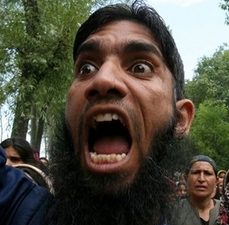
 By Ros Prynn Shame on Yale! Remember the faux outrage that swept across Europe when a Danish newspaper published cartoons like the one above? I am deliberately calling this rage fake, since I proved that it really had less than zero to do with disrespect to ANY religion. What was disrespectful of the Muslim faith was the manufactured violence and mayhem that erupted across Europe. Now comes this: From Israel National News comes this:
Academic Freedom: Yale Bans Book on Mohammed Cartoons
by Tzvi Ben Gedalyahu
Yale University Press has banned the scheduled publication of a book that includes 12 cartoons spoofing Mohammed which appeared in a Danish newspaper four years ago. Its decision also affects any future pictures of Mohammed after consultations with Muslim clerics, diplomats and counterterrorism officials.
After the initial appearance of the cartoons, which are available on the Internet, violent Muslim protests resulted in several deaths and widespread riots. The book, authored by Brandeis University professor and Danish native Jytte Klausen, originally was entitled “The 12 Little Drawings that Shook the World: The Danish Cartoons and the Clash of Civilization." Read more ... Source: FSMYale
Latest recipient of The Dhimmi Award

Why did Yale University Press remove images of Mohammed from a book about the Danish cartoons?By Christopher Hitchens The capitulation of Yale University Press to threats that hadn't even been made yet is the latest and perhaps the worst episode in the steady surrender to religious extremism—particularly Muslim religious extremism—that is spreading across our culture. A book called The Cartoons That Shook the World, by Danish-born Jytte Klausen, who is a professor of politics at Brandeis University, tells the story of the lurid and preplanned campaign of "protest" and boycott that was orchestrated in late 2005 after the Danish newspaper Jyllands-Posten ran a competition for cartoons of the Prophet Mohammed. (The competition was itself a response to the sudden refusal of a Danish publisher to release a book for children about the life of Mohammed, lest it, too, give offense.) By the time the hysteria had been called off by those who incited it, perhaps as many as 200 people around the world had been pointlessly killed. Yale University Press announced last week that it would go ahead with the publication of the book, but it would remove from it the 12 caricatures that originated the controversy. Not content with this, it is also removing other historic illustrations of the likeness of the Prophet, including one by Gustave Doré of the passage in Dante's Inferno that shows Mohammed being disemboweled in hell. (These same Dantean stanzas have also been depicted by William Blake, Sandro Botticelli, Salvador Dalí, and Auguste Rodin, so there's a lot of artistic censorship in our future if this sort of thing is allowed to set a precedent.) Read more ... Source: SlateYale
Latest recipient of The Dhimmi Award
In its August 13 report on the decision by Yale University Press to censor Jytte Klausen’s book The Cartoons that Shook the World by insisting that she publish the book without the Danish cartoons or other images of Mohammed, The New York Times informed its readers that Yale University and Yale University Press consulted two dozen authorities, including diplomats and experts on Islam and counterterrorism, and the recommendation was unanimous: The book, “The Cartoons That Shook the World,” should not include the 12 Danish drawings that originally appeared in September 2005. What’s more, they suggested that the Yale press also refrain from publishing any other illustrations of the prophet that were to be included, . . . It turns out, though, that the recommendation was not “unanimous.” As The Guardian reported yesterday, Sheila Blair, professor of Islamic and Asian art at Norma Jean Calderwood University and one of the authorities consulted by Yale about publication, said she had “strongly urged” the press to publish the images. “To deny that such images were made is to distort the historical record and to bow to the biased view of some modern zealots who would deny that others at other times and places perceived and illustrated Muhammad in different ways,” she wrote in a letter to the New York Times which is yet to be published. As it happens, I have a copy of Professor Blair’s letter to the Times. I asked her whether I could make it public; she said no. Read more ...Source: PJMH/T: Gramfan Yale
Latest recipient of The Dhimmi Award
COPENHAGEN - A Danish press freedom group said Wednesday it is selling copies of a cartoon of the Prophet Muhammad that caused outrage across the Muslim World. Some 1,000 printed reproductions of a drawing depicting the prophet wearing a bomb-shaped turban are being sold for $250 each, said Lars Hedegaard, chairman of the Danish Free Press Society. "All we are doing is starting a debate," Hedegaard said. "We are using our freedom of speech." Hedegaard said Danish artist Kurt Westergaard, who drew the cartoon in 2005, had given the society permission to produce the copies and sell them. Each numbered copy has been signed by Westergaard, Hedegaard said. "We have not, and are not, breaking any laws," Hedegaard told The Associated Press. Westergaard has been living under police protection since an alleged plot to murder him was discovered last year. Twelve cartoons depicting the prophet, including the one by Westergaard, were published in the Jyllands-Posten newspaper in 2005. Read more ...Source: AP
 By Jacob Laksin For someone who inadvertently triggered a clash of civilizations, Flemming Rose doesn’t look much like a provocateur. With his salt-and-pepper hair, college sweatshirt, and jeans over sneakers, the cultural editor of the largest Danish daily, Jyllands-Posten, seems disarmingly casual, a far cry from the frothing “Islamophobe” and “far-right” reactionary—never mind the “Straussian neocon Mossad agent”—that some of his more intemperate detractors imagine him to be. But such is the reputation that has shadowed the mild-mannered Rose since September 30, 2005, when he published the 12 now-famous (or infamous) cartoons of the Prophet Muhammad that took the world by storm. By now, the basic outlines of what the Danes call the Karikaturkrisen are well known. Troubled by what he saw as a growing tendency toward self-censorship in Denmark and elsewhere in Europe, especially on the sensitive subject of Islam, Rose commissioned 40 Danish artists to submit drawings of the prophet. Contrary to later accusations, the idea was not to insult Muslim believers but to test whether freethinking artists were prepared to privilege a religious taboo over freedom of speech. Rose made his point. Revealingly, only 12 artists participated, submitting drawings that ranged from lampoons of the center-right paper to a drawing of the prophet with a bomb-shaped turban. Then all hell broke loose. Although the initial response was muted, by February 2006, the cartoons, distorted to destructive effect by a group of Danish imams, had stoked a backlash in the Muslim world. Rage-fueled riots killed 139 and injured 823; Danish embassies were torched in Lebanon and Syria; and Denmark was hit with boycotts and diplomatic sanctions from Muslim countries. Whatever one’s views of the offending cartoons, they were, by any objective measure, the deadliest drawings ever published. Read more ...Source: Doublethink
 One of the two Tunisians who were allegedly plotting to kill the cartoonist who drew the 2006 controversial drawings of the prophet Mohammed has been released from Danish prison into society. The sensitive court case has been heard at every level of Denmark’s legal system, but eventually the Supreme Court ruled there was not enough evidence to continue detaining the remaining suspect, known only as SC.
The other Tunisian, known as KS, left Denmark voluntarily in August in a shadowy case where Danish intelligence let him go allegedly because to try him in court would have meant revealing the methods and sources they use to do their intelligence work.
The JP news service reported that suspect SC was also to be deported back to Tunisia, but the Refugee Appeals Board killed the motion because they felt he would be persecuted or tortured at home. SC has now been placed on ‘temporary stay’ status, which means he can come and go freely from the asylum centre where he is staying but must still report to local police each day. Source: Ice NewsAnother nail in the coffin of "terrorism is a law enforcement (not military) issue" philosophy.
 Lars Hedegaard, President of the Free Press Society and free speech champion and Kurt Westergaard, cartoonist and free speech icon, are under renewed threat of death from pious Muslims and adherents to the religion of pieces. I know, they kill people, it's what they do. Learn these men's names, ladies and gentlemen. Commit them to memory. They fight for you. Their lives are in danger because they speak freely. If they and/or their cause go down,you are next. What will you be harassed, fined, arrested (or worse) for? What is in your mind, your words, your deed that is unacceptable to the Islamic overlords and multicultural brownshirts? Free speech is the line in the sand in this war. It is not ambiguous. This is not a gray area. Nuance? Not. Free speech is the end game. If we lose freedom of speech, all is lost. It is not lost on me that the brave warriors on the fight for the West should emerge from the only country in Europe that saved its Jews during the last holocaust. How fitting and predictable. The Institute for Counter-Terrorism has uncovered two websites known for their affiliation with al-Qaeda - al-Hesbah (the Front) and al-Hanein - are baying for Danish blood as a reaction to the just released book by Lars Hedegaard and Kurt Westergaard (of Danish cartoon fame). Read more ... Source: Atlas
Swedish artist Lars Vilks is at the centre of a new controversy as his new musical Dogs premiered in Stockholm on Saturday. Meanwhile, an exhibition of his Muhammad caricatures has been blocked by Kalmar Art Museum. At a panel discussion after the premiere of the musical - a filmed documentation of events occurring after the drawings of the Muslim prophet Muhammad as a roundabout dog, chaos reigned on Saturday. When Vilks stood to address the several hundred people gathered in the ABF building in Stockholm, a young woman rose to her feet, made threatening gestures with her key ring and screamed at the artist. One of the debate's organizers seized the woman in order to escort her from the premises. Read more ...Source: The Local
 By Kathy Shaidle Nearly three years ago, a shocked Western world witnessed “a carefully orchestrated campaign of incitement” and intimidation that left embassies ablaze and innocent people dead – all ostensibly on account of some mediocre drawings of the Prophet Mohammed deemed offensive by Muslim leaders. The resulting debates about the limits of free speech have died down, but depictions of Mohammed continue to spark outrage around the world, mostly below the mass media’s radar. Last week, for example, the government of Indonesia denounced as “very inappropriate” two online drawings of the Prophet Mohammed. Many Muslims believe it is forbidden to depict Mohammed under any circumstances, let alone in “sexual situations,” as these cartoons reportedly do. The country’s communications minister asked the website to remove the drawings or face being shut down by its internet service provider. Now comes a report from a Jordanian news service of “New Danish Anti-Islamic Drawings to be Published Soon,” in a book of political satire co-authored by Kurt Westergaard. Westergaard drew the most notorious of the original “Mohammed cartoons”: a bearded man wearing a bomb instead of a turban. Read more ...Source: FrontPage Magazine
Kurt Westergaard has illustrated a new book and includes a picture reminiscent of his contribution to the Jyllands-Posten Mohammed cartoon series The man who was nearly killed for drawing a picture of Mohammed with a bomb in his turban plans...
The man who was nearly killed for drawing a picture of Mohammed with a bomb in his turban plans to release another set of provocative cartoons as part of a new book from historian Lars Hedegaard.
Kurt Westergaard will contribute 26 illustrations to the new book, ‘Groft Sagt’ (Roughly Speaking), a collection of Hedegaard’s sardonic contributions to the Berlingkse Tidende newspaper column of the same name.
One of the cartoons features former Foreign Minister Uffe Ellemann-Jensen, who took a stance against the original Mohammed cartoons, calling them a caricature of Denmark’s ‘cherished freedom of expression’.
In the new drawing, Ellemann-Jensen is pictured kneeling with an inkwell that reads ‘freedom of expression’. A black-bearded man with a bomb in his turban is peeking out from the inkwell.
Hedegaard told The Copenhagen Post that there was ‘no intention to depict the so-called prophet’, but that it is always possible for someone to interpret drawings in different ways. He was pleased with the Westergaard’s input and is not expecting any backlash.
Westergaard said that he has never been against Islam as a religion, but he takes issue with terrorists using a variation of Islam as their own ‘religious dynamite’. The 73-year-old remains unbothered by the potential furore his new drawings could cause, despite the need for him to remain under the protection of domestic security and intelligence agency PET.
Westergaard, who was given free reign to illustrate the writings he thought appropriate in the new book, returned home this summer after nine months in hiding. He had been living in police safe-houses after a plot to murder him for drawing one of the Mohammed cartoons in 2005 was uncovered.
The Supreme Court is currently handling the case of the two Tunisian men charged with the plot. One has left the country voluntarily and the other is facing an administrative deportation. Source: The Copenhagen Post
 A Prophet Mohammed look-alike contest was cancelled in Frankfurt after city officials declined to hold the event during a book fair at which Turkey is guest of honour.
"The city of Frankfurt became afraid, and backed out of its pledge to hold the competition on Saturday at the Museum of Caricature," satirical magazine Titanic said on its Internet site.
"We will do everything we can to find another site, but it will be hard in the middle of the book fair," the world's biggest which fills hotels and meeting rooms here, the magazine's editors said.
City officials said the site initially chosen appeared to be too small to hold the number of people that might show up, given the buzz being generated.
"We are relieved, because there will be no protests this way," the Frankfurter Rundschau daily quoted police spokesman Juergen Linker as saying.
Frankfurt prosecutor Doris Joeller-Scheu said: "We are pleased because there would surely have been problems without this cancellation."
In 2005, publication in a Danish newspaper of cartoons depicting the prophet Mohammed, deemed blasphemous in the Islamic world, sparked outrage in many countries. Source: AFPFrankfurt Government
Latest recipient of The Dhimmi Award

(COPENHAGEN) - Danish Prime Minister Anders Fogh Rasmussen called Tuesday on the European Union to strengthen its commitment to basic freedoms, and in particular freedom of expression, saying it remained under threat. Publication in 2005 in a Danish newspaper of cartoons of the prophet Mohammed, deemed blasphemous in the Islamic world, created outrage in many countries. "Denmark is working for the EU to step up its fight for the right to basic freedoms, which are universal and inviolable," Rasmussen told the opening of the 2008-9 parliamentary session in Copenhagen. Read more ...Source: EU Business (press release), UK
 Markus Aurelius' explosive new book, "Bleeding for Allah: Why Islam will Conquer the Free World, What Americans Need to Know" has Muslims from Turkey to Saudi Arabia blistering with rage. The new book, which took more than four years to research and write, scrutinizes Islam from its very birth. The Koran, the holy book of more than one billion people worldwide, is systematically analyzed by Aurelius to reveal the true nature of its message. "Bleeding for Allah" goes the full distance in detailing the uncomfortable and painful truth of that message. Turkish news agencies have attacked the author as a being "Christian extremist" (Ankara News) and of "promoting culture wars" (Jurnalturk). Dozens of websites in Turkey, Syria and Saudi Arabia have condemned the work as nothing more than propaganda of the Bush administration. The Turks appear particularly sensitive to Aurelius' gruesome account of the Turkish propagated Armenian Genocide. Turkish news outlets reiterate that Islam is only a religion of peace. Aurelius also carefully examined the Prophet Muhammad's life, including the gruesome details of his ruthless rise to power in the early seventh century. "The shrewd Prophet creatively found divine words of support from Allah for his banditry and mass murder," Aurelius writes. "Sadly, more than one billion people believe those words today." Aurelius believed that such beliefs contributed to the genocide of Hindus in Bangladesh and to the current human catastrophe in the western Sudan. Although touted as a peaceful religion and Islamic terrorists dismissed as misguided fanatics, it is clear that the very words of Allah, as voiced through the Archangel Gabriel to the Prophet Muhammad, are anything but peaceful. Markus Aurelius’ breakthrough work gives countless examples of Koranic verse that readily demonstrates its militancy and violence. While Aurelius was quite sensitive to the influence of cultural bias on interpretation, he found it extremely difficult to dismiss the troubling tenor of so many of the Koran’s verses, such as: -Believers, take neither the Jews nor the Christians for your friends.-- Koran, 5:51.
-Prophet, make war on the unbelievers and the hypocrites, and deal sternly with them. -- Koran, 66:9.
-When the sacred months are over, slay the idolaters wherever you find them. Arrest them, besiege them, and lie in ambush everywhere for them. --Koran 9:5. Read more ... Source: Westender
By Elizabeth Samson
There are strange happenings in the world of international jurisprudence that do not bode well for the future of free speech. In an unprecedented case, a Jordanian court is prosecuting 12 Europeans in an extraterritorial attempt to silence the debate on radical Islam.
The prosecutor general in Amman charged the 12 with blasphemy, demeaning Islam and Muslim feelings, and slandering and insulting the prophet Muhammad in violation of the Jordanian Penal Code. The charges are especially unusual because the alleged violations were not committed on Jordanian soil.
Among the defendants is the Danish cartoonist whose alleged crime was to draw in 2005 one of the Muhammad illustrations that instigators then used to spark Muslim riots around the world. His co-defendants include 10 editors of Danish newspapers that published the images. The 12th accused man is Dutch parliamentarian Geert Wilders, who supposedly broke Jordanian law by releasing on the Web his recent film, "Fitna," which tries to examine how the Quran inspires Islamic terrorism.
Jordan's attempt at criminalizing free speech beyond its own borders wouldn't be so serious if it were an isolated case. Unfortunately, it is part of a larger campaign to use the law and international forums to intimidate critics of militant Islam. For instance, in December the United Nations General Assembly passed the Resolution on Combating Defamation of Religions; the only religion mentioned by name was Islam. While such resolutions aren't legally binding, national governments sometimes cite them as justification for legislation or other actions.
More worrying, the U.N. Human Rights Council in June said it would refrain from condemning human-rights abuses related to "a particular religion." The ban applies to all religions, but it was prompted by Muslim countries that complained about linking Islamic law, Shariah, to such outrages as female genital mutilation and death by stoning for adulterers. This kind of self-censorship could prove dangerous for people suffering abuse, and it follows the council's March decision to have its expert on free speech investigate individuals and the media for negative comments about Islam.
Given this trend, it's worth taking a closer look at the Jordanian case.
The prosecutor is relying on a 2006 amendment to the Jordanian Justice Act that casts a worryingly wide net for such prosecution. Passed in response to the Danish cartoons incident, the law allows the prosecution of individuals whose actions affect the Jordanian people by "electronic means," such as the Internet. The 2006 amendment, in theory, means anyone who publishes on the Internet could be subject to prosecution in Jordan. If the case against the 12 defendants is allowed to go forward, they will be the first but probably not the last Westerners to be hit by Jordan's law.
Amman has already requested that Interpol apprehend Mr. Wilders and the Danes and bring them to stand before its court for an act that is not a crime in their home countries. To the contrary. Dutch prosecutors said in July that although some of Mr. Wilders's statements may be offensive, they are protected under Dutch free-speech legislation. Likewise, Danish law protects the rights of the Danish cartoonists and newspapers to express their views.
Neither Denmark nor the Netherlands will turn over its citizens to Interpol, as the premise of Jordan's extradition request is an affront to the very principles that define democracies. It is thus unlikely that any Western country would do so, either. But there is no guarantee for the defendants' protection if they travel to countries that are more sympathetic to the Jordanian court.
Unless democratic countries stand up to this challenge to free speech, other nations may be emboldened to follow the Jordanian example. Kangaroo courts across the globe will be ready to charge free people with obscure violations of other societies' norms and customs, and send Interpol to bring them to stand trial in frivolous litigation.
A new form of forum shopping would soon take root. Activists would be able to choose countries whose laws and policies are informed by their religious values to prosecute critical voices in other countries. The case before the Jordanian court is not just about Mr. Wilders and the Danes. It is about the subjugation of Western standards of free speech to fear and coercion by foreign courts.
Ms. Samson, an attorney specializing in international and constitutional law, will join the Hudson Institute this fall. Source: The Wall Street Journal (http://online.wsj.com/article/SB122099204692716155.html) H/T: Europe News
 By Mohammad Ghazal
AMMAN - A group of French lawyers are currently studying the possibility of filing a lawsuit against Danish cartoonist Kurt Westergaard in support of the “Messenger of Allah Unites Us" campaign.
Osama Bitar, a lawyer with the campaign, said on Saturday that French lawyers have expressed their support for the campaign and its lawsuit against Westergaard, who drew inflammatory caricatures seen as insulting to the Prophet Mohammad.
"The lawyers are studying the possibility of filing a lawsuit against the cartoonist in accordance with French and international law such as the International Covenant on Civil and Political Rights,” Bitar, who returned from a weeklong visit to Paris on Friday, told The Jordan Times.
The French lawyers in question said they are also considering contacting colleagues in other European countries to support the campaign and file separate lawsuits against Westergaard, according to Bitar.
"The idea of European lawyers joining us in the campaign and supporting our efforts is tremendous. We are defending Islam in a civilised way and are trying to hold those responsible for the caricatures accountable according to the law," Bitar stressed.
The 73-year-old Danish cartoonist said last week he will not appear before a court in Amman even if he receives an official notification, citing "hate remarks" by campaign organisers and insisting that he only was "doing his job."
Westergaard was subpoenaed by the Amman prosecutor general in early June along with several Danish journalists and editors involved in the republication of the caricatures, which spurred worldwide protests among Muslims. Source: Jordan Times
 By Cliff May In Europe, free speech may end with neither a bang nor a whimper – but with a lawyerly assist. It was three years ago this month that the Danish newspaper, Jyllands-Posten, published twelve editorial cartoons satirizing Islamist terrorism. Some Muslim organizations objected. Protests were organized. Danish embassies in Syria, Lebanon and Iran were set ablaze. Dozens of people were killed. The cartoonists and their editors received death threats from such characters as Mahmoud al-Zahar, a senior Hamas leader in Gaza. Kurt Westergaard is the artist who drew the most iconic and controversial cartoon: He depicted Mohammed with his turban turned into a bomb, its fuse lit. His message was clear: Here is how Mohammed appears to those who learn about Islam from suicide bombers. Westergaard is neither apologetic nor regretful. But he has said as clearly as he can that his drawing was aimed “at fanatic Islamist terrorists -- a small part of Islam.” Westergaard has required police protection ever since. Last year he had to leave his home after Danish intelligence learned of a “concrete” assassination plot. Earlier this year, he also was forced to leave the hotel in which he had been staying because he posed “too much of a security risk” to other guests and staff. Read more ...Source: Townhall.com
Vellore, Sept 2 (ANI): Police in Tamil Nadu detained 200 agitators of the Muslim community protesting against a local daily that published a cartoon of Prophet Muhammad. Dinamalar a leading daily in the state published the cartoon on September 2.
The cartoon angered Muslim community, who first stoned the office of the newspaper and later destroyed 4 state run buses. Police has reportedly filed a case against the newspaper and is investigating the issue further. Source: ANI H/T: Jihad Watch
Belgrade, 18 August (AKI) - The Islamic Community in Serbia said on Monday it was not satisfied with the withdrawal of Sherry Jones’ novel, The Jewel of Medina, from the country's bookshops. Referring to the book released by Belgrade publisher Beobuk three weeks ago, the organisation's leader Muamer Zukorlic said it was "offensive to Muslims" and demanded all of the published copies be handed in. He also called for director Aleksandar Jasic to repent for what he had done. After an initial complaint from the Islamic community, Jasic apologised saying the company "had no intention of insulting Muslims in Serbia" and announced the book would not be available in any bookstore in the country. Read more ...Source: AKI
After a year-long hearing, costing half a million dollars, a Canadian Human Rights body has concluded that a man who reprinted the Danish “Mohammed cartoons” in his magazine did not incite hatred against Muslims. The Alberta Human Rights and Citizenship Commission’s hearing became a cause celebre as the defendant, Ezra Levant, posted videos of the hearings on Youtube. The Commission was considering a complaint from the Edmonton Council of Muslim Canadians against Levant after he republished the cartoons in his now-defunct magazine Western Standard. Ezra Levant said: “I was let go because I’m in the media every day. I’ve been down to (the U.S.) Congress to testify, I’ve been on CNN, even. That’s why I was let go, because if I caused them this much pain just in an investigation, imagine what the trial would be like,” he said. He does not consider this a victory, though. For more information see this report from the Calgary Herald. Read more ...Source: National Secular Society
 |
|
|
Copyright Muslims Against Sharia 2008. All rights reserved.
E-mail: info AT ReformIslam.org
|
|
|




 Posts
Posts


