 Jewish Israelis oppose a Swiss-style ban on mosque minarets in the country, with opposition to the restriction highest among right-wing and haredi Jews, according to a poll conducted in late December and early January. The respondents opposed such a measure by 43 percent to 28%, with 29% undecided. Five hundred Israeli Jews were questioned by Jerusalem-based KEEVOON Research, for the US-based Foundation for Ethnic Understanding. In November, a 57.5% majority of Swiss voters approved a referendum outlawing the construction of minarets, though the construction of mosques remains legal. According to Mitchell Barak, director of KEEVOON, the new poll found that opposition to a minaret ban is strongest among religious and right-leaning Jews. Respondents who considered themselves "national-religious" opposed such a ban by 72% to 16%, with 55% saying they were "strongly opposed". The ultra-Orthodox opposed the measure by 53% to 21%, with declining opposition among secular (42% to 29%) and "traditional" (36% to 31%) Jews. The survey demonstrated that "when it comes to freedom of religion, Israelis are apparently much more tolerant than their Swiss counterparts," according to Rabbi Marc Schneier, president of the Foundation for Ethnic Understanding. "There is a definite correlation between religious observance and tolerance towards Islam... The fact that less than one-third of all Israelis support banning minarets indicates that from the Israeli point of view, there is room for respectful coexistence between Israeli Jews and Israeli Arabs when it is based on religion and not politics." Analysis of the results according to political affiliation showed a similar tendency among politically conservative Israeli Jews to support the Muslim position on the issue. Thus, voters for the far-right National Union party opposed a Swiss-style measure by 92%, with 65% "strongly opposed" and just 8% expressing support. Similarly, voters for right-wing Israel Beiteinu opposed a ban by 64% to 36%, and those who voted for Habayit Hayehudi, the successor to the National Religious Party, opposed it by 54% to 20%. Among haredim, opposition was similarly high, with 68% of United Torah Judaism voters and 55% of Shas voters saying they would oppose aminaret ban, compared to 22% and 20%, respectively, who would support it. Voters for left-wing Meretz also expressed strong opposition, with 66% saying they would vote against a ban. It was in the three parties in the political center that opposition to a minaret ban was weakest. Labor, Kadima and Likud voters' opposition to such a ban was just 43%, 42% and 41%, respectively. In the case of the Likud, the number of voters supporting the measure was equal (41%) to the number opposing it, while Labor and Kadima voters' support for a ban was at 27% and 31%, respectively. The margin of error was 4.5%. JPost 
 A report published by the Shlomit - National Service Placement Organization indicated that the past year has seen a 90% increase in the number of Arab-Israelis volunteering for National Service. In 2009, 1,400 Arabs joined the National Service program, compared with only 580 in the previous year. Every Israeli citizen who is not obligated to serve in the army has the option of volunteering for National Service, which involves assisting staff at schools, hospitals and other institutions. Haya Shmuel, director general of Shlomit, told Ynet that the figures are indicative of the Arab youngsters' desire to integrate into Israeli society.
According to her, this trend began in 2006, when the recruitment of Arabs to National Service was made possible following a High Court petition filed by Shlomit to that end. "One of the factors that had prevented Arabs from volunteering in the past was the objection voiced by Arab politicians and the Higher Arab Monitoring Committee, but during the past year we have not heard from the committee on this matter," Shmuel explained. "They understood that when it comes to (National Service) they cannot suppress their people's will." According to her, the sharp rise in the number of Arab volunteers stems form the realization that their involvement in the National Service program benefits the entire sector, as most of the youngsters recruited to National Service work within the Arab communities – in schools, kindergartens and community police. However, many Arab-Israelis still disapprove of National Service.
Amdad Darawsham, 18, who resides in a village near Akko, began his volunteer work at Magen David Adom emergence services this year. "There were those who called me a traitor; I don’t know why, and I don't care, because I'm doing exactly what I want to be doing," he told Ynet. "I recommended the National Service to a few friends. I think it's very helpful. During these two years after graduating from high school we can evolve as people and connect to Israeli society," said Darawsham, who hopes to become a nurse. Minister Hershkowitz (Habayit Hayehudi) said in response to the report that he considers increasing the number of Arabs volunteering for National Service an important mission.
 Efrat Weiss Nine police officers were lightly injured Sunday stones and Molotov cocktails hurled at forces stationed at the Temple Mount as part of the high state of alert in the area. A female Australian reporter was lightly injured by stones in the Old City. Forces patrolling the area also noticed oil poured on the floor, apparently in order to cause the officers to slip and make their activity in the area more difficult. A police force entered the Temple Mount compound in order to catch the stone throwers, using shock grenades.
More than 18 people were arrested on the Mount and in its surroundings, including senior Fatah member Khatem Abdel Kader, who is charge of the Jerusalem portfolio in the Palestinian organization. Palestinians and members of the Waqf reported that at least eight worshippers were injured, but the police said they were unaware of any injuries.
Abdel Kader was arrested at the Temple Mount plaza after allegedly rioting, assaulting policemen and calling on worshippers to launch a parade. He was taken in for questioning by the Jerusalem Police's minority unit.
Three masked Arab men were arrested in the afternoon hours after hurling stones at the security forces in the east Jerusalem neighborhood of Ras al-Amud. Police also detained Ali Abu Sheikha, No. 3 in the Islamic Movement's northern branch.
Abu Sheikha was arrested on suspicion of rioting and calling on residents to go out and demonstrate. In mid October he was detained on suspicion of inciting Arabs near the Temple Mount during the riots which began on Yom Kippur Eve.
Another incident was recorded when Knesset Member Ahmad Tibi (United Arab List-Ta'al) tried to enter the Temple Mount but was stopped by the police. "This is extremely severe," Tibi said in response. "The police are violating the law. It's not in their authority. The al-Aqsa Mosque is not a closed military zone."
Police Commissioner Dudi Cohen told reporters while visiting the Mount, "I identify many large groups of east Jerusalem Arabs and Israeli Arabs who have arrived here following calls made by the Islamic Movement, whose leaders are here. I call on them to practice restraint and calm and not to incite.
"The Jerusalem Police will act firmly against any rioters on the Temple Mount. The inciters are the same people you know. It's impossible that the Israel Police will have to deal with the Islamic Movement every Sunday, and so we will handle this on the investigative level."
He clarified that the police did not enter the al-Aqsa Mosque and had no plans to do so.
The Jerusalem Police accused elements in the Islamic Movement and Hamas of inflaming the situation after calling on youngsters to riot on the Temple Mount on Saturday.
Read more here,,,,
Source: YNet
 Prime Minister Benjamin Netanyahu accused Muslim extremists of being behind recent violence in Jerusalem and said Monday they spread baseless lies to "undermine the peaceful life" in the holy city. The comments followed days of low-level unrest at the city's most sacred shrine. The violence has added to regional tensions fueled by stalled peace efforts, Israeli construction in Jewish settlements and a U.N. report accusing Israel of committing war crimes in the Gaza Strip. Late Sunday, Palestinian President Mahmoud Abbas accused Israel of "Judaizing" Jerusalem and undermining Palestinian claims to the city. In an about-face, Abbas also announced he would push for a vote in the U.N. Human Rights Council, which commissioned the Gaza report, to refer it to the U.N. General Assembly — a move that could ultimately lead to war crimes proceedings against Israel. Israel put thousands of police on high alert in Jerusalem last week after several days of scuffles between police and Palestinians around the disputed hilltop compound known to Jews as the Temple Mount and to Muslims as the Noble Sanctuary. The competing claims to the site — home to the biblical Jewish Temples and to the Al Aqsa Mosque — is seen as the most intractable issue in the Israeli-Palestinian conflict. Arab protests around the site were fed in part by rumors by local Muslim leaders that Israel was digging tunnels under the mosque and planning to take over the site. "I wish to clarify. This is an unfounded lie," Netanyahu told his Cabinet on Monday. "Last week, extremists tried to undermine the peaceful life in Jerusalem," he said. "I appreciate the fact that the vast majority of Arab Israeli citizens did not follow the provocations and did not let the extremists exploit the lies." He also appealed for coexistence with Israel's Arabs, who make up about one-fifth of Israel's 7 million citizens. Netanyahu's comments were his first on the Jerusalem unrest, which has added to growing mistrust of the Israeli leader in the Arab world. Israel and the Palestinians both claim Jerusalem.
Netanyahu insists Israel will retain control over the entire city, including the eastern sector it captured and annexed in 1967.
The Palestinians claim east Jerusalem, home to the most sensitive religious sites, as the capital of a future independent state. Read more here,,,, Source: FoxNews
 by Nissan Ratzlav-Katz Amnon Lin, a former Knesset Member and authority on the Middle East, told Israel National News' Hebrew-language radio that a segment of the Arab-Israeli community is taking its orders from global jihadist organizations, such as Hizbullah and Hamas. "We need to get used to the idea that today, among Arab Israelis, there is a very extremist group - led by the Islamic Movement, Raed Salah, Kamal Khatib and others - who maintain very close relations with organizations in the Islamic movement outside Israel, be it Hamas, the Hizbullah or other elements, such as Ikhwan Al-Muslimoon - the Muslim Brotherhood. Israeli Arabs no longer live on an isolated island," Lin explained. Connections between Israeli Arabs and Islamist groups worldwide, Lin said, are by way of the Internet, telephone, through the mass media, and more. This facilitates events such as the pre-planned rioting in Jerusalem this week, which can be essentially orchestrated from afar. "Nowadays," Lin told Arutz Sheva, "Arab Israelis have many methods by which to receive guidance, and even orders and instructions, that 'you must do such-and-such' and thus place the struggle for Jerusalem - that is, the battle for the Temple Mount - at the center." Asked by the interviewer if this constitutes, in effect, an operational arm within Israel of the global jihadist movements, Lin replied: "I am certain that [the Islamist leadership in Israel] is an operational arm that acts in full coordination with the leadership of the Hamas groups or of Hizbullah. It is all networked by the extremist fundamentalist Islamic movement." INN: "If so, then we have to treat it like a spy network, because we are a country that has to deal with existential threats." Lin: "I don't think you or I need to encourage the security services. They do their job well." Asked if he sees the justice system at fault for the growth of Islamic fundamentalist activity, Lin replied that, in his estimation, the legal penalties for terrorist activities are not sufficient to deter those who want to attack innocent Jews. "The only thing that surprises me," added Lin, "is that we, Jews in the State of Israel, apparently have not yet learned, and are not investigating or aspiring to learn well, the sad truth that describes the situation among the Arab Israelis - [that they are] not separate from the general Arab public or from the Islamic fundamentalist public in the Arab countries." Amnon Lin, a graduate of the Shomer HaTza'ir Kibbutz movement in pre-state Israel, started his political career as in the mainstream socialist Mapai party led by David Ben-Gurion. Lin was responsible for Mapai party activities among the Israeli Arab sector in the 1950s and '60s. By the 1970s, Lin had switched parties and joined the Likud under Menachem Begin. Then, due to local political issues in his hometown of Haifa in the late 1970s and early 1980s, Lin rejoined the left-wing Labor party, Mapai's successor. His last term in the Knesset ended in 1988. Lin has published several publications and many articles dealing with the Arab refugees of 1948, the Arab states, politics in the Arab Israeli community, as well as on the future of Judea, Samaria and Gaza. Source: INN
by Daniel Pipes
July 5, 2009 I have long argued that the presence of Jews living on the West Bank does not present a problem to a resolution of the Arab-Israeli conflict, for a true resolution would allow them to live peaceably in a Palestinian state. We'll know the conflict has ended, I like to say, when the Jews of Hebron have no more need for security than the Arabs of Nazareth. So, I read with considerable interest that Salam Fayyad, who calls himself the prime minister of the Palestinian Authority (a title I do not use, by the way), said roughly the same thing at a meeting of the Aspen Institute's Aspen Ideas Festival on July 4. According to "Palestinian prime minister: Jews would be welcome in future state" by Brent Gardner-Smith in the Aspen Daily News, former CIA director James Woolsey noted that a million Arabs in Israel account for one-sixth of the Israeli population and that they "generally they enjoy the guarantees that Americans look for in the Bill of Rights." He went on to ask: Now, if there is to be the rule of law in a Palestinian state, and if Jews want to live in someplace like Hebron, or anyplace else in a Palestinian state, for whatever reasons or historical attachments, why should they not be treated the same way Israeli Arabs are? That would be, there could be a sixth of the population consisting of them. They could vote for real representatives in a real Palestinian legislature, freedom of religion, freedom of speech, and most importantly, be able to go to the sleep at night without worrying someone is going to kick down the door and kill them.  Salam Fayyad, "prime minister" of the Palestinian Authority. | Fayyad responded: I'm not going to disagree with you. And I'm not someone who will say that they would or should be treated differently than Israeli Arabs are treated in Israel. In fact the kind of state that we want to have, that we aspire to have, is one that would definitely espouse high values of tolerance, co-existence, mutual respect and deference to all cultures, religions. No discrimination whatsoever, on any basis whatsoever. Jews to the extent they choose to stay and live in the state of Palestine will enjoy those rights and certainly will not enjoy any less rights than Israeli Arabs enjoy now in the state of Israel. Gardner-Smith reports that the crowd "applauded enthusiastically" at this statement. Comments: (1) I applaud it no less enthusiastically. (2) But I would like Fayyad to say it not just in English in the rarified air of Aspen, Colorado, but also in Arabic in Ramallah. (3) Still, this is an important statement and a standard to which to hold the Palestinian Authority. (July 5, 2009) Source: Daniel Pipes
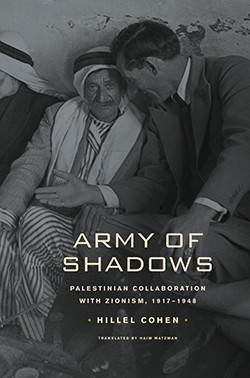 By Daniel Pipes Palestinians have so loudly and for so long (nearly a century) rejected Zionism that the Mufti Amin al-Husseini, Yasir Arafat, and Hamas may appear to command unanimous Palestinian support. But no: polling research finds that a substantial minority of Palestinians, about 20 percent, is ready to live side-by-side with a sovereign Jewish state. Although this minority has never been in charge and its voice has always been buried under rejectionist bluster, Hillel Cohen of the Hebrew University of Jerusalem has uncovered its surprisingly crucial role in history. He explores this subject in the pre-state period in Army of Shadows: Palestinian Collaboration with Zionism, 1917–1948 (translated by Haim Watzman, University of California Press); then, the same author, translator, and press are currently preparing a sequel, Good Arabs: The Israeli Security Agencies and the Israeli Arabs, 1948–1967, for publication in 2010. In Army of Shadows, Cohen demonstrates the many roles that accommodating Palestinians played for the Yishuv, the pre-state Jewish community in the Holy Land. They provided labor, engaged in commerce, sold land, sold arms, handed over state assets, provided intelligence about enemy forces, spread rumors and dissension, convinced fellow Palestinians to surrender, fought the Yishuv's enemies, and even operated behind enemy lines. So great was their cumulative assistance, one wonders if the State of Israel could have come into existence without their contribution. Read more ...Source: FrontPage Magazine
 Lost in the blur of slogansBy Ishmael Khaldi Last year, at UC Berkeley, I had the opportunity to "dialogue" with some of the organizers of these events. My perspective is unique, both as the vice consul for Israel in San Francisco, and as a Bedouin and the highest-ranking Muslim representing the Israel in the United States. I was born into a Bedouin tribe in Northern Israel, one of 11 children, and began life as shepherd living in our family tent. I went on to serve in the Israeli border police, and later earned a master's degree in political science from Tel Aviv University before joining the Israel Foreign Ministry. I am a proud Israeli - along with many other non-Jewish Israelis such as Druze, Bahai, Bedouin, Christians and Muslims, who live in one of the most culturally diversified societies and the only true democracy in the Middle East. Like America, Israeli society is far from perfect, but let us deals honestly. By any yardstick you choose - educational opportunity, economic development, women and gay's rights, freedom of speech and assembly, legislative representation - Israel's minorities fare far better than any other country in the Middle East So, I would like to share the following with organizers of Israel Apartheid week, for those of them who are open to dialogue and not blinded by a hateful ideology: You are part of the problem, not part of the solution: If you are really idealistic and committed to a better world, stop with the false rhetoric. We need moderate people to come together in good faith to help find the path to relieve the human suffering on both sides of the Israel-Palestinian conflict. Vilification and false labeling is a blind alley that is unjust and takes us nowhere. You deny Israel the fundamental right of every society to defend itself: You condemn Israel for building a security barrier to protect its citizens from suicide bombers and for striking at buildings from which missiles are launched at its cities - but you never offer an alternative. Aren't you practicing yourself a deep form of racism by denying an entire society the right to defend itself? Your criticism is willfully hypocritical: Do Israel's Arab citizens suffer from disadvantage? You better believe it. Do African Americans 10 minutes from the Berkeley campus suffer from disadvantage - you better believe it, too. So should we launch a Berkeley Apartheid Week, or should we seek real ways to better our societies and make opportunity more available. You are betraying the moderate Muslims and Jews who are working to achieve peace: Your radicalism is undermining the forces for peace in Israel and in the Palestinian territories. We are working hard to move toward a peace agreement that recognizes the legitimate rights of both Israel and the Palestinian people, and you are tearing down by falsely vilifying one side. To the organizers of Israel Apartheid Week I would like to say: If Israel were an apartheid state, I would not have been appointed here, nor would I have chosen to take upon myself this duty. There are many Arabs, both within Israel and in the Palestinian territories who have taken great courage to walk the path of peace. You should stand with us, rather than against us. Ishmael Khaldi is deputy consul general of Israel for the Pacific Northwest. Source: Tundra Tabloids Ishmael Khaldi
Latest recipient of The MASH Award

 By Ali Zahalka The Arab-Israeli leadership is increasing pushing us into anti-Israel radicalism. This extremism climaxed with the “Death to the Jews” chants during Operation Cast Lead. Here is what I have to say to those leaders: Look at what you’ve done. We did not cry out in the face of rocket attacks on southern residents that went on for years. We did not cry out in the face of the suffering of our brethren, Gaza residents, who have been brutally repressed by Hamas. Yet we cried out, of all things, in the face of an onslaught against the most radical element in the Arab world. The Arab-Israeli leadership won’t connect, heaven forbid, to the moderate Arab elements such as Egypt, Mahmoud Abbas’ Palestinian Authority, or Jordan. These are of no interest to it. We saw Azmi Bishara, who left, and we saw where he went to. I don’t need to explain what Hamas is all about. The Egyptians and Palestinian Authority officials are doing it better than me. They ask Hamas how it can talk about victory when the war against Israel – which it sought and advanced – was managed on the backs and blood of thousands of Palestinians that were killed, wounded, or lost their property, while Hamas’ leadership stayed at fortified bunkers or in Damascus. Read more ...Source: Y Net News
 Jason Koutsoukis Herald Correspondent in Ramla | December 6, 2008
THE Abu Ghanem clan has lost another one of its women, the 10th in eight years to be killed for supposedly breaching the family's "honour".
The latest victim is Dalia Abu Ghanem, a 16-year-old mother of one, who vanished several weeks ago after an argument with her family.
It's the most recent in a horrific series of "honour killings" that has infested the Abu Ghanem clan of Juarish, an Arab neighbourhood on the outskirts of Ramla, a blue-collar city of 64,000 south of Tel Aviv.
"A few days after the argument, we received a tip-off, anonymously, that she was missing," Israel Police superintendent Shlomi Sagi told the Herald.
"Immediately, we were afraid because of the family history," he said.
Last week, Sagi said, police picked up Dalia's brother, Mahmoud Abu Ghanem, in Rahat, a city near Gaza in Israel's south. "He told us he was looking for work there. His sister is missing and he goes away to look for work? We arrested him."
Although a body has still not been found, in a court appearance on Monday police formally charged Mahmoud with his sister's murder. He was remanded in custody.
A look into the bloody history of the Abu Ghanem family and it seems like escape was never an option for Dalia.
In 2000, her mother Naifa was the victim of an honour killing, and in 2006 her sister Shirihan bled to death after her throat was slashed.
Dalia also watched as six of her cousins were gunned down, strangled and stabbed for "crimes" as trivial as talking to another man on the telephone.
Further unhappiness was forced upon Dalia when, at the age of 14, shortly after her sister's murder, she was forced by her father to marry a man she barely knew, against her will.
Three months ago she gave birth to a daughter, but motherhood was an experience she had to endure alone as her husband is serving a prison sentence.
At various times during her marriage, Dalia had sought refuge in shelters for battered women, after she had endured beatings and several murder threats.
"But she chose to go back to her family's neighbourhood, as other local women did and were then attacked," a police prosecutor told the Ramla Magistrates Court on Monday.
As recently as March this year, 40-year-old Sara Abu Ghanem sustained light injuries to her head and neck when several unidentified men opened fire at her on her way to work.
Sara had recently divorced her Palestinian husband and wished to make official her relationship with a local Jewish man, a fact that had outraged the family.
So-called honour killings number about 10 a year among Israel's 1.5 million-strong, mostly Muslim Arab population.
"Dalia was a quiet girl, who rarely spoke to me," says Omar al-Omar, a senior organiser at the Juarish Community Centre who knew Dalia well and had taught her gymnastics and folk dancing. "This is a family ruled by fear and you can see it in the faces of the Abu Ghanem women. They grow up with this huge weight on their shoulders," al-Omar says.
Al-Omar says economic hardship and lack of education are likely reasons why the Abu Ghanem clan, which numbers about 2000 people in Juarish, has bred such a culture of violence. "There are a lot of social problems in this family. They pull the girls out of school at age 12 and force them to get married, stop them getting educated, stop them getting out. It's a cycle that goes around and around. It's an epidemic here."
On the streets of Juarish, several people approached by the Herald walked away when approached to talk about Dalia's disappearance.
"When she first disappeared, the kids who come here to the community centre never talked about it with words, they talked about it with pictures that they drew for each other in school. Everyone knows right away that she is killed," al-Omar says.
"It shows how deeply this affected the culture here, where the 'honour killing' is an epidemic, but where no one can talk openly about."
This culture of silence is something that Israeli police have struggled to break as they tried to solve the murders, most of which remain unsolved.
But in January 2006, things started to change after 18-year-old Hamda Abu Ghanem was shot nine times while she lay in her bed. Instead of maintaining the usual wall of silence, the Abu Ghanem women opened up, with police gathering testimony from 20 female witnesses.
Hamda had refused to marry a man she had been promised to, it was revealed. She also talked too much on the telephone and had once been spotted talking to a male cousin. Convictions were eventually secured against several relatives, including her brothers Rashad and Kalil Abu Ghanem.
Convictions against another four Abu Ghanem brothers were also secured over the murder of their 19-year-old sister Reem, who was strangled to death in March 2006.
One of the brothers, Suleiman Abu Ghanem, a respected physician at a local hospital, had conspired in the murder by supplying sleeping tablets to his brothers and instructing them on how to sedate her.
Once asleep, Reem was wrapped in a blanket, placed in the boot of a car and driven to a local field. She awoke and pleaded for her life with her brothers. They tried to convince her that she had disgraced the family's honour because she had refused to marry the man she had been promised to and had instead ran away from home to be with another man she had fallen in love with. They then suffocated her and dumped her body in a nearby well.
"These convictions show that things are changing slowly," Sagi said. "We hope we can continue to get people to talk, especially in this latest case."
Meanwhile, says al-Omar, whose work on the ground in Juarish provides a crucial link to the world outside the Abu Ghanem clan, there are small signs of change.
"In my folk dancing class now, I have nine Abu Ghanem women. Ten years ago this would never have happened. It means they are getting bolder. I am hoping it will continue." Source: Sydney Morning Herald
Department fears for life of 16-year-old girl who went missing several weeks ago, say two other women in her family were victims on such slayingsEli Senyor Deadly coincidence? The police are investigating the possibility that three women in the same family have been the victims of "honor killings." According to police suspicions, Naifa and Sharin Abu-Ganem were both killed by relatives in the past few years, for supposedly dishonoring the family name. Police now fear that Naifa's 16-year-old daughter, who disappeared a few weeks ago, may have met a similar fate. Read more ... Source: Ynet News
By Ramzy Baroud In a recent conference, I was faced with a recurring question: Will there be a third Palestinian uprising? Although seemingly uncomplicated, the question is loaded, and exceptionally important. I rushed through the answer, knowing fully that one cannot address such a multilayered query in two minutes or less. A “third uprising” implies that the second uprising has already folded. But has it? Or did it simply lose momentum, sense of focus and direction, or were its energies squandered — as a popular uprising — on factional disputes and internal division? Surely some of the visible leaders in guiding the uprising, or intifada, in its initial stages are no longer involved in the current stage. One cannot simply speak of one cohesive intifada if many of the players have switched sides or changed roles, or are absent altogether. To approach this subject more practically, the first intifada, that of 1987, would too have to be scrutinized, and thoroughly so. Read more ...Source: Arab News
Abraham Rabinovich, Acre, Israel | October 11, 2008
A CAR driven through a Jewish neighbourhood in this city by an Israeli Arab on Yom Kippur, the Jews' holiest day, touched off the worst Jewish-Arab rioting inside Israel since the outbreak of the Palestinian intifada eight years ago.
Hundreds of residents of this ethnically mixed city clashed for two successive nights, leading to fears that similar rioting might spread to other parts of the country. Police poured reinforcements into Acre and Prime Minister Ehud Olmert issued a call for restraint by both sides. "We must safeguard the ability to live together in mixed cities," he said.
On Yom Kippur, the Jews' day of fasting, cars are not driven on the streets of Jewish towns except for emergency vehicles. Even those Jews who do not spend the day in synagogue, as do the religiously observant, refrain from playing radios loudly or otherwise disturbing the silent solemnity of the day in public. Arabs traditionally show respect for the day by not driving into Jewish areas.
On Wednesday night (local time), however, an Arab resident of Acre, Taufik Jama, drove through a Jewish neighbourhood with his 18-year-old son and a friend of the son close to midnight. Jama said afterwards he was going to a relative's apartment across town to pick up his daughter. When he reached his destination, he said, he and his two passengers were attacked by Jewish youths and barely managed to escape.
A police spokesman, Chief Superintendent Eran Shaked, dismissed Jama's version. "This was a provocation," he said. "An Arab driver enters a Jewish neighbourhood on Yom Kippur with blaring music (on the car radio) and refuses to leave when asked to by local residents. We believe he was intoxicated." Jama denied that he had been playing the car radio.
Rumours that an Arab had been lynched reached the Arab quarters and hundreds of Arabs began marching towards the Jewish side of the city, smashing shop windows and car windows along the way. They were met by crowds of Jews and the two sides hurled rocks at each other while exchanging shouts of "Death to the Arabs" and "Death to the Jews" as police tried to intervene.
Police commanders met Arab leaders in an attempt to restore calm but rioting broke out again yesterday. Police used water cannon and teargas to pry the sides apart. Eight people were injured and several arrests were made.
The rioting was the worst inside Israel since September 2000, when 13 Israeli Arabs were shot dead as they blocked main roads and rioted in support of the Palestinian uprising in the West Bank and Gaza.
Right-wing Knesset member Esterina Tartman said yesterday the Acre riots justified demands to transfer some Arab areas inside Israel to an emergent Palestinian state in a territorial swap.
"The Arabs of Israel are the real threat to the state," she said. Arab Knesset member Ahmed Tibi termed the incident a "Jewish pogrom" against Arabs.
The ancient walled city at the heart of Acre, which contains significant remains from the Crusader period, is inhabited almost exclusively by Arabs, who constitute about one-third of the city's population. Jewish inhabitants live in new neighbourhoods outside the walls.
A four-day theatre festival, an annual feature that is one of the liveliest cultural events in Israel, is scheduled to be held next week inside Acre's old city. It is not clear now whether it will be in view of the ongoing tension. Source: The Australian
 |
|
|
Copyright Muslims Against Sharia 2008. All rights reserved.
E-mail: info AT ReformIslam.org
|
|
|


 Jewish Israelis oppose a Swiss-style ban on mosque minarets in the country, with opposition to the restriction highest among right-wing and haredi Jews, according to a poll conducted in late December and early January.


 Posts


