 BY JAMSHEED K. CHOKSY BY JAMSHEED K. CHOKSY As the fallout continues from the June election, Ahmadinejad is working to consolidate power in his secular executive branch, and away from the mullahs. But what happens if his play backfires? Taking advantage of the chaos following June's civic protests, Iranian President Mahmoud Ahmadinejad is moving to consolidate authority in the executive office -- and to wrest it away from the clerical wing of the Iranian government, particularly Supreme Leader Ayatollah Ali Khamenei. Following the 1979 Islamic Revolution, Iran's revolutionary leader, the late Ayatollah Ruhollah Khomeini, had established a guardianship of Islamic jurists headed by a supreme leader to oversee the executive, legislative, and judicial branches of Iran's government. Khamenei, who became supreme leader in 1989, was a mentor to Ahmadinejad and during June's protests, quickly endorsed his presidential candidacy to keep their relationship smooth. Although Ahmadinejad had begun centralizing authority during his first presidential term, he usually deferred to Khamenei if there was a divergence of opinion. But Ahmadinejad and his cohorts, junior members of the 1979 revolution who are just now coming into their own politically, are not themselves clerics. And though they claim deep religiosity, they are best described as secularists, as their primary aim is consolidating political power in their own hands. Since the recent election, members of the executive branch are openly disregarding revolutionary or activist mullahs -- knowing full well that most clerics are quietists who prefer not to be directly involved in politics. Even Ahmadinejad's famous incident of kissing Khamenei's shoulder or characterizing their relationship as "like that of a father and son" is just etiquette, not a sincere sign of deference. Ahmadinejad's secular political expansionism is made possible by the schisms and weaknesses that have emerged among fundamentalist clerics in the wake of this summer's election protests.
Most threatening for Iran's religious system of governance, the protesters' focus expanded from the rigged presidential election to the more basic question of why Iran needs a faith-based supreme leader.
The idea of cutting out the theocratic branch, while retaining the executive, legislative, and judicial ones, has gained considerable popularity. Read more here,,,, Source: Foreign Policy 
The lessons that Muslims must learn from the Iranian model: Islam is NOT the solution
Thursday, June 25, 2009 - posted by Dr. Tawfik Hamid
For decades the Muslim Brotherhood and its affiliated Islamic groups such as Hamas used the expression “Islam is the solution” as their slogan. They used it in a way to convince Muslims that Islam will bring solutions to all their problems. Many young Muslims became attracted to Islamism because they believed that using Islam in politics and implementing Sharia would bring a solution to the problems they face in their societies. The economic success of Saudi Arabia, which implements Sharia Law, and the success of early Muslims in building a huge powerful Islamic empire, were two powerful examples that attracted many of our young Muslims, myself included, to this “Islamic Solution”. Failure of many Islamic societies to succeed in several fields, including economic state, has fueled the feeling that adopting the Islamic solution is the only answer for our problems.
The Iranian Revolution was seen by many Muslims as a proof that Islam is the solution. On the contrary, the failure of the Iranian regime in bringing prosperity to its people can debunk this concept. The recent demonstrations against the Iranian regime are clear evidence that Islam is NOT the solution, as the government has not brought success and true justice to its people. not having brought success and true justice to its people.
The Muslim world also needs to look to other failures of the Islamic systems and regimes. Sharia laws have been implemented in Sudan, parts of Afghanistan and Pakistan, parts of Nigeria, and in Somalia. This has not brought wealth and prosperity to people as many Muslims expected. On the contrary it has brought poverty and misery to their populations. The best evidence for this is that we see tens of thousands of young Muslims applying to immigrate the West but we do not see many of them trying to immigrate to Somalia or Taliban-controlled areas!
The Muslim world must face the reality that Islamic and Sharia-based solutions for countries have failed to bring prosperity to people in most parts where they have been implemented. The media has a role to play in showing the failure of many Islamic systems in several parts of the world. The Muslim world must wake up from its dream that applying Sharia will solve all their problems and recognize the reality that “Islam is NOT the Solution”. Source: http://www.tawfikhamid.com/ The Silent Holocaust: Why Humanity Must Achieve Victory over Islam
by Azam Kamguian What I am going to talk about is Islam; contemporary Islam in Iran. I will describe some episodes of Islamic carnage and pass you briefly through what happened and still is happening in Iran. I will talk about those who have nurtured Islamic movements or have tried to justify Islam. I will conclude by emphasizing the urgency of achieving the victory of humanity over Islam and the practical steps that should be taken to achieve this.
The final decades of the 20th century witnessed another Holocaust - an Islamic one, in which millions have been and continue to be shot, decapitated and stoned to death; in which people have been slaughtered and displaced by Islamic states, political Islamic movements and Islamic terrorists in Iran, the Sudan, Afghanistan, Algeria, Egypt, Nigeria, Central Asia, and now in America. The robe, turban and Koran continue to victimize people. Any voice of dissent or freedom has been silenced on the spot. The oppression maintained by Islamic movements primarily takes the form of opposition to the freedom of women, by crushing women's civil liberties, by curtailing freedom of expression in the cultural and personal domains, by enforcing brutal laws and traditions, and by the mass killing of people from young children to the elderly.
Essentially, Islam is a set of beliefs and rules that militate against human prosperity, happiness, welfare, freedom, equality and knowledge. Islam and a full human life are contradictory concepts, opposed to each other. Islam under any kind of interpretation is and always has been a strong force against secularism, modernism, egalitarianism and women's rights. Political Islam, however, is a political movement that has come to the fore against secular and progressive movements for liberation, and against cultural and intellectual advances. Violence and disregard for human dignity are inherent in the manifestos of political Islamic groups.
“The very statement that an Islamic republic exists somewhere means that brutal violence exists within it.”
After political Islam took power in Iran, creating an Islamic Republic, this movement came out of the margins in other Middle Eastern countries. It was in Iran that political Islam first organised itself into a government and thus turned into a considerable force in the region. In Iran, under an Islamic state, violence has had another dimension: one that is based on Islam. The very statement that an Islamic Republic exists somewhere means that brutal violence exists in it. The mere fact that people are forced to abide by laws based on something some god is believed to have said somewhere, or that some prophet has said, itself represents a form of violence. If anyone protests against such laws, they are subject to punishment and suppression. Islam means the worst and the most ferocious kind of violence. Iran is the most transparent picture of what Islam is capable of. I will try to pass you briefly through this period of violence, atrocities, and misogyny - a bloodbath committed by Islam in power.
In Iran, I lived through thousands of days when Islam shed blood. Since 1979, a hundred thousand men, women and children have been executed in the name of Allah. I have lived through days when I, along with thousands of men and women throughout the country, looked for the names of our lovers, husbands, wives, friends, daughters, sons, colleagues and students in newspapers which daily announced the names of the executed. Days when the soldiers of Allah attacked bookstores and publishing houses and burned books. Days of armed attacks on universities, killing students all over the country. Weeks and months of bloody attacks on workers' strikes and demonstrations. Years of assassination of opponents inside and outside Iran. Years of suppression and brutal murder of atheists, freethinkers, socialists, trade union leaders and activists, Marxists, Bahais, women who resisted the misery of hijab and the rule of sexual apartheid, and many others who were none of these, who were arrested in the streets and then executed simply because of their innocent non-Islamic appearance. And to the hundred thousand murdered in Iran must be added the millions who have died in Algeria, the Sudan, Afghanistan, Pakistan and elsewhere. A silent holocaust about which the civilised world does nothing.
I, along with thousands of political prisoners, was tortured by order of the representative of Allah and Sharia; tortured, while the verses of the Koran about nonbelievers were played in the torture chambers. The voice reading the Koran was mixed with our cries of pain from lashes and other brutal forms of torture. They raped women political prisoners for the sake of Allah and in expectation of his reward. They prayed before raping them. Thousands were shot to death by execution squads while Koranic verses were recited. Prisoners were awakened every day at dawn to the sound of gunshots aimed at their friends and cellmates. From the numbers of shots you could work out how many had been murdered that day. The killing machine did not stop for a minute. The fathers and mothers, husbands and wives who received the bloody clothes of their loved ones had to pay for the bullets. They created an Islamic Auschwitz. Many of the best, the most passionate and progressive people were massacred. The dimensions of the horror are beyond imagining.
From that time, love, happiness, smiling, any free human interaction was forbidden. Islam took over completely. This is what happened to my generation. But it was not limited only to my generation, It had bloody consequences for our parents’ generation and for the next generation. During those years, millions of children were brainwashed and manipulated. The crimes committed by the Islamic Republic of Iran and political Islam in the region are comparable to the crimes committed by Fascism in the 1930s and early 1940s, and to the genocide in Rwanda and Indonesia.
Yet these are events that humanity around the world has been largely unaware of. A Holocaust which, if humanity knew of its dimensions and intensity, would certainly cause it to weep. With the downfall of such regimes, the world will finally be given an opportunity to know the truth - victims will speak out, prisons and torture chambers will be exposed, torturers will make heart-wrenching confessions, Islamic prosecutors and judges will reveal what they did to their victims behind prison walls. Then people all over the world will see what a despicable phenomenon Islam is. They will finally find out the truth about those governments that backed the Islamic movements and the Western mainstream media that deliberately blocked people's access to the truth.
The aftermath of September 11 exposed some of the reality of what is happening to people living under the constant terror of Islam. It exposed something of the tragedy that befell women under the Taliban. It revealed, to some extent, the true substance of Islam. But it became plain to see that this carnage is Islamic. It became evident that it is all about Islam.
When I came to the West in the beginning of the 1990s, I was faced by the fact that the majority of intellectuals, the mainstream media, the academic world, and many feminists, in the name of respecting other cultures and religions, were trying to justify Islam by dividing it into fundamentalist and moderate, progressive and reactionary, Medina's and Mecca's, folksy and non-folksy, poisonous and edible. For people like me, first-hand victims of the Islamic Holocaust, it was suffocating to listen to and to have to refute endless tales to justify this terror, atrocity and misogyny. Parallel to this Islamic carnage, apologists for Islam try to divert people's righteous loathing for Islam and for the political Islamic movement, to limit it to a hatred of fundamentalism'. They attempt to reduce the anti-Islamic struggle to anti-fundamentalism. They keep telling us that what we loathe is fundamentalism, not the 'true', the 'real' Islam. They pledge 'reform in Islam' and the application of a 'positive interpretation of the Koran' to women's rights by ‘linguistic turn’. They raise the idea of Islamic feminism and try to attach a human face to the monstrous face of Islam against women.
“The rights of freedom of expression, equality of men and women, and a secular state apply to people in the 'Third World' too. Isn't it shameful that we have to argue about it?”
The truth should be spoken. We shouldn't let apologists for Islam play with people's lives any more. We should say clearly and loudly that it is all about Islam. What we have seen is the reality of Islam in power. The fact is that Western liberal and left-wing intellectuals feel guilty about past colonial history and are apologetic to the ‘Third World’. They consider the 'Third World' a given entity, where people are keen to suffer under the rotten rules of Islam, where people are happy to be deprived of the achievements of human civilization in the 21st century. According to them, women desire sexual apartheid, girls love to be segregated from boys, and people hate civil rights and individual freedom. In their view, people are the allies of Islamic movements and Islamic governments. This is indeed a distorted image of the realities. This is an inverted colonialism. In this picture, people who are fighting for civil rights, secularism and against political Islam do not exist. This self-centered mentality in which everything should revolve around the guilt of Western pseudo-intellectuals is appalling. The rights of freedom of expression, equality of men and women, and a secular state apply to people in the 'Third World' too. Isn't it shameful that we have to argue about it?
Contrary to this view, there is a fight going on - and it has been going on for over 20 years - between progressive movements in the Middle East and in the West on the one side, and political Islam on the other. The records of the daily struggle of people and the non-Islamic opposition in Islam-ridden countries, and the news of the daily resistance of the youth and women in Iran, demonstrate the reality of peoples' demands in the 'Third World'. Since 1979, Iranian society has changed dramatically and deeply. The movement for secularism and atheism, for modern ideas and culture, for individual freedom, for women's liberation and civil liberties has been widespread and deep. Disgust for religion and the backward culture of those in power is immense.
Secularism must be defended actively and resolutely in Islam - ridden countries. Universal human and civil rights must be the standard. Secularism is not only realizable, but also, after the experiences of Iran, Afghanistan, the Sudan and Algeria, is an urgent and pressing need and demand of the people of the region. The demand for secularism must push for absolute and complete separation of religion from the State; complete separation of religion from education; freedom of religion and atheism; laws free of religious content; and for religion to be declared the private affair of individuals. A conscious struggle must be conducted against the power of organised religion. All religious denominations and sects should be officially registered as private enterprises, subject to regulations and laws.
To realise these ideals and demands, we need a massive joint force. Despite the struggles of the non-Islamic opposition in the Middle East and in the West in the past decades, all that has been visible has been occasional reports of the barbarity of political Islam and the reactions of Western governments, media and 'intellectual' apologists for Islam. But, there is a third force, a sleeping giant who can turn the situation around. If this giant awakes, this era could see the beginning of positive changes and the realisation of ideals that were almost abandoned during the final decades of the 20th century. Humanity must rise up and defend itself against the barbarity of Islam.
The ranks of civilised humanity form a massive force that has, so far, sadly been silenced. It can come to the fore. For the future of humanity, it must come to the fore. If there is to be a future, it is in the formation of an active, progressive and freedom-loving policy at the forefront of the ranks of the people. Otherwise, the stage is left open to terrorism and barbarism. I finish my speech with the hope that in the coming years of the 21st century, we will witness the victory of humanity, of humanism, over Islam. All freedom-lovers and secularist forces around the world should come together in a joint effort to combat political Islam; to promote secularism, egalitarianism and freedom, in the societies that Islam oppresses.
Adapted from the speech delivered at the session on Humanism and Islam at the IHEU World Congress 2002. [Email: azam_kamguian@yahoo.com ] Source: http://www.centerforinquiry.net/isis/islamic_viewpoints/the_silent_holocaust_why_humanity_must_achieve_victory_over_islam/
 The official French umbrella group for Muslims, the French Council of the Muslim Faith (CFCM) is angry that the Sarkozy Government appears to be encouraging the formation of a rival secular representative body. The CFCM was originally set up in 2003 by President Nicolas Sarkozy when he was interior minister. The intention was to give a representative voice to the estimated six or seven million French Muslims. But now the CFCM thinks that Sarkozy considers them too powerful and influential and is seeking to establish the rival organisation to act as a curb. Malika Belarabi, an Algerian-born deputy governor of Seine-Saint-Denis district in Paris, who is one of the leading lights behind the plans for a secular Muslim council says that it is well advanced. Previous efforts to establish such a council have failed, but Belarabi is convinced that this time it will get off the ground. “The idea is to bring together all Arab and Muslim groups of secular nature within one framework,” he said. “The goal is to set up a body similar to the one which represents secular French Jews; Council of French Jewish Institutions (CRIF).” Read more ...Source: National Secular Society
Results of recent local elections strongly indicate that Iraqis have made a giant leap forward in political sophistication.By Amir Taheri With the results of Iraq's latest elections nearly complete, it's clear that the nation has taken another major step toward lasting democratization. A robust campaign - more than 14,000 candidates and 400-plus political parties and alliances competing for 440 seats in the provincial assemblies - gave Iraqis the widest possible choice of personalities and policies. The election concerned 14 of Iraq's 18 provinces and more than 80 percent of the electorate. (The three Kurdish provinces will hold their elections later this year. Another state, oil-rich Kirkuk, was left out because of unresolved problems regarding its ethnic composition.) Read more ... Source: Family Security Matters
 Correspondents in Baghdad February 03
IRAQI voters have punished religious-leaning parties blamed for stoking sectarian violence, and rewarded secular parties seen as capable of holding the nation together, important shifts that will be welcomed in Washington and scorned in Tehran.
The biggest Shia party in Iraq once appeared to hold all the political sway: control of the heartland, the backing of influential clerics and a foot in the Government with ambitions to take full control.
But the days of wide-open horizons could be ending for the Supreme Islamic Iraqi Council, as the signs began to take shape yesterday with hints of the voter mood from provincial elections.
The broad message - built on Iraqi media projections and post-election interviews - was that the eventual results would punish religious-leaning factions such as the Supreme Council that are blamed for stoking sectarian violence, and reward Prime Minister Nouri al-Maliki and several secular parties.
The early returns show Mr Maliki could be strengthened in his dealings with parliament before national elections to be held by next year.
His Dawa Party drew strong support in Basra and Baghdad, two of Iraq's largest and most politically important provinces, according to political parties and election officials.
The outcome of the provincial polls will not directly affect Iraq's national policies or its balance between Washington's global power and Iran's regional muscle. But Shia political trends are critically important in Iraq, where the majority Shi'ites hold sway after the fall of Saddam Hussein's Sunni-dominated regime.
"There is a backlash from Iraqis against sectarian and religious politics," said Mustafa al-Ani, an Iraqi political analyst based in Dubai. "The voting gave us an indication of what will happen in the general election."
Although official results from the weekend's provincial elections are still days away, the early outlines are humbling for the Supreme Council. The group had been considered a linchpin in Iraqi politics as a junior partner in the government that had political control in the Shia south.
But forecasts point to widespread losses for the party across the main Shia provinces. The setbacks could include embarrassing stumbles in the key city of Basra and the spiritual centre of Najaf, hailed as the future capital in the Supreme Council's dreams for an autonomous Shia enclave.
The big election winners appear to be allies of Mr Maliki - a vivid lesson in Iraq's fluid politics.
A year ago, Mr Maliki looked to be sinking. Shia militiamen ruled cities such as Basra and parts of Baghdad, and rockets were hitting the protected Green Zone, which includes the US embassy and Iraq's parliament.
Mr Maliki - with apparent little advance co-ordination with the US - struck back. An offensive broke the militia control in Basra and elsewhere in the south, enhancing his reputation.
And many voters appeared happy to reward his political backers with seats on provincial councils, which carry significant clout with authority over local business contracts, jobs and local security forces.
"Al-Maliki ended the militiamen's reign of terror," said Faisal Hamadi, 58, after voting in Basra. "For this he deserves our vote."
The Supreme Council appeared to stagger under the weight of negative baggage.
It was accused of failing to deliver improvements to public services in the south. And its strong ties to Iran began to offend Iraqis' nationalist sentiments.
Its leader, Abdul Aziz al-Hakim, spent decades in Iran during Saddam's rule, and was allowed an office-villa in Tehran. After Saddam's fall, the Supreme Council was Iran's main political conduit into Iraq, although it also developed ties with the US.
Iran now could face limits on its influence in the south, with the Supreme Council forced into a coalition or second-tier status - and confront resistance from a stronger Maliki Government seeking to curb Tehran's inroads. Source: The Australian
 Liberal Author Dr. Shaker Al-Nabulsi: Secularism Will Triumph in the Arab World; Terrorism's Crimes Are 'The Death Struggle of Fundamentalism'On May 15, 2008, the liberal Arab website Aafaq.org published an interview with prominent Jordanian-American liberal author Dr. Shaker Al-Nabulsi. In the interview, Al-Nabulsi discussed the meaning of secularism and its importance to the future of the Arab world. The following are excerpts from the interview: "'Secularism'... [Is] In the Interest of Religion - To Keep the Sacred (Religion) Apart from the Profane (Politics)"Interviewer: "What is your concept of secularism?" Nabulsi: "'Secularism' means the separation of religion from the state, excluding the clergy from politics, and not permitting religious political parties. These measures are all in the interest of religion, to keep the sacred - religion - apart from the profane - politics. "This is because when, throughout the ages, politics made use of religion, the joining of religion and politics was to religion's detriment. Politics gained, and religion lost. And likewise, this separation [exists] in order to hold the politician accountable for his political activity, and not [let him] take refuge under the umbrella of religion to avoid accountability and punishment. It is difficult to oppose or hold to account the clergy who combine religion and politics. "In fact, the separation of religion from politics is easier for the Shi'a than for the Sunnis. Shi'ite institutions evolved like the Church, and the Shi'ite hierarchy resembled the ecclesiastical hierarchy, so that both hierarchies remained separate from the state. Read more ... Source: MEMRIDr. Shaker Al-Nabulsi
Latest recipient of The MASH Award

 By Supna Zaidi
The liberal-conservative divide has worsened since 9/11 to a point where each side is having a different conversation over the other's head, preventing Americans from coming together to defend democracy against the "enemy" in the "war on terror."
A possible explanation comes in the form of Herb London's book, "America's Secular Challenge - The Rise of a New National Religion." He is the president of the Hudson Institute, a conservative think tank located in New York. In this work, London argues that western secularism has evolved to such an extreme form that it cannot fight militant Islam because it no longer knows what it stands for. By stretching the purpose and meaning of multiculturalism, and tolerance to a point where "anything goes" anti-democratic sentiment is applauded as diversity even though it threatens secularism itself.
Multiculturalism was once an appreciation for everyone's differences in society, especially minority groups. It has morphed into an assumption "that non Western cultures are somehow more equal, more worthy, than their Western counterparts. This Orwellian phenomenon preaches the gospel of equality, but proceeds as much from self-loathing as from egalitarianism." In other words, the West is embarrassed of its historically dominant role around the world. This has mistakenly given anti-western movements, like Islamism, the green light to spread their divisive message in their home countries and among their immigrant populations in the West without scrutiny.
This has resulted in a tolerance that "has degenerated into an unwillingness to discriminate. According to this anesthetic philosophy, right and wrong are archaic concepts that belong to the ash heap of history. What counts is 'openness', that perversion of tolerance that, as Allan Bloom observed in The Closing of the American Mind, is indistinguishable from indifference." Such indifference chips away at secularism itself. Supremacist ideologies like Islamism are allowed to use democratic institutions to grow and gain influence with the hopes of gaining enough voter support (via conversion and lobbying) to replace the very secularism that gave it a home and protected it under the U.S. Constitution.
Lastly, the decay of religion in favor of the "other" - any "new age" or spiritual" outlook has allowed secularists to forget its own origins in Judeo-Christian principles. This allows radical secularism to deride its parentage and further, fail to defend it against a religious ideology that specifically wants to replace other ideologies, including radical secularism wherever it can.
American secularism was meant to be neutral in its position on religion, but in a post-religious society, it looks down on individuals that actually practice their faith. This tendency prevents secularists from accepting that foreign religious movements could actually be sincere and truly rooted in religious sentiment.
Consider the statement, "Palestinian mothers love their children too." That was the answer an audience member received on November 10th, at the Anti-Defamation League's 10th Annual Conference on the Middle East, to a question regarding the connection between education and the indoctrination of Palestinian children into suicide bombers.
Shibley Telhami gave that odd answer. Odd, precisely because no one doubts the love Palestinian parents have for their children. It is this knowledge that demands an explanation as to why they still permit their children to be indoctrinated into violently killing themselves for a cause they cannot possibly have the emotional and intellectual maturity to understand, let alone "volunteer" for.
Secularists like Telhami argue that religion is simply the "rhetoric" behind socio-political, foreign policy or domestic frustrations of men and women in the Middle East.
Unfortunately, as London reminds his readers, this completely ignores the sincerity of the Islamist movement, which has been growing since the early 1900s in the Middle East with subversive "brother" organizations in the West. Islamists like Hamas, Hezbollah and the Muslim Brotherhood advocate a separatist interpretation of political Islam as an ideology that divides global society into Muslim versus non-Muslim as an answer to the social, economic and political problems in the Muslim world. Quoting, a Hamas leader, London states, "It is hard for someone raised on university banalities [speaking on anti-American remarks after 9/11 at NYU] to believe that Hamas leader Sheik Hasan Josef can possibly be serious when he says 'We like to grow [Islamic martyrs] from kindergarten through college.'"
Though, they are by no means the majority of Muslims, Islamists offer leadership counter to autocratic governments who do not provide much needed social and civil services, leaving their respective citizenry vulnerable to the religious Islamist message. The material needs of Muslim populations have allowed real Islamist indoctrination to succeed where secular democracy or socialist movements have failed.
In pondering the dilemma of the West's failure to understand Islamism, and its consequent inability to create meaningful policy against it, London argues for the reassertion of Judeo-Christian values, which found the humane secularism that has been lost under radical secularism.
But what are Judeo-Christian values? I concede that when I first read London's book, I took his words as a literal call to reassert the Judeo-Christian faiths. This is one element of London's otherwise, strong argument that a reader might need more explanation of. London is not arguing for Americans to become evangelical and get on the crusader bandwagon. Rather, he wants Americans to respect the role of religion in society. Realize that it has been the evolution of multiple interpretations of God and faith in the US that forced Americans to seek overriding common principles to bring us together rather then keep us apart.
A simple internet search of the phrase "Judeo-Christian" offers some interesting background. The Oxford dictionary puts the origins of the phrase as early as the 1800s. With the rise of anti-semitism in the 1920s and 1930s the phrase reemerged as a way to unify Jews and Christians as Americans arguing that tolerance, equality and liberty were principles common to both faiths and inherent in the founding of American democracy as well. Today, the phrase, as London can attest to, evokes not these unifying themes, but an evangelical conservative paradigm that excludes all "others" by liberals.
It is important for liberals and conservatives alike to read Herb London's book, "America's Secular Challenge - The Rise of a New National Religion" to understand that we need a unifying civic culture or "religion" capable of unifying the diversity that makes America a country everyone wants to be a part of. Otherwise, we will continue to mistakenly allow divisive and separatist ideologies like Islamism to flourish within our own borders to the detriment of all democrats, especially radical secularists. Source: Muslim World Today
 Dear Jalal,
Let us stop talking and start working.
Here is my proposal: Are the following American Muslims on this list willing to write an Open Letter to Barack Obama asking him to stop flirting with ISNA and CAIR or they will stop supporting him.
Jalal Zuberi
Rafi Aamer
Hummyun Mirza
Aamir Riaz
If you are willing to sign a letter to Obama, we have the foundation of an all-American MCC-type secular Muslim organization. The least the four of you can do is to reply to this message.
As far as the people you mentioned in your message, they are all in it for their INDIVIDUAL careers and fame, and I do not mean that in a negative way. This is a disease that has afflicted many bright Muslim secularists. They only prefer to fly solo, not in formation. Formation flying requires caring and wrrying for your wingman and the other planes, while solo flying like Gary Powers is a great thrill, until one gets shot down.
What Irshad Manji, Eteraz and Mona do not realize is that solo flyers rarely leave the people on the ground in awe or moved, while formation flights do exactly the opposite. Hence, even though we are individually not as glistening as the star performers of the USA, we in the MCC have moved mountains.
In a few months we will have MCC type orgs in Holland, France and Germany as well as UK and Denmark. It would be a pity if we cannot do this in US.
So please do let me know if you are prepared to affix your signatures on this open letter. If not, that is OK, but please do lend me the courtesy of a response, an affirmation or a regret.
BTW, I’ll be back in Toronto on Saturday morning. I can tell you folks that the MCC is seen among European Secular Muslims as a role model. We have a huge fight to win and so please lend your leadership your shoulder to carry the weight and at times to cry on, please.
Tarek Source: Shariah Finance Watch
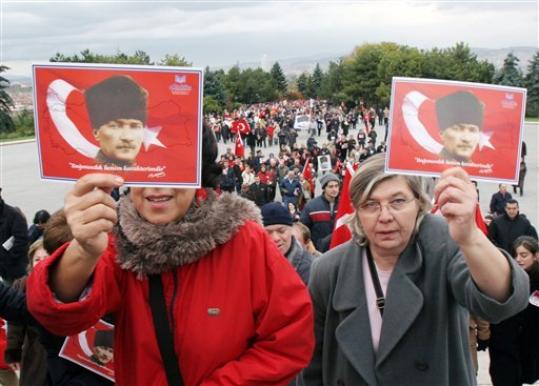 Turkish women protesting shariah laws and headscrafs Turkish women protesting shariah laws and headscrafsOzer Aksoy *VP of The Turkish World Congress, 821 United Nations Plaza, New York, NY USA* Headscarf is more than a piece of cloth: Pinned carefully to conceal the neck, throat and hair, Islamic headscarf has become the unmistakable symbol of political Islam. This is why secular people have been insisting on keeping it out of the universities and government institutions, as the secular laws require. I read Mark Mackinnon's article "Traditional head scarf unveils new rifts in Turkey" (Globe, July 22, 2008) with interest. There seems to be a chaos of concepts 'and I mean it in the nicest possible way' involving the dichotomies secularism and Islam, modern law and Islamic canon (Sharia,) the elites and the uneducated, the periphery and the center, black Turks and white Turks, old guard versus Islamic reformers, and more. I urge your readers to gain a deeper understanding of dichotomies before jumping into evaluating the recent issues about Turkey. Let’s see if I can shed some light on all this. Read more ...Source: Shariah Finance Watch
 E. Haldun Solmazturk At the heart of the political debate in Turkey lies the tension between Islam and secularism. Is the former democratic and the latter, at least in Turkey, autocratic? Ömer Taşpinar, a non-resident fellow at the Brookings Institute, recently argued this case in Foreign Affairs ("The Old Turks' Revolt," November/December 2007). His thesis is trendy in certain circles, but it is dishonest. He bases his argument on false assumptions, cherry-picks data, and ignores context. What results is not so much scholarship as propaganda. Taşpinar paints Turkish prime minister Recep Tayyip Erdoğan as a progressive, committed democrat, and enthusiastic about embracing Europe. The reality is more ambivalent. On September 2, 2004, for example, Erdoğan proposed making adultery a crime. When the European Union criticized this move, Erdoğan told them "to mind their own business," for they were not qualified to opine on such issues. On November 15, 2005, after the European Court of Human Rights decided against permitting head scarves in Turkish universities, he declared that "only ulama [Islamic religious scholars] could" make this decision. These episodes dismissing European consensus and institutions are well-known in Turkey and were featured on the front pages of major newspapers. Turkish commentators and editorialists discussed whether the prime minister's statements suggested that religious law guided Erdoğan as much if not more than secular law. Read more ...Source: The Middle East Quarterly
 By Soner Cagaptay The jailing of two retired Turkish generals over the weekend has heightened tensions between the government in Ankara and its critics. The generals are among 21 people whom police have detained over the past week, including a senior industrialist and a prominent journalist, on suspicion of plotting a coup against the ruling Justice and Development Party (AKP) government. Interestingly, the interrogations occurred as the chief prosecutor appeared before the constitutional court to make his case that the AKP be shut down for violating the state's official secularism. While this showdown immediately revived the cliché of the "real Turks" of the AKP fighting off the "secular elites," this is not a case of the pious, popular masses versus an irreligious intelligentsia. Both Turkeys in this power struggle are religious, both are wealthy, and both are equipped with powerful media and security assets. Still, the outcome will have a profound effect on Turkey's future direction. Read more ...Source: The Wall Street Journal H/T: Shariah Finance Watch
Largely underreported in Western media, a significant constitutional battle is taking place in Turkey these days. On March 14th 2008, the Chief Prosecutor filed suit in Constitutional Court demanding the closure of the incumbent AKP party. Read more ...Source: Dhimmi Watch
 |
|
|
Copyright Muslims Against Sharia 2008. All rights reserved.
E-mail: info AT ReformIslam.org
|
|
|


 BY JAMSHEED K. CHOKSY



 Posts
Posts


