When Bushra goes out, she wears the full niqab. It covers her face. She says it stops people staring. If they do catch a sight of her, the Pakistani woman has a story prepared. She tells them her injuries were caused by hot milk being spilled. It is not true. Bushra looks the way she does because of greed, because of anger, because of the evil in some people's hearts. Fifteen years ago, she went to the wedding of her brother. It was a happy occasion. There was music and laughter. When she returned to her husband, her in-laws demanded money.They told her it was tradition to bring money back after a wedding. They wanted 50,000 rupees – almost $600. She told them "I don't have that kind of money. My brothers don't have this kind of money either." It was not what they wanted to hear. They called her a liar. They beat her repeatedly. Then they tied her up. Her mother-in law grabbed her hair and yanked her head back. "I was terrified," said Bushra. Her voice quivers, remembering the moment. She gulps hard, chocking back the tears. "Then they put a cloth on a stick, soaked it in acid and her husband rubbed it over the side of my face". She remembers the pain, but this is not where her ordeal ended. "His uncle snatched the stick and rubbed it across the other side of my face. He forced open my mouth and dripped it on my tongue. It burned". Bushra does not remember what happened next. She passed out from the pain. She only knows what happened next from what people tell her. Her family tied her body to a ceiling fan and set the house on fire. They told people in the village on the outskirts of Lahore that Bushra had tried to commit suicide. But people did not just stand around. They burst their way into the house and grabbed her limp body. They took her to hospital. For a year, she stayed in hospital. She drifted in and out of consciousness. She could not see, could not open her eyes, but she could hear. And she heard people express their disgust at how she looked and run away. And those who stayed made her worried and tense. She went to live with her sister. When some of her family saw her they fainted. Her body was skinny, but her head was massive. She heard them say, "This is a woman but it doesn't look like a woman because she has no face". And she cried. That was fifteen years ago. Bushra has gone through 28 operations. "Slowly my face has got better" she tells me. "Maybe if they could fix my nose it would be better". She would like to be a beautician. And now she is training in a salon in Lahore. It is run by Musarat Misbah. This elegant, articulate woman decided to help Pakistan’s acid burns victims after a chance encounter five and a half years ago. A woman walked into her office late one evening and demanded her help. She asked her to return in the morning. "The woman was very insistent and said no, you must help me now. She removed her scarf and I saw a woman without a face. I saw a girl, there was no nose, eyes are gone, she had a contraction from his chin to her chest which meant she could not move her neck. And I sat down. There was no life in my legs. I asked her 'What happened?'" "She told me acid had been thrown at her by her own family members, her husband, her in-laws. She said she wanted me to help her look beautiful. And no make up could change her features or bring back the eyes, so I told her 'I will help you'". And Misbah did. Using her own money, she paid for surgery. Word spread and now, almost 400 women and girls have asked Misbah and her Smile Again Foundation for help. Doctors from Italy and the UK have given their services to help with medical treatment. And she tries to direct many of the women into jobs. "Employers say, 'We can't have someone who looks like that working in our place, it is too upsetting for everyone else', so I tell them - use them as telephone operators". Her pushiness and determination means 98 have found work. Each case brings new heartache, a story worse than the last. There is 17-year-old Naseera with her flawless skin and long blonde hair. He took revenge because she rejected his proposal. She says "It was like burning in hell." Acid burned through her upper body melting away the skin. Then there is Shamim who was verbally abused by a street gang. When she rejected their advances, they kidnapped her, raped her and poured acid on her face, trying to silence her forever. She was just 17. Bushra does not preach forgiveness. Her pain has been too long and too great. "People are cruel towards young girls and the innocent. Divorce is one thing. If someone does not get along with someone else then its fine, get a divorce and move on. "But to ruin someone's face, to set fire to someone or to pour acid on someone's face, people who do this, 20 or 25 of them should be hanged in public at once to strike fear into the hearts of people so that men realise that you cannot do this to a woman. "I've even learned how to drive so that if I see my husband walking on the street I can kill him with my car". There are no accurate figures for the number of acid attacks in Pakistan each year, but it is thought only a handful are actually reported to police. Even those cases are sometimes hard to pursue. Misbah tells me: "I took one girl who had been attacked to the police station. The first question the officer asked was 'What did you do to deserve this?'"’ She continues to try to help the victims, and also change the way of thinking. Al Jazeera
 The face-covering burqa and niqab veils worn by some Muslim women have no place in Denmark, Prime Minister Lars Loekke Rasmussen says, adding his government was considering restricting them. The face-covering burqa and niqab veils worn by some Muslim women have no place in Denmark, Prime Minister Lars Loekke Rasmussen says, adding his government was considering restricting them. Rasmussen stopped short, however, of calling for a ban on the veils, noting "legal and other limits". "The government's position is clear: the burqa and the niqab have no place in Danish society.
They symbolise a view of women and humanity that we totally oppose and that we want to combat in Danish society," Rasmussen told reporters on Tuesday. Denmark is "an open, democratic society where we look at the person to whom we are talking, whether it's in a classroom or on the job," he said. "That is why we don't want to see this garment in Danish society," he added. He said his centre-right government was "discussing ways of limiting the wearing" of the veils without violating the Scandinavian country's constitution. The prime minister's comments came a day after the publication of a report which showed that use of the burqa was "extremely rare" in Denmark, though no figures were given, and that the niqab was worn by "between 100 and 200" women. The report was commissioned by the social affairs ministry and written by researchers at the University of Copenhagen. It follows a heated debate on the burqa that has divided the two-party coalition government since the summer amid pressure from its key parliamentary ally the far-right Danish People's Party. Some 100,000 Muslim women live in Denmark, representing about 1.9 per cent of Denmark's total population of 5.5 million. Some 0.15 per cent of the Muslim women wear the niqab, according to the report. Denmark has had tense relations with the Muslim world following the publishing in 2005 of cartoons depicting Islam's Prophet Mohammed that were considered blasphemous and insulting by much of the Islamic world. It triggered violent protests in Muslim countries. SMH 
 The battle which began in Egypt in December over a ban on the niqab in universities continues, with female students opposing the measure by Higher Education Minister Hani Helal alternating defeat and victory.
As it had done on January 3 for 55 petitioners, on Saturday in Cairo the State Council Administrative Court once again sided with the ministry against the appeal filed by 17 students, though on Friday the Mansoura (Nile Delta) court instead sided with that by 42 others.
The Egyptian daily Al Masri Al Yom reported that the Mansoura judges issued their sentence on the basis of Article 2 of the Constitution, which establishes Islam as the state religion and Sharia (Islamic law) as the main source of laws.
They added that neither the Koran nor the Sunna state in any explicit manner the need not to cover hands and face. Therefore, the use of the niqab, in their opinion, is not prohibited. They noted that a ban on it is therefore incompatible with the personal freedoms guaranteed in other Articles of the Constitution. It is a sentence that seems to give weight to the thesis expressed by Egyptian intellectual Nasr Abu Zayd, who said that if the debate has now shifted to the niqab, it is because the hijab - the veil covering only women's hair - is "a religious order" now taken for granted.
In his opinion, this is in part the direct responsibility of the Al Azhar University - the highest Sunni religious authority - despite the fact that the Grand Imam Mohammed Sayyed Tantawi has said that the niqab does not come into play as concerns religion, prohibiting it in schools linked to the institution.
On the other hand, Abu Zayd has also asked, "why is individual freedom only spoken of in terms of the niqab? I am prepared to stand up for it as such in Europe, where human rights are guaranteed and forcing a girl to get married - to take an example - is a crime.
But here in Egypt it is a different situation."
A court in Egypt has ruled in favour of the government's decision to ban students from wearing the face veil (niqab) while taking university examinations. But female students who had appealed the ban when it was originally imposed by the government last October have vowed to appeal the verdict. The students said the ban on niqab infringed on their religious rights. "We had never hoped to see such a verdict issued by our fair Egyptian judicial system. Our rights are being raped. What freedom would we have after this? Where is freedom in Egypt?," one student told Al Jazeera after Sunday's verdict. Nizar Ghorab, the lawyer of the students, said the ban "supports rape and sexual harassment". "It forces a woman to expose part of her body she doesn't want exposed. It is soul-crushing for these women," he told Al Jazeera. The government said it banned the niqab in part because students, male and female, were attending exams disguised as other candidates by wearing a face veil. Sunday's administrative court ruling will not necessarily be definite because such cases can be appealed and refiled many times in Egypt's legal system. "We will hold on to our right and we will go to a higher court. They claim we are the ones who are backward, then they turn around and ban us from our education," a student told Al Jazeera. Some of the students were in tears at the news but vowed they would not be fazed or put off by the decision. "I will go to my exams anyway, and if they prevent me from entering and expel me, I swear by God, I will never forgive this," another student said. "I swear, I will sue every person who prevents me from sitting my exams. I will never take off my niqab. Never." Full facial cover was also outlawed from the dormitories of public universities in October but the court overturned that ban in mid-December saying it violated the constitutional right of freedom to practice faith. The number of women wearing various grades of hair- and face covers have increased in Egypt in recent years, and so has the controversy around the garb. Al Jazeera's Rawya Rageh, reporting from the Egyptian capital, Cairo, said the trial reflected a divide in the Egyptian society "It highlights the intensifying divide between the government’s brand of moderate Islam and a population increasingly turning to stricter interpretations of the religion. "For some, covering up has even been a tacit defiance against the system." In 2007, a court ruled that the American University in Cairo, seen as a bastion of Western liberal education in Egypt, was wrong to bar a female scholar from using its facilities for wearing a niqab. The court cited personal and religious freedom as grounds for its ruling. A majority of Islamic scholars say they believe wearing a headscarf is a must, while few consider the niqab obligatory. Al Jazeera
 The French are enjoying a debate about their cultural identity. Obviously the word “enjoying” is a euphemism, since the focus of the debate, whether or not to ban the burqa — full female coverage with an eye screen — in public, has riven the population of France, and by no means along the obvious fault line of Muslim vs. non-Muslim. The French are enjoying a debate about their cultural identity. Obviously the word “enjoying” is a euphemism, since the focus of the debate, whether or not to ban the burqa — full female coverage with an eye screen — in public, has riven the population of France, and by no means along the obvious fault line of Muslim vs. non-Muslim. Algerian-born Fadela Amara, France’s cities minister, reinforced her view in an interview with the Financial Times: “The vast majority of Muslims are against the burqa. It is obvious why. Those who have struggled for women’s rights back home in their own countries — I’m thinking particularly of Algeria — we know what it represents and what the obscurantist political project is that lies behind it, to confiscate the most fundamental liberties.” President Nicolas Sarkozy had called for a ban on the public wearing of the burqa altogether. But as of this writing, apparently a compromise has been struck and the burqa will be banned in public buildings only. A partial ban is better than nothing, though, and may hopefully serve to inject some steel into the spine of other European nations who feel threatened by the rise of anti-Western radicalization amongst their own growing Muslim populations. Some pundits argue that the numbers of women in France in full coverage are small — in the low hundreds. But more recent estimates run much higher. A report by the minister of the interior conservatively estimates there are at least 2,000, not a nugatory figure, considering that 15 years ago there were virtually no niqabs or burqas in France. If they are not banned now, it may be impossible to do so when there are critical masses of them, as there surely will be as radicalization rates trend upward, if not checked. Critics will claim that these garments do no harm to others and nobody has the right to interfere with women’s religious choices in a free society. But President Sarkozy got it right last June in explaining to Parliament why the burqa is “not welcome in the French Republic”: “The burqa is not a sign of religion; it is a sign of subservience.” Sarkozy understands what most people refuse to acknowledge. Full coverage is not about religion; it is about ideology. Full face coverage is an ideological symbol of hatred for democracy, particularly the democratic value of gender equality. While some converts wear full cover as a badge of religious commitment and some educated Muslim young women wear it as a political gesture, by and large full cover goes hand in hand with women leading lives of grim physical and mental deprivation, and often routine, unchallenged, lifelong abuse. Most women wearing the niqab or burqa can never aspire to a Western model of citizenship. They have not been provided with the kind of education or upbringing that would allow them to understand the meaning of freedom as we know it. It is insulting to the intellect to speak of women in these “walking coffins” in the same breath with the words “choice” or “rights.” But to hold such rational views is to beat against a strong current of political correctness. As is now the norm whenever hypersensitive Muslim nerves are brushed by political decisions involving perceived insults to Islam, the French debate on cover as well as the recent referendum-driven ban on the further construction of minarets in Switzerland have provoked a great deal of hand-wringing anxiety amongst Islamophobia-phobic liberals. Unwillingness to criticize the burqa, implying a corollary willingness to abandon these imprisoned women to their fate, even within Western borders, is morally tantamount to depraved indifference to voiceless suffering. Liberals hide behind the iron rubric of non-judgmentalism of other “cultures,” but that strain of logic would have absolved slave owners in the “culture” of pre-Civil War America. Yet even conservatives who agree that fully covered women are chattel and a walking insult to American values struggle with the issue of legislative bans against what is misleadingly considered a garment. It seems draconian to prescribe what any individual can or cannot wear in public. They must first understand that the burqa and niqab are not articles of clothing. They are tents thrown over clothing. In their intention and their effect, they perform the function of a ball and chain. Full cover is worn as a reminder to the wearer that she is not free and to remind the observer that the wearer is a possession, something less than a full human being. More at Pajamas Media
 by M. A. Khan French President Nicolas Sarkozy, in a rare speech to lawmakers of both Houses on June 22, 2009, kicked up a controversy by declaring the head-to-toe burka “not a sign of religion” but of “subservience,” which would not be welcome in France. Ignoring criticism, which divided the French, the Sarkozy administration pursued its intended burqa ban by forming a parliamentary committee consisting of 32 lawmakers to investigate whether wearing a burqa trampled Muslim women’s liberty and how the ban could be enacted. The committee, after a protracted investigation involving Muslim community leaders and intellectuals (including Tariq Ramadan), is about to deliver its verdict; recent statements by leading French politicians suggest that a recommendation banning the burqa in public spaces in France is on its way. Islam subjugated both non-Muslims (dhimmis) and the Muslim women. The West, including the French, spearheaded the liberation of dhimmis of the Islamic world in the so-called age of colonialism by direct intervention or through diplomatic pressure (e.g. Iran and Turkey). But the fate of oppressed Muslim women remained largely unchanged as colonial powers avoided intervening in the private affairs of Muslims. Ironically, Muslim women experienced bits of liberation, under the indirect influence of liberal thoughts brought to the Muslim world by the colonists and under their protection. But in the post-colonial world, it is being taken away from them. It should by now be obvious that Muslim societies will not liberate their women, despite the passive influence flowing in from the liberal West. A direct intervention from without remains to be tried. Whether it works or not, the pending French ban on the burqa would constitute the first substantial effort in liberating Muslim women. But this time the French would not be doing it not as a discredited colonial power, but to uphold the Human Rights of its citizens as demanded by both the United Nations and its own Constitution. The move was led by France in 2004, when it banned the wearing of headscarves by Muslim girls in schools (also Christian Crosses, Jewish skullcaps and Sikh Turbans) to keep secular institutions free from religious symbols. The Islamic veil, called the hijab, the niqab or the burqa, and seen by critics as a sign of religious fundamentalism and a tool of suppression of Muslim women, has been banned by various institutions in the European countries of France, Denmark, Netherlands and Belgium. Sarkozy’s comment ignited condemnations from Muslims, as well as non-Muslim leaders and intellectuals, all over the world. Muslims claimed the comment ‘stigmatized’ Islam. Even President Barack Obama, weeks earlier on June 4, 2009, indirectly condemned the limited ban on Muslim headscarves in his Cairo Speech: “ …it is important for western countries to avoid impeding Muslim citizens from practising religion as they see fit, for instance, by dictating what clothes a Muslim woman should wear. We cannot disguise hostility towards any religion behind the pretence of liberalism.” President Sarkozy reaffirmed his commitment to banning the burqa on November 12, saying: “France is a country where there is no place for the burqa, where there is no place for the subservience of women.” The French immigration minister, Eric Besson, said on December16, 2009, that he would like the head-to-toe Muslim veils to be legal grounds for denying citizenship and long-term residence in France. “I want the wearing of the full veil to be systematically considered as proof of insufficient integration into French society,” he said, “creating an obstacle to gaining (French) nationality.” More at Hudson New York
 Tarek Mehanna, 27, was arrested on Oct. 21, 2009, in Sudbury, Massachusetts and charged with conspiring to provide material support to terrorists. He allegedly planned to launch terrorist attacks both inside and outside the United States, specifically planning to attack a shopping mall with automatic weapons. Mehanna was a graduate of the Massachusetts College of Pharmacy and Health Sciences (MCPHS), where his father Ahmed teaches chemistry. Today, the dean of students at MCPHS issued a directive to students that "any head covering that obscures a student's face may not be worn, either on campus or at clinical sites, except when required for medical reasons." (The full memorandum follows below.) Comment: Banning niqabs and burqas is an excellent security measure and one that all educational and other institutions should follow. Indeed, every "head covering that obscures" every face should be banned in every public space. For dozens of reasons why, see my weblog entry, "Niqabs and Burqas as Security Threats." (December 8, 2009) From: Jean M. Joyce-Brady
Date: Tue, Dec 8, 2009 at 3:23 PM
Subject: Revised MCPHS Identification Policy - Beginning January 1, 2010
To: All Students
Cc: All Faculty, All Staff Dear MCPHS Students, As of January 1, 2010, the MCPHS Identification Policy will be revised as stated below. Language in blue font indicates changes in the policy. Human Resources (HR) will be communicating with faculty and staff shortly regarding a similar change to the HR employee identification policy. Thank you for your attention to this policy change. Sincerely, Dean Joyce-Brady IDENTIFICATION POLICY For reasons of safety and security, all students must be readily identifiable while they are on campus and/or engaged in required off-campus activities, including internships and clinical rotations. Therefore, any head covering that obscures a student's face may not be worn, either on campus or at clinical sites, except when required for medical reasons.
In addition, all students are required to wear their College-issued ID at all times when on campus and/or engaged in required off-campus activities, and to show such upon request of a properly identified official or member of the MCPHS staff. Loss of an ID Card should be reported immediately to the MCPHS Department of Public Safety. The fee to replace an I.D. card–for any reason– is $10; application and payment for replacement is made at the Office of the Registrar. The I.D. card also serves as the College library card. Jean M. Joyce-Brady, Ph.D.
Dean of Students
Massachusetts College of Pharmacy and Health Sciences Daniel Pipes
 How lovely Oprah and Katie will look. Sharia Alert from the Kingdom of the Two Holy Places: "Saudi TV presenters break new ground by wearing niqab," by Amani Fikri for the BBC Arabic Service, December 9 How lovely Oprah and Katie will look. Sharia Alert from the Kingdom of the Two Holy Places: "Saudi TV presenters break new ground by wearing niqab," by Amani Fikri for the BBC Arabic Service, December 9 Until recently you would never have seen women presenting television programmes dressed from head to toe in the niqab or burqa.
But on the Saudi religious channel Awtan TV it has now become the norm. Female broadcasters at the station are draped in the all-enveloping dresses, which are usually black and also cover their faces. The work environment too is very different. Male technical assistants do not enter the studio while the women are presenting. There are more than 60 religious channels across the Middle East. Some allow women to present programmes without being fully covered or dressed in black. Others have no women presenters at all. Relationship Awtan TV decided to take a unique approach. The station was launched in 2008, and last month it set a precedent by allowing women to present, but only on the condition that they wear the niqab.... With thanks to JihadWatch
 The sexual harassment of women in the streets, schools and work places of the Arab World is driving them to cover up and confine themselves to their homes, said activists at the first-ever regional conference addressing the once taboo topic. The sexual harassment of women in the streets, schools and work places of the Arab World is driving them to cover up and confine themselves to their homes, said activists at the first-ever regional conference addressing the once taboo topic. Activists from 17 countries across the region met in Cairo for a two-day conference ending Monday and concluded that harassment was unchecked across the region because laws don't punish it, women don't report it and the authorities ignore it. The harassment, including groping and verbal abuse, appears to be designed to drive women out of public spaces and seems to happen regardless of what they are wearing, they said. Amal Madbouli, who wears the conservative face veil or niqab, told The Associated Press that despite her dress, she is harassed and described how a man came after her in the streets of her neighborhood. "He hissed at me and kept asking me if I wanted to go with him to a quieter area, and to give him my phone number," said Madbouli, a mother of two. "This is a national security issue. I am a mother, and I want to be reassured when my daughters go out on the streets." Statistics on harassment in the region have until recently been nonexistent, but a series of studies presented at the conference hinted at the widespread nature of the problem. As many as 90 percent of Yemeni women say they have been harassed, while in Egypt, out of a sample of 1,000, 83 percent reported being verbally or physically abused. A study in Lebanon reported that more than 30 percent of women said they had been harassed there. "We are facing a phenomena that is limiting women's right to move ... and is threatening women's participation in all walks of life," said Nehad Abul Komsan, an Egyptian activist who organized the event with funding from the U.N. and the Swedish development agency. Open discussion of the harassment issue first emerged in Egypt three years ago, after blogs gave broad publicity to amateur videos showing men assaulting women in downtown Cairo during a major Muslim holiday. More at FoxNews
 CAIRO — Egypt's top Islamic cleric said Thursday that students and teachers will not be allowed to wear face veils in classrooms and dormitories of Sunni Islam's premier institute of learning, al-Azhar, part of a government effort to curb radical Islamic practices. CAIRO — Egypt's top Islamic cleric said Thursday that students and teachers will not be allowed to wear face veils in classrooms and dormitories of Sunni Islam's premier institute of learning, al-Azhar, part of a government effort to curb radical Islamic practices. The decision announced by Sheik of al-Azhar Mohammed Sayyed Tantawi came days after he said the face veil, or niqab, "has nothing to do with Islam." His comments and actions have sparked an outcry from Islamists who see them as an attack on their religion and some rights organizations who believe banning the niqab violates constitutional freedom. The explosive issue of how much of a Muslim woman's body should be covered remains contested among Islamic scholars. The majority of scholars say the face veil is not required but is merely a custom that dates back to tribal, nomadic societies living in the Arabian desert before Islam began. While a vast majority of Egyptian women wear headscarves, few wear the niqab, which is common in Saudi Arabia where the more conservative form of Wahhabi Islam is practiced. The trend seems to be gaining ground in Egypt, leading to government attempts to ban the face veil from public institutions. Tantawi, who was appointed by the Egyptian government, first attacked the niqab Sunday during a field visit to a middle school where he asked a student to remove her face veil, according to local media. Read more here,,,, Source: FoxNews
 Actually it was a Canadian Muslim group -- a group that knows full well what these garments mean for the subjugation of women. But our enlightened multicultural Western governments know better, of course. "Muslim group urges gov't to ban burkas, niqabs in public," from The Canadian Press, October 7 TORONTO -- Middle Eastern garments designed to cover a woman's face are "medieval" and "misogynist" symbols of extremism with no basis in Islam, a Canadian Muslim lobby group said Wednesday as it urged Ottawa to ban the burka and the niqab. The Muslim Canadian Congress called on the federal government to prohibit the two garments in order to prevent women from covering their faces in public -- a practice the group said has no place in a society that supports gender equality. "To cover your face is to conceal your identity," congress spokeswoman Farzana Hassan said in a telephone interview, describing the issue as a matter of public safety, since concealing one's identity is a common practice for criminals. The tradition of Muslim women covering their faces in public is a tradition rooted more in Middle Eastern culture than in the Islamic faith, Hassan added. There is nothing in any of the primary Islamic religious texts, including the Qur'an, that requires women to cover their faces, she said -- not even in the controversial, ultra-conservative tenets of Sharia law. Considering the fact that women are in fact forbidden from wearing burkas in the grand mosque in Mecca, Islam's holiest site, it hardly makes sense that the practice should be permitted in Canada, she said. "If a government claims to uphold equality between men and women, there is no reason for them to support a practice that marginalizes women."... Source: JihadWatch
 Muslim scholars have questioned plans by the head of Egypt's most famous university to ban female students from veiling their faces on its premises and affiliated educational establishments. Muslim scholars have questioned plans by the head of Egypt's most famous university to ban female students from veiling their faces on its premises and affiliated educational establishments. Shaikh Ali Abu al-Hasan, the former head of the Fatwa Council at the Islamic Studies Institute (ISI) in Cairo, said although it was not required by Islam for women to cover their faces, Al-Azhar University should allow women to chose what they want to wear. "No official has the right to order a young lady to remove a form of dress that was sanctioned by none other than Umar ibn al-Khattab, except for the purposes of identification for security reasons," he said. "The niqab [face veil] is not in contravention of the sharia or Egyptian law." Shaikh Safwat Hijazi, a scholar and preacher, said he would personally sue anyone who prevented his daughter or wife wearing full niqab from going about her daily life, including entering government offices. "Preventing a woman from wearing what she wants is a crime," Hijazi said. "Whoever says the niqab is a custom is not respectable." Husam Bahgat, of the Egyptian Initiative for Personal Rights, said the series of government decisions against the niqab are "arbitrary" and while designed to combat extremism, only end up being discriminatory against women. "[Veiled female students] are barred from government subsidised housing and nutrition because they are considered extremists," he said. But other Egyptian scholars, such as the ISI's Abd ul-Hamid al-Atrash, said there would be nothing wrong with such a ruling at a time when the anonymity afforded by the face veil was being abused by people intent on causing trouble. "There have even been instances of men entering [schools for girls] under cover. So there is no reason why a ruling that benefits the people and the nation cannot be issued", al-Atrash said. And Abd ul-Moati Bayumi, a scholar in an al-Azhar affiliated research centre, said most scholars would back Tantawi if he issued the order. "We all agree that niqab is not a religious requirement," Bayoumi said.
"Taliban forces women to wear the niqab ... . The phenomena is spreading" and it has to be confronted. "The time has come." Read more here,,,, Source: Al Jazeera English
 Egypt's highest Muslim authority has said he will issue a religious edict against the growing trend for full women's veils, known as the niqab. Egypt's highest Muslim authority has said he will issue a religious edict against the growing trend for full women's veils, known as the niqab. Sheikh Mohamed Tantawi, dean of al-Azhar university, called full-face veiling a custom that has nothing to do with the Islamic faith. Although most Muslim women in Egypt wear the Islamic headscarf, increasing numbers are adopting the niqab as well. The practice is widely associated with more radical trends of Islam. The niqab question reportedly arose when Sheikh Tantawi was visiting a girls' school in Cairo at the weekend and asked one of the students to remove her niqab. The Egyptian newspaper al-Masri al-Yom quoted him expressing surprise at the girl's attire and telling her it was merely a tradition, with no connection to religion or the Koran. Source: BBC
 By Supna Zaidi
In Philadelphia, I recently crossed paths with a small, chubby cheeked African-American girl swathed in a black cotton ankle length head-scarf. Her amorphous little body walked passed me, holding hands with her niqab clad mother without eye contact or a smile.
Normally, I wouldn’t think anything of this. Since 9/11 the increase in hijabs, niqabs and other "Islamic" dress by women has grown highlighting the politicized nature of Muslim identity in the U.S. But to see such a little girl wearing clothing that purports to protect her sexuality from strangers seemed grossly at odds with her prepubescence. But then I realized that the child was probably being mentally prepared for the full face covering her mother wore when she reached puberty. The dress length hijab on this 5-7 year old girl, was merely a transitional garment.
Unlike most parts of the US, The niqab is a very common garment in Philadelphia. The city has a very large convert community of African Americans to Islam, who have been "evangelized" by particularly politicized, anti-establishment Salafi Muslims. The Salafi ideology is the same as that of the Muslim Brotherhood in Egypt and shares the same ultra-conservative tendencies of the Wahhabis of Saudi Arabia. In Philadelphia it is normal to see as many as ten niqabis in a day, where one would be hard pressed to see one or two in Los Angeles or Houston.
European nations from Italy and France to the UK, are debating banning the niqab. The arguments against the garment range from labeling it as a symbol of Islamic female oppression to the security and safety risk the face covering poses to the public at large. On the other hand, supporters of the niqab focus on religious freedom, cultural diversity and the right to personal choice, hallmarks of western societies, which should not be denied Muslims in the West.
The niqab/burka debate has not reached national media scrutiny yet in the US. It may with Philadelphia as a contentious starting point. Multiple robberies in the past two years were committed by burka clad women and men highlighting the security risk the niqab poses to the public. But, how likely is an all out national ban?
Unlike European nations, the U.S. anti-niqabi position must contend with the First Amendment and its protection of religion. The First Amendment requires that a state restriction against a religious practice survive strict scrutiny. This is the highest standard before our judiciary where the state must provide a compelling argument on the ground’s of protecting the public health and safety.
Many writers, like Daniel Pipes, have written repeatedly that this requirement is met by the security and identification risks face coverings like the niqab and burka pose in the public space. Pointing to Philadelphia alone, he cites:
"Philadelphia, Pennsylvania boasts multiple robberies (3 banks and 1 real estate leasing office) in a sixteen-month period in 2007-08, including the murder of a police officer."
With the conclusion:
"Some observers would ban hijabs from public places, but what legal grounds exist for doing so? Following my rule of thumb that Muslims enjoy the same rights and obligations as other citizens, but not special rights or obligations, a woman’s freedom of expression grants her the option to wear a hijab.
In contrast, burqas and niqabs should be banned in all public spaces because they present a security risk. Anyone might lurk under those shrouds - female or male, Muslim or non-Muslim, decent citizen, fugitive, or criminal - with who knows what evil purposes."
Bank robberies are only the beginning. Photographs for legitimate identification purposes have become an issue in multiple states, including Florida, where women refuse to show their face. Women appearing before a judge in civil disputes refuse to testify if they are asked to reveal their face, ignoring the legitimate legal need to ascertain a witness’ character by demeanor, body language and facial expression.
In schools neither students nor teachers should be permitted to wear the niqab since it interferes with the learning process. A teacher, for example, compromises the student-teacher relationship by creating a harmful barrier between herself and her students, limiting trust and clear communication necessary in class. Students, on the other hand, isolate themselves from their peer group and their teacher, limiting communication and bonding, which assist in the learning process as well.
The state right to marginalize the face coverings of any kind in public for the safety of all citizens is supported by "soft" policy arguments as well. It is a well known fact that most Muslims do not wear the niqab. Rather, it is a garment worn by women in a few Arab countries, but unfortunately, due to increased Wahhabi proselytizing around the globe, more and more women are being told that it is necessary in order to be considered a good Muslim. Its pre-Islamic history is evident in Yemen, where some tribes socialize women to keep their faces covered before their own husbands and children until death. Yet, many Muslims and Muslim clerics demand that it be worn to keep women marginalized in society.
At the end of the day, it should not matter whether one believes the niqab is religiously legitimate or "cultural," it should simply be illegal.
US law protects everyone’s right to believe what they like, but not practice anything if it violates the law. Mormons know polygamy is illegal. Evangelical Christians cannot deny minor children medical treatment where the doctor raises the issue before a judge. A doctor or pharmacist cannot deny a patient birth control just because he or she believes using it is a sin.
The niqab prevents girls from integrating into mainstream society. It supports the creation of parallel societies within mainstream American society that advocates an anti-establishment attitude makes American born citizens feel foreign. Lastly, the garment is a threat to a cohesive American identity for all, where individuals of all faiths or none are expected to come together and respect each other’s backgrounds.
American citizens should take note of the debates Europeans are currently engaged in over religious dress. Philadelphia offers a unique opportunity for its local citizens to ask their congressmen and law enforcement officers why there is no policy on the niqab given its prevalence there. Source: Muslim World Today
 By Ian SparksFrance's hardline immigration minister has launched a fresh demand to ban the burkha - decribed by president Nicolas Sarkozy a sign of 'subservience and debasement'. Eric Besson said the Islamic full head and body covers were 'unacceptable' and not welcome in France. His demand for a total ban comes after 58 French MPs called last June for a public inquiry on whether it should be illegal for women to hide their faces in public. Mr Sarkozy backed the move, saying at the time: 'This garment makes women prisoners and deprives them of their identity. 'I say solemnly that they are not welcome on the territory of the French Republic.' Women's rights groups and Left-wing MPs went even further, descibing the item as a 'walking coffin' and and a 'mobile prison'. A burkha refers to a full-body covering worn largely in Afghanistan with only a mesh screen over the eyes, while a niqab is a full-body veil, often in black, with slits for the eyes. France - home to Europe's largest five million Muslim population - already passed a law in 2004 forbidding students and staff from wearing veils and other religious symbols in schools as part of a drive to defend secularism. Earlier this year Mr Besson said he though a law banning burkhas and niqabs would only 'create tensions'. But he has now said he wants Islamic garments which cover the face - worn by an estimated 2,000 women in France - outlawed everywhere. He said yesterday: 'I recognise that my views have now evolved. 'The burkha is unacceptable and contrary to the principles of national identity, of sexual equality and of the French Republic.'
Mr Besson said: 'The burkha is unacceptable and contrary to the principles of national identity, of sexual equality and of the French Republic' Left-wing MP Andre Gerin, who is heading the government commission on burkhas and niqabs, added: 'We find it intolerable to see images of these imprisoned women when they come from Iran, Afghanistan or Saudi Arabia.
'They are totally unacceptable on the territory of the French Republic.'
The latest debate over the burkha comes after a French mother was last month banned from wearing a 'burkini' swimsuit at her local swimming pool. Carole, a 35-year-old Muslim convert, was told by the manager of pool in Emerainville, near Paris, that the garment was 'inappropriate' on hygiene grounds. The woman said she bought her burkini for £40 during a holiday in Dubai, adding: 'I was told that it would allow me the pleasure of bathing without showing off my body, which is what Islam recommends.'
She now intended to take her local council to court on the grounds that the ban was not a hygiene issue but a political issue. In July, Al Qaeda terrorists vowed revenge on France if it banned the burkha on its streets. Leaders of Al Qaeda's North African network wrote on an Islamic extremist website: 'French Muslims should react to this ban with the utmost hostility. 'We will seek dreadful revenge on France by all means at our disposal, for the honour of our daughters and sisters.'
The government inquiry in the legality of the burkha and niqab is due to reveal its findings next month. Source: Mail Online
 Her voice trembling with emotion, the leader of an advocacy group for Muslim women and girls urged a French parliamentary panel on Wednesday to press for laws that would ban the wearing of Islamic body- and face-covering veils. Sihem Habchi appeared as the first witness before a newly created parliamentary group studying Islamic clothing such as burqas and niqabs - part of France's effort to integrate its growing Muslim population while preserving its heritage and secular roots. The panel, chaired by a Communist Party lawmaker, will hold months of hearings before issuing a report, likely by January. It has no power to draft laws but could recommend legislation restricting or banning women from wearing head-to-toe Islamic robes that mask facial features in public. The panel was announced in June, a day after President Nicolas Sarkozy all but prejudged the debate, saying that the robes make "prisoners" out of women and won't ever be welcome in France. A ban could spur a backlash. A 2004 law in France banned wearing Muslim headscarves at public schools, along with Jewish kippot and large Christian crosses. That law sparked fierce debate both at home and abroad. Habchi spoke passionately of her family roots in the former French colony of mostly Muslim Algeria, and how France needs to do more to protect women and root out feelings of segregation. "The survival of many young women depends on" new laws to protect them, she said. "They get around with their ghetto on their backs." She said such full-body veils contribute to "the separation of populations." Habchi heads Ni Putes, Ni Soumises - Not Prostitutes, Not Submissive - an outspoken group fighting to improve the lot of Muslim women and girls in poor areas. The group's founder Fadela Amara, now the government's urban affairs minister, supports a ban on full-body veils. The parliamentary panel is also to hear from supporters of the veils, though the list of witnesses has not yet been completed, the panel said. Some Muslim leaders interpret the Quran to require women to wear a headscarf, niqab or burqa in the presence of a man who is not their husband or close relative. France is home to Western Europe's largest population of Muslims, estimated at about 5 million. A marginal but growing group of French women wear veils that either cloak the entire body or cover everything but the eyes. Le Figaro newspaper, citing a confidential Interior Ministry report on Islam, reported Wednesday that it estimates no more than 2,000 women in France wear the niqab or burqa. A ministry spokeswoman contacted by The Associated Press for comment declined comment. Source: JPost Sihem Habchi
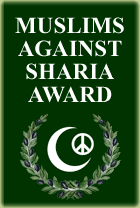
Latest recipient of The MASH Award
 Lorsqu’on a annoncé il y a deux mois que les hommes n’auraient plus le droit de travailler dans les boutiques pour femmes, certains ont exprimé des craintes quant à la sécurité des femmes sans gardiens de sexe masculin. Mais peu de gens auraient pu prévoir que cette mesure entraînerait une vague de crimes par des travestis.
Lundi, les policiers ont arrêté sept Afghans qu’ils accusent de porter des abayas pour dévaliser des magasins. Les hommes ont ciblé les boutiques employant uniquement du personnel féminin, a dit un officier de police. Les abayas offrent le double avantage de permettre aux hommes d’entrer dans des boutiques réservées aux femmes et de masquer leur identité afin de rendre leur arrestation plus difficile.
Lire la suite...Source: The National (Traduction d'extraits par Poste de veille)
August 31st, 2009 8:10 am - Phyllis Chesler
The Burqa: Ultimate Feminist Choice?
Naomi Wolf Discovers That Shrouds Are Sexy Women in chadors are really feminist ninja warriors. Rather than allow themselves to be gawked at by male strangers, they choose to defeat the “male gaze” by hiding from it in plain view.
But don’t you worry: Beneath that chador, abaya, burqa, or veil, there is a sexy courtesan wearing “Victoria Secret, elegant fashion, and skin care lotion,” just waiting for her husband to come home for a night of wild and sensuous marital lovemaking.
Obviously, these are not my ideas. I am quoting from a piece by Naomi Wolf that appeared in the Sydney Morning Herald a few days ago. Yes, Wolf is the bubbly, feminist author who once advised Vice President Al “The Climate” Gore on what colors he should wear while campaigning and who is or was friendly with Gore’s daughter. Full disclosure: I have casually known Wolf and her parents for more than a quarter-century.
Wolf recently traveled to Morocco, Jordan, and Eygpt, where she found the women “as interested in allure, seduction, and pleasure as women anywhere in the world.” Whew! What a relief. She writes:
“Many Muslim women I spoke with did not feel at all subjugated by the chador or the headscarf. On the contrary, they felt liberated from what they experienced as the intrusive, commodifying, basely sexualizing Western gaze. … Many women said something like this: …’how tiring it can be to be on display all the time. When I wear my headscarf or chador, people relate to me as an individual, not an object; I feel respected.’ This may not be expressed in a traditional Western feminist set of images, but it is a recognizably Western feminist set of feelings.”
Really? If so, I’m the Queen of England.
Now that Wolf is no longer the doe-eyed ingenue of yesteryear, she sees the advantage of not being on view at all times. A Westerner, “playing” Muslim-dress up, Wolf claims that hiding in plain view gave her “a novel sense of calm and serenity. I felt, yes, in certain ways, free.” In addition, Wolf believes that the marital sex is hotter when women “cover” and reveal their faces and bodies only to their husbands.
Marabel Morgan lives! In the mid-1970s, Morgan advised wives to greet their husbands at the door wearing sexy clothing and/or transparent saran wrap with only themselves underneath. Her book, Total Woman, sold more than ten million copies. According to Morgan, a Christian, “It’s only when a woman surrenders her life to her husband, reveres and worships him and is willing to serve him, that she becomes really beautiful to him.”
Well, what can I say? Here’s a few things.
Most Muslim girls and women are not given a choice about wearing the chador, burqa, abaya, niqab, jilbab, or hijab (headscarf), and those who resist are beaten, threatened with death, arrested, caned or lashed, jailed, or honor murdered by their own families. Is Wolfe thoroughly unfamiliar with the news coming out of Afghanistan, Pakistan, Iran, Saudi Arabia, and Sudan on these very subjects? Has she forgotten the tragic, fiery deaths of those schoolgirls in Saudi Arabia who, in trying to flee their burning schoolhouse, were improperly veiled and who were beaten back by the all-powerful Saudi Morality Police? Most Muslim girls and women are impoverished and wear rags, not expensive Western clothing beneath their coverings. Only the pampered, super-controlled, often isolated, and uber-materialistic daughters of wealth, mainly in the Gulf states, but also among the ruling classes in the Islamic world, match Wolf’s portrait of well kept courtesan-wives.
Being veiled and obedient does not save a Muslim girl or woman from being incested, battered, stalked, gang-raped, or maritally raped nor does it stop her husband from taking multiple wives and girlfriends or from frequenting brothels. A fully “covered” girl-child, anywhere between the ages of 10-15, may still be forced into an arranged marriage, perhaps with her first cousin, perhaps with a man old enough to be her grandfather, and she is not allowed to leave him, not even if he beats her black and blue every single day.
Wolf claims that she donned a “shalwar kameez and a headscarf” for a trip to the bazaar. I suggest that Wolf understand that the shalwar kameez and headscarf that she playfully wore in Morocco are not the problem.
I wonder how Wolf would feel if she’d donned a burqa, chador (full body bags) or niqab (face mask) for that same trip; how well she would do in an isolation chamber that effectively blocked her five senses and made it difficult, if not impossible, for her to communicate with others?
And, by the way, the eerie effect, ultimately, of shrouded women is that they become invisible. They cease to exist. They are literally ghosts.
Wolf presents the West as anti-woman because it treats women as sex objects. Am I happy about pornography and prostitution in the West? Hell no and, unlike Wolf, I’ve fought against them–but to portray these vices as a “Western” evil, and one that the Islamic world opposes, is sheer madness.
It is well known that the Arabs and Muslims kept and still keep sex slaves–they are very involved in the global trafficking in girls and women and frequent prostitutes on every continent. You will find pornography magazines in every princely tent–those for boys as well as for girls. I am told that the Saudis fly in fresh planeloads of Parisian prostitutes every week. Perhaps they veil them before they conduct their all-night and all-day orgies. Or, perhaps they view them as natural, “infidel” prey.
Let me suggest that Wolf read a book that is coming out in September, written by a Christian-American woman, Mary Laurel Ross, whose American Air Force husband trained the Saudi Air Force. It is called Veiled Honor and is a timely, comprehensive, “nuanced” (Wolf calls for “nuance” in our understanding of “female freedom”) account of her approximately fifteen year sojourn in Saudi Arabia. I would also suggest that Wolf read the works of Ayaan Hirsi Ali (Infidel) and Nonie Darwish (Cruel and Usual Punishment) for starters.
Then again, I suspect that Wolf is not necessarily looking for any “nuanced” truths about “female freedom” but is, rather, fishing for Saudi gold and positioning herself within the Democratic Party. After all, what she has written in this brief article supports President Obama’s position vis a vis the Muslim world. Source: http://pajamasmedia.com/phyllischesler/2009/08/31/the-burqa-the-ultimate-feminist-choice/
 The immigration spokesman for Denmark's Conservative Party is calling for a ban on the wearing of burqas in public. He says the garment was introduced by the Taliban and is "not Islamic at all."Denmark's Conservative Party said this week it wants to introduce a ban on Muslim burqa or niqab dress codes which require women to completely cover their faces in public. "We don't want to see burqas in Denmark. We simply can't accept that some of our citizens walk around with their faces covered," Naser Khader, a Danish member of parliament of Syrian-Palestinian extraction who was recently appointed spokesman for integration issues for the Conservative Party, told the newspaper Jyllands-Posten. In comments published on Sunday, Khader said the burqa is un-Danish and oppressive towards women and should be completely banned. He and his party say that what people do in their own homes is their business, but as soon as they walk into the public domain, one should be able to see their faces. The Danish People's Party and the Social Democratic Party have welcomed the proposal, while the Liberal Party, which is the senior partner in Denmark's coalition government, rejects the idea of legislating about citizens' clothing, provided they are not employed in a public function. Read more ... Source: SpiegelH/T: Weasel ZippersNaser Khader
Latest recipient of The MASH Award

By Olivier Guitta In his speech in Cairo, President Obama mentioned no less than three times the headscarf sometimes worn by Muslim women. Each time, his purpose was to stress "the right of women and girls to wear the hijab"--but never their right not to wear it. It was as if it had never occurred to the president that this sartorial practice could be anything but wholly voluntary. The French, whose 2004 ban on the hijab and other religious attire in public schools Obama was indirectly criticizing, are more attuned to the use of the headscarf as an instrument of domination by religious extremists. It was Muslim women seeking relief from pressure to cover themselves whose complaints led ultimately to the French ban. Now the issue has cropped up again in the form of a call, endorsed by French president Nicolas Sarkozy, to ban the total veiling of the face. It all started in mid-June when André Gérin, the Communist mayor of Vénissieux, a suburb of Lyon, who is also a member of the National Assembly, proposed a parliamentary commission to investigate the burqa (an outer garment covering a woman from head to toe) and the niqab (which veils the whole face except the eyes) as oppressive to women. Read more ...Source: The Weekly Standard
 |
|
|
Copyright Muslims Against Sharia 2008. All rights reserved.
E-mail: info AT ReformIslam.org
|
|
|


 Posts
Posts


