 The Pakistani Taliban has released an audiotape which it says is proof that Hakimullah Mehsud, ( pictured), its leader, was not killed in a US missile attack earlier this week. The Pakistani Taliban has released an audiotape which it says is proof that Hakimullah Mehsud, ( pictured), its leader, was not killed in a US missile attack earlier this week. The tape, purportedly carrying the voice of Mehsud, condemned the rumours of his death, but made no reference to the raid which killed 18 people in North Waziristan. "Sometimes they [the government] launch propaganda about my martyrdom through media and sometimes they say that the operation has been completed in South Waziristan," the recording, released to media on Friday, said. "This can never happen," it continued, referring to military operations against Taliban strongholds launched last year. Reporters familiar with Mehsud said the voice appeared to be his, but it was impossible to confirm if it was recorded before or after Thursday's raid. Mehsud is know to have recorded a number of similar tapes after an attempt on his life in October. Conflicting reports emerged from intelligence agents and security officials on Friday, with some saying Mehsud was injured, while others said the he and some of his senior commanders were probably killed. "So far we do not have confirmation of him either getting killed or getting injured. It will take a little more time to confirm this or otherwise," Major-General Athar Abbas, a military spokesman, told the AFP news agency. The Taliban has issued a number of statements denying Mehsud's death, and Azam Tariq, one of their spokesmen, said his boss had left the Shaktoi area struck by the missiles "40 to 60 minutes" before the raid. "Hakimullah is alive and safe. I met with him last night, there was not even a scratch on him," Tariq told AFP on Friday. Mehsud took over as leader of the Pakistani Taliban five months ago, after Baitullah Mehsud, his predecessor, was killed in a US drone attack. The Taliban denied Baitullah Mehsud's death for weeks, apparently amid fierce infighting over his successor. The "Mehsud audiotape" was released against a backdrop of continued violence in different parts of Pakistan. A suicide bomber attacked a military vehicle in the southern part of Pakistani-administered Kashmir on Saturday, killing two soldiers, security officials said. The bomber attacked the vehicle as it was travelling near the town of Rawalakot, the officials said. "It was a suicide blast, the target was an army vehicle," Sardar Khurshid, a senior police official, told the AFP news agency by telephone. Chaudhry Raqeeb, a senior administrative official, told AFP: "Two security personnel have been injured. The injured were immediately shifted to the nearby hospital." On December 27, a suicide bomber killed seven people outside a Shia Muslim mosque in Muzaffarabad, the capital of Pakistani Kashmir. The Kashmir bombing followed US drone raids in North Waziristan in which at least five fighters were killed. One of those killed on Friday was on the FBI's most-wanted list, Pakistani intelligence officials said. Jamal Saeed Abdul Rahim was reportedly wanted for his alleged role in a deadly 1986
plane hijacking and had a $5 million bounty on his head. The FBI's website identifies him as a Palestinian with possible Lebanese citizenship, who was a member of the armed Palestinian group Abu Nidal. The Pakistani officials called him an al-Qaeda member. Al Jazeera 
 Earlier today, I was lying on my gynecologist’s table in a highly exposed position when suddenly she said: “You’re probably going to think this is very politically incorrect but isn’t it crazy not to profile? I mean, isn’t it clear who’s doing what?” Earlier today, I was lying on my gynecologist’s table in a highly exposed position when suddenly she said: “You’re probably going to think this is very politically incorrect but isn’t it crazy not to profile? I mean, isn’t it clear who’s doing what?” I immediately shot straight up and engaged this worthy liberal in a very politically incorrect conversation. (No, she had absolutely no idea what I’ve been writing about). So: Some things are becoming clear and can no longer be denied. Not even by some liberals. Jihadic terrorists tend to be Muslims. Atheists are not blowing themselves up nor are Jews, Christians, Buddhists, Hindus, Sikhs, Ba’haii or Zoroastrians. Not all Muslims are terrorists; but these days, all terrorists seem to be Muslims. Terrorists and their handlers are not all motivated by poverty and suffering. Many are often wealthy and educated men. For example, according to the Wall Street Journal, Humam Khalil Abu Mulal al-Balawi, the Jordanian double agent who recently blew himself up along with seven American CIA operatives in Afghanistan, was a 32 year-old physician. A physician—not a madrassa trained slum dweller. He is now being linked to Al Qaeda in Pakistan. On video, he said: “ We will never forget the blood of our emir, Baitullah Mehsud. We will always demand revenge for him inside America and outside.” (Al-Balawi was shown meeting with the Pakistani Taliban/Al Qaeda and vowing revenge for the death of their leader). Our own homegrown jihadic terrorist, Major Nidal Malik Hassan, (a Palestinian-American), is also a physician, a psychiatrist in fact. He had money, independence, prestige. His massacre at Fort Hood was not motivated by illiteracy, poverty, or war-related trauma. Many Westerners find it difficult to accept that a religious war has been declared against the West; that jihadists are ready to die, wave after wave of them, in order to ensure that our way of life is destroyed.
Their ideal is Islamic supremacy (only Muslims will rule because they are “superior”) and they want to return to a seventh century way of life, albeit one with cellphones, the internet, and nuclear weaponry. Moderate, peaceful Muslims certainly exist—but how many are willing to stand up to the jihadists? For example, according to the AP, only 50 Muslims showed up for a “Muslims Against Terrorism” rally outside the federal courthouse in Detroit where the Christmas Day crotch-bomber, Umar Farouk Abdulmutallab, was being arraigned. Although the local Detroit press estimated that there were 150 protestors there—this is still a very small showing given that Detroit and its suburbs are also known as “Dearbornistan” and boast the largest Muslim community in the United States. How many European-Muslim leaders protested the fatwa against Salman Rushdie, the murder of Theo Von Gogh, the character assassination of Geert Wilders and Ayaan Hirsi Ali, ore the recently attempted murder of Kurt Westergaard, the Danish cartoonist? How many Muslim religious leaders in Egypt protested the Orthodox Christmas Day shooting of Coptic Christians as they left church? Or protested the abductions, forced conversions, and the hastily arranged marriages of Coptic Christian female children to Muslim adult males? How many Muslim religious leaders have issued fatwas against the Islamic regime of Iran for its heart stopping persecution of Iranian dissidents? Too few, if any. The danger of not standing up early enough is that we condemn ourselves to a higher body count. If we refuse to (behavior) profile now—we must accept that more airports and airplanes will be blown up, more cities held hostage, Mumbai-style.
And, those of us who travel frequently will all have to spend a good part of the rest of our lives standing on line at the airport. And, eventually, at the boat dock, or at the train or bus station. Phyllis Chesler
Jim Hoft The Taliban released a video today of the Jordanian doctor and Al-Qaeda blogger before he killed 7 CIA officers in a suicide bombing. In the video Humam Khalil Abu-Mulal al-Balawi says the attack will be the first of revenge operations against the Americans and their drone teams outside the Pakistani border. The CIA bomber also says in the video that he can not be bought off by the West before his suicide attack:
The Taliban said that the attack was a revenge operation for drone attacks in the Pakistani border regions ordered by President Obama.
…But weren’t we told they hated us because of Gitmo? The BBC reported on the video: The Jordanian “double agent” who killed himself and seven American Central Intelligence Agency officials in Afghanistan’s Khost province last month must have been very sure of the success of his mission. “This… attack will be the first of revenge operations against the Americans and their drone teams outside the Pakistani border, after they killed the Amir [chief] of Tehrik Taliban Pakistan (TTP), Baitullah Mehsud, may God’s beneficence be upon him,” he apparently said in a video broadcast released on Saturday. The video shows the purported Jordanian suicide bomber sitting next to Baitullah Mehsud’s successor and the new Pakistani Taliban, or TTP, chief, Hakimullah Mehsud, and reading from written text. “We [the Jordanian himself and the Taliban, whom he describes as Mujahideen or the holy warriors] arranged together this attack to let the Americans understand that our belief in Allah… cannot be exchanged for all the wealth in the world,” he says. It would appear that he had already set the trap for the CIA agents at the time he made the video. …The father of the accused Jordanian has said that the man who appears on the video is definitely his son. The Pakistani Taliban has claimed responsibility for the Khost attack, alongside similar claims by the Afghan Taliban and al-Qaeda. All of them said that the attack was planned to avenge the 6 August 2009 killing of Baitullah Mehsud in a drone strike. With thanks to Gateway Pundit
 Keep in mind, this is after the Spanish elected Zapatero and withdrew their soldiers from Iraq following the 2005 Madrid bombings. I thought that was supposed to satisfy the terrorists? Keep in mind, this is after the Spanish elected Zapatero and withdrew their soldiers from Iraq following the 2005 Madrid bombings. I thought that was supposed to satisfy the terrorists? From CAN: The court set up by the Spanish government to try terrorism suspects has convicted 11 Asians, ten from Pakistan and one from India, for plotting to carry out subway bombings in Barcelona, The Sydney Morning Herald reports.
The terrorists were sentenced to between 8 and 14 years in jail. Ten of the terrorists were arrested in January 2008, and the final one was arrested later in the Netherlands. The authorities were able to foil the plot due to information provided by an informant.
The plotters were connected with Tehrik-e-Taliban, a group led by Baitullah Mehsud, the leader of the Pakistani branch of the Taliban that was killed by an airstrike from an American unmanned aerial vehicle in August.
Mehsud’s group said that it hatched the plot against Spain due to that country’s military contributions to the war in Afghanistan. Robert Spencer of JihadWatch.org used the report’s omission of the terrorists’ faith to criticize the media’s reporting on this and other similar incidents. “Eight paragraphs in, we learn it was a’ suspected Islamist cell.’ Until then, one might almost have gotten the impression that Pakistan had declared war on Spain,” Spencer wrote on his blog. “And that is the problem with this kind of coverage, which is, of course, thoroughly ordinary. It is not because they are ‘men,’ or ‘Asians,’ or ‘Pakistanis’ that they are waging war on Spain. So these reports are essentially misleading.” This isn’t the first time terrorists have targeted Spain and specifically Barcelona.
On March 11, 2004, terrorists loyal to Al-Qaeda detonated backpack bombs on several buses, killing 191 people. Eleven Pakistanis were also arrested and later acquitted of planning attacks in Barcelona in 2007, although five were found guilty of other charges, reports The Sydney Morning Herald. The suspects found guilty in Spain are appealing their verdict, Newstrack India reports. World Threats
 AL-QAEDA said the suicide bombing at a US base in Afghanistan that killed seven CIA agents was "revenge" for the deaths of top militants in US drone strikes in Pakistan. AL-QAEDA said the suicide bombing at a US base in Afghanistan that killed seven CIA agents was "revenge" for the deaths of top militants in US drone strikes in Pakistan. A Jordanian identified as Humam Khalil Abu-Mulal al-Balawi, who was said to be a triple agent, blew himself up at the base in Khost on December 30 in the deadliest attack against the CIA since 1983. The head of al-Qaeda in Afghanistan, Mustafa Abu al-Yazid, said the bomber wrote in his will that the attack was revenge for "our righteous martyrs" and named a number of top militants killed in US drone attacks, US monitoring group SITE reported. These included Baitullah Mehsud, (pictured) the leader of Pakistan's Taliban blamed for a wave of deadly attacks including the killing of former Pakistan prime minister Benazir Bhutto in December 2007. Mehsud was killed when a US missile slammed into his father-in-law's house in August last year. The al-Qaeda statement surfaced after another round of US drone strikes left 11 militants dead near Pakistan's Afghan border yesterday. Attacks by unmanned US spy planes have soared in the past year, with Washington determined to wipe out militant sanctuaries while the extremists have vowed fierce retaliation. The Australian
 "Asians." "Men." "Men of South Asian origin." "Pakistanis." "Men." "Born in Pakistan." "Pakistani origin." "Asians." "Men." "Men of South Asian origin." "Pakistanis." "Men." "Born in Pakistan." "Pakistani origin." Eight paragraphs in, we learn it was a "suspected Islamist cell." Until then, one might almost have gotten the impression that Pakistan had declared war on Spain.
And that is the problem with this kind of coverage, which is, of course, thoroughly ordinary. It is not because they are "men," or "Asians," or "Pakistanis" that they are waging war on Spain. So these reports are essentially misleading. "Asians jailed over planned metro attack," from AFP, December 15 Spain's anti-terrorism court has convicted 11 men of South Asian origin, mostly Pakistanis, in connection with a plot to stage suicide attacks in the Barcelona metro last year. The men have received jail terms of between eight and 14 years, a copy of the ruling indicates. They intended to "carry out a violent attack using explosives against the Barcelona metro, which could have caused many casualties", the court said on Monday. "The indiscriminate aim is evidence of the terrorist nature of the attacks." Shaib Iqbal and Qadeer Malik, both born in Pakistan, received the stiffest terms of 14 years and six months for "belonging to a terrorist group" and for "weapons possession". Maroof Ahmed Mirza, also of Pakistani origin and who the court said was "the leader of the group", was jailed for 10-and-a-half years for "belonging to a terrorist group", while the other eight each received terms of eight-and-a-half years on the same charge. Ten of the men were arrested in the northeastern city of Barcelona in January 2008 in raids during which police also recovered bomb-making equipment. Another was detained five months later in the Netherlands. The charges were based on the declarations of an informant who was a member of the suspected Islamist cell and who then became a protected witness. The court said the cell was inspired by Baitullah Mehsud, leader of a Pakistani Taliban group linked to al-Qaeda, Tehrik-e-Taliban Pakistan.... In May 2007, Spain's high court acquitted 11 Pakistanis of planning extremist attacks in Barcelona, but convicted three of them of collaborating with terrorists and two of falsifying documents. With thanks to JihadWatch
 As the Pakistani soldiers moved into South Waziristan, they found something almost as valuable as al Qaeda itself: the diaries and books that explain how militant ideology binds the diffuse world of terrorism together. As the Pakistani soldiers moved into South Waziristan, they found something almost as valuable as al Qaeda itself: the diaries and books that explain how militant ideology binds the diffuse world of terrorism together. Until the Pakistani Army swept into this small, hill-flocked valley on Nov. 3, Sararogha had served as the South Waziristan headquarters of the powerful terrorist group Tehrik-i-Taliban Pakistan -- known in English as the TTP.
Despite the chaos since the death of its founder -- Baitullah Mehsud, killed by a U.S. drone strike on Aug. 5 -- the TTP had the area firmly in its grip, and made it a virtual black hole for government security and intelligence forces. The TTP had seized the town in a surprise raid on a paramilitary fort on Jan. 25 last year. They instantly executed half of the two dozen Frontier Corps soldiers, a move that filled the roughly 8,000 inhabitants with fear and forced them into silence.
The stones and debris still litter the ground of the fort -- the result of heavy artillery fire that the army used while entering the town. "It all started from here, the challenge to the state of Pakistan," Brig. Muhammed Shafiq, the commanding officer, told me during a recent visit. "Sararogha has turned into a symbol of the TTP terror in the region." But this month, the Army overtook the town and its southern ridge -- Point 1345 -- which overlooks Sararogha and the road to the periphery of the valley. The fight for this point has been fierce and bloody, with one soldier losing one of his legs to gunfire from the TTP and al Qaeda militants. The soldier is currently under treatment at a military hospital in Rawalpindi, where the Pakistani Army is headquartered, and officials will not name him for security reasons. Officials claim they have killed more than 550 militants in the current campaign thus far, while suffering close to 100 casualties themselves. More at Foreign Policy
 Able to observe the Taliban close up for an extended period, a New York Times reporter discovers that they aren't actually the moderate nationalists that his own paper may have led him to believe they were. "7 Months, 10 Days in Captivity," by David Rohde in the New York Times, October 17 Able to observe the Taliban close up for an extended period, a New York Times reporter discovers that they aren't actually the moderate nationalists that his own paper may have led him to believe they were. "7 Months, 10 Days in Captivity," by David Rohde in the New York Times, October 17 Over those months, I came to a simple realization. After seven years of reporting in the region, I did not fully understand how extreme many of the Taliban had become.
Before the kidnapping, I viewed the organization as a form of "Al Qaeda lite," a religiously motivated movement primarily focused on controlling Afghanistan. Living side by side with the Haqqanis' followers, I learned that the goal of the hard-line Taliban was far more ambitious. Contact with foreign militants in the tribal areas appeared to have deeply affected many young Taliban fighters.
They wanted to create a fundamentalist Islamic emirate with Al Qaeda that spanned the Muslim world. And beyond. As Beitullah Mehsud put it in 2007, "We will continue our struggle until foreign troops are thrown out. Then we will attack them in the US and Britain until they either accept Islam or agree to pay jazia (a tax in Islam for non-Muslims living in an Islamic state)." Source: JihadWatch
 The Pakistani military has begun a ground offensive against Taliban strongholds in South Waziristan. The Pakistani military has begun a ground offensive against Taliban strongholds in South Waziristan. The ground operation began early on Saturday, advancing from at least three directions - Zhob to the south, Razmak to the north and Jandola from the east. Air power was also put to use. About 28,000 troops are to be employed in the offensive against about 10,000 Taliban. The move followed crisis-talks and a meeting headed by Yousuf Raza Gilani, the prime minister, on Friday in which it was decided to launch the operation against Taliban. The drive comes in response to continued bomb attacks in the country over the past two weeks that have killed more than 150 people. Hundreds of residents in the South Waziristan have been moving out of the area in anticipation of the military offensive. A curfew was imposed in South Wazaristan on Saturday, ahead of any offensive. Mohammad Khalid Khan, a senior government official, said: "The curfew is for the protection of military convoys [moving toward Taliban strongholds] and it is on the roads. The bazaars are open." The government said on Friday that a ground offensive against the Pakistani Taliban in South Waziristan was imminent and the army has been stepping up its air and artillery attacks in recent days to soften up their defences. Pakistani forces attacked the Taliban in South Waziristan on the same day with aircraft and artillery. The US hopes that a Pakistani army operation in South Waziristan will help break much of the opposition network that threatens both Pakistan and American troops across the border in Afghanistan. Analysts say that with winter approaching, any push would have had to have begun soon to be successful. Saturday's offensive came a day after at least 11 people died in two explosions near a police office in the city of Peshawar. The bombs were detonated at an investigation bureau in an army garrison of the city, Asghar Hussain, a police official, said. The strikes were the latest in a series of attacks that have killed more than 150 people in Pakistan over the past two weeks. Local police said one of the attackers was a woman, making it the second time that a female suicide bomber has attacked in Pakistan. "Police tried to intercept a woman sitting on a motorcycle with a terrorist. She blew herself up and after that there was another blast when a suicide attacker sitting in a car exploded," Liaqat Ali Khan, the city police chief, said. "An attack had happened here already once before ... We don't feel secure here, we don't know when it will happen again," Allah Ditta, a local resident, said. Hasan Askari Rizvi, a political and defence analyst, said: "Different terrorist groups are now trying to reassert themselves, because after the [Pakistani army] Swat operation and the death of Baitullah Mehsud, [the leader of the Pakistani Taliban] the impression was that they were in disarray. "Now they want to demonstrate they are capable of taking action in any part of the country. "They want to deter [security forces] from taking action in South Waziristan where action is expected against the Taliban." Also on Friday, police said dozens of people had been picked up in overnight raids in slum areas of Lahore and neighbourhoods populated by Afghans, a day after 40 people died in a string of attacks on security buildings in Lahore and bombings in the northwest. "There has been considerable progress in the ongoing investigation. We have arrested dozens of suspects during overnight raids in Lahore," Haider Ashraf, senior police official at the Manawan police academy, told the AFP news agency. "These people are being interrogated. We are also trying to identify the terrorists who were killed yesterday," he said. Source: Al Jazeera (English)
 by Amanda Hodge THE Taliban's wave of carnage continued across Pakistan yesterday, with at least 39 people killed in simultaneous attacks on three police buildings in Lahore and two bombings in and around Peshawar. The five co-ordinated assaults marked the 11th day of violence by Pakistani terrorists who have vowed to avenge the death of former Tehrik-e-Taliban leader Baitullah Mehsud, and strike back against a planned military operation in their northwest stronghold of South Waziristan. Two of the police buildings attacked yesterday were targeted in previous terror strikes this year, underscoring the weakness of a Pakistani police force under-trained and under-resourced to deal with a militant insurgency. The attackers were reportedly disguised in police and militia uniforms. They were armed with machineguns, hand grenades and suicide belts. The third attack targeted the Bedian Elite Police Training Centre, near Lahore's international airport. Five attackers, including at least one teenager, scaled the back wall of the commando academy at Bedian, sparking a siege that dragged on nearly four hours before the army announced it was in full control. Police officer Mohammad Azfar said one young gunman was shot in the head, and eight grenades were found on his body. "He was 15, 16 years old. He could not detonate his (suicide) jacket," Mr Azfar said. Interior Minister Rehman Malik said the country was facing a new war. "They are involved in guerilla war. First they were active in NWFP (North West Frontier Province), now they are engaged in Punjab.
They are terrorists paid to destabilise Pakistan," he said. "The whole nation should be united against this handful of terrorists and, God willing, we will defeat them." Yesterday's carnage follows a string of attacks claimed by Tehrik-e-Taliban militants over the past 11 days that have killed at least 137 people. At least 52 civilians were killed last Friday when a suicide bomber rammed his car into a market in Peshawar, capital of the NWFP. The following day, Taliban-linked gunmen staged the brazen attack on army headquarters near Islamabad. About 23 people were killed in the commando operation to free 39 hostages. Read more here,,,, Source: The Austraian
 THREE Pakistanis and an Iraqi national were killed when a suicide bomber struck inside a heavily-fortified UN office in the heart of the Pakistani capital Islamabad, officials and the UN said. Police officers said they were investigating how the bomber managed to breach strict security measures and walk into the offices of the World Food Program (WFP) and detonate about eight kilograms of explosives. There was no immediate claim of responsibility, but the attack comes during an upsurge of suicide bombings in Pakistan as the new Taliban leadership vow to avenge the killing of their commander Baitullah Mehsud in a US missile strike. "According to the latest reports, four people have been martyred - one of them is an Iraqi national. Six people have been injured, all of them are Pakistanis," Interior Minister Rehman Malik told reporters. There were scenes of confusion around the WFP compound in central Islamabad, with smoke billowing out from behind the blast walls and ambulances rushing to the scene, where bloodied survivors were walking amid shattered glass. Bani Amin, deputy inspector general of police operations, earlier confirmed that two Pakistani women and an Iraqi man were killed, and said the explosion was caused by a suicide bomber who entered the building on foot. "We have recovered legs and the skull of the suicide bomber. We are investigating how he managed to enter inside the building. There are scanners, there are cameras, and strict security arrangements," Amin said. The WFP confirmed in a statement from Rome that three of its staff members had died in the blast, with two UN employees still in a critical condition. "It is a tragedy for WFP and for the whole humanitarian community in Pakistan," Amir Abdulla, the WFP's deputy director based in Rome, said in the statement. "These people were working to help vulnerable people." There was no immediate information available about the fourth fatality. UN spokeswoman Ishrat Rizvi said that all the UN offices in the capital "have been closed for security reasons until further notice". Prime Minister Yousuf Raza Gilani's office issued a statement saying he "strongly condemned" the blast and ordered an inquiry into the bombing. There was no immediate claim of responsibility, but Taliban militants holed up in the northwest tribal belt have been blamed for a string of attacks and suicide blasts that have killed more than 2,100 people in the last two years. Three bomb blasts in the past two-and-a-half weeks in the northwest have killed 28 people, with the Taliban claiming responsibility for one of the blasts and threatening to unleash bigger assaults. There was a lull in bomb attacks after Baitullah Mehsud's death in an August 5 US drone strike, but analysts had warned that the new Taliban leadership would likely be keen to show their strength with fresh, dramatic strikes. Security measures have been high in the capital, where the last blast hit on June 6, killing two policemen at their offices. Source: The Australian
 Al Qaeda's deputy leader on Monday seized upon President Barack Obama's failure to bring about a freeze in Israeli settlement construction in the West Bank and called him a "fraud" in a new audio message. Al Qaeda's deputy leader on Monday seized upon President Barack Obama's failure to bring about a freeze in Israeli settlement construction in the West Bank and called him a "fraud" in a new audio message. Ayman al-Zawahri's 28-minute audio message was mainly a eulogy for slain Pakistani Taliban leader Baitullah Mehsud, but he also took the opportunity to slam NATO member states operating in Afghanistan, including Germany, which he criticized for keeping troops there. The recording comes after a series of Al Qaeda videos this past month, including several attacking Germany and threatening strikes against Berlin's military mission in Afghanistan. Those releases raised concerns among German authorities ahead of parliamentary elections which ended Sunday. Al-Zawahri reserved special scorn for Obama, whom he has insulted in nearly every one of his messages since the latter's historic election as U.S. president. Many experts believe that Al Qaeda is struggling in the face of Obama's popularity in the Muslim world, especially compared to his predecessor George W. Bush. Obama publicly called for an Israeli freeze in settlement construction in order to restart the peace talks, but was rebuffed by Israeli Prime Minister Benjamin Netanyahu last week. Read more here,,,, Source: FoxNews
 At least five Taliban fighters have been killed in a suspected US drone attack in a northwest Pakistani town, according to Pakistan officials. At least five Taliban fighters have been killed in a suspected US drone attack in a northwest Pakistani town, according to Pakistan officials. At least five other people were wounded in the double missile raid on a suspected Taliban hideout in Mir Ali, in a tribal region of North Waziristan, Pakistani authorities said. "The strike targeted a madrassa and an adjoining house in North Waziristan," a Pakistani security official said. "Most of the casualties are Taliban militants." Local residents and intelligence officials confirmed five people had died. The destroyed house and school had been cordoned off to enable a search for more bodies after the attack by the unmanned US aircraft, local officials said. The semi-autonomous tribal belt on the Afghan border has been identified by the US as a refuge for Taliban and al-Qaeda fighters who fled Afghanistan after the 2001 US invasion of the nation. Washington does not confirm drone attacks despite the fact the US military is the only organisation operating drones in the area. Baitullah Meshud, the Pakistani Taliban chief, was killed in a similar attack in neighbouring South Waziristan on August 5. Violence in the northwest has risen since the appointment of his successor, former aide Hakimullah Meshud. At least five Pakistani troops were killed in a landmine explosion in South Waziristan on Sunday. Gunfire was also exchanged between security personnel and opposition fighters, although no casualties have been reported. Another US drone attack killed eight suspected Taliban fighters on August 27 in South Waziristan. The Pakistani government has publically said that it does not support the US drone attacks, however, some analysts believe that Islamabad gives tacit agreement to the strikes. Source: Al Jazeera (English)
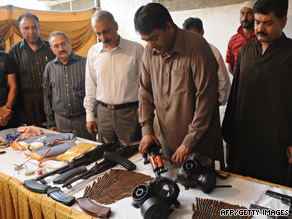 Pakistan security officials show seized weapons Pakistan security officials show seized weapons
and ammunition in Karachi on Sunday after
the arrest of seven alleged militantsPakistani authorities have launched a massive crackdown on terror groups that they say were planning numerous suicide attacks, including in the country's largest city of Karachi. At least 24 suspects were arrested Sunday and Monday, including three people carrying suicide jackets and explosives inside a bus station, a police official said. The three were seized early Monday after police raided a bus station in Sargodha, a city located about 190 kilometers (120 miles) south of Islamabad in Pakistan's Punjab province.The suspects were plotting to attack two Shiite mosques, police stations, and a Norwegian telecommunications company in Punjab, according to district police officer Usman Anwar. Three other suspects linked to the plot were arrested hours later in Sargodha, he said. The arrests come a day after the Pakistani Taliban's chief in Punjab was arrested, along with five others, according to Anwar. The Taliban in Punjab have direct ties to Baitullah Mehsud, the former head of the Pakistan Taliban, and have been accused of sectarian murders in Punjab. Pakistan and U.S. officials contend Mehsud was killed in an August 5 drone attack in Waziristan at his father-in-law's house. The Taliban claim Mehsud is alive but ill. Hakeemullah Mehsud has been selected as the new head of the Pakistani Taliban, a Taliban commander said Saturday. Pakistani authorities also said they thwarted planned attacks in the southern port city of Karachi, Pakistan's largest city and the capital of Sindh province. Five suspected members of the Pakistani Taliban were seized Sunday in Karachi, along with suicide vests and a large quantity of ammunition, according to the city's police superintendent Mohammed Fayyaz Khan. Read more here ... Source: CNN
 Hakimullah is said to be a powerful commander Hakimullah is said to be a powerful commander
who operates from the Orakzai tribal districtThe Pakistani Taliban have said that they had appointed Hakimullah Mehsud as the new chief of the movement. The announcement was made by Maulvi Faqir Mohammad, the deputy of Tehrik-e-Taliban Pakistan (TTP), or Pakistani Taliban Movement, on Saturday. Mohammad said that Hakimullah Mehsud had been unanimously appointed by the movement’s shura (council) as successor to Baitullah Mehsud at a meeting in north Pakistan on Friday. "The shura has appointed Hakimullah as successor to Baitullah Mehsud. The shura earlier had nominated me as the acting chief but now I will be again deputy chief," Mohammad was quoted as saying. "I shall continue to be ameer (chief) of TTP in Bajaur," he said. Read more here ... Source: Al Jazeera (English)
ISLAMABAD: Security forces captured the Pakistani Taliban's top spokesman in an operation near the Afghan border, a government official said yesterday, dealing another blow to the militants following the reported killing of their leader earlier this month. The seizure of Maulvi Umar follows government claims of disarray in the Taliban leadership over who should replace their chief, Baitullah Mehsud, who is believed to have been killed in a CIA missile strike on August 5. Umar was captured along with two associates in a village in the Mohmand tribal region on Monday night, local time, while he was travelling in a car to South Waziristan, a Taliban stronghold, said Javed Khan, a local government administrator. "Maulvi Umar is in our custody, and he is being questioned," Mr Khan said. Earlier, three intelligence officials said local tribal elders assisted troops in locating Umar in the village of Khawazeo. The officials, who spoke on condition of anonymity, said Umar's arrest would probably be publicly announced overnight. As the official spokesman for Tehrik-e-Taliban Pakistan, the umbrella organisation formed in 2007 for various regional and tribal militant movements, Umar frequently called journalists to claim responsibility for terrorist attacks in Pakistan. He was known to be close to Mehsud.
Last week, he called the Associated Press to insist Mehsud was still alive and to deny reports of a power struggle within the Pakistani Taliban's disparate factions over who would succeed him. Umar's capture was the second arrest of a senior Taliban figure in 24 hours. On Monday night, police said they had arrested a militant commander and close Mehsud aide, who was being treated in a private hospital in Islamabad, the capital. Militant commander Qari Saifullah, who is reportedly linked to al-Qa'ida, told police he had been wounded in a US missile strike in South Waziristan, said two police officials. It was unclear whether it was the same strike believed to have killed Mehsud. Read more here ... Source: The Australian
 The fighting comes one week after a US missile The fighting comes one week after a US missile
strike in South Waziristan reportedly killed Mehsud At least 70 people are reported to have been killed and dozens injured in a major battle between Taliban fighters and another tribal group in Pakistan. The fighting in South Waziristan erupted when fighers loyal to Baitullah Mehsud, the Pakistani Taliban chief, attacked the followers of Turkistan Bittani, who allied with the government after defecting the Taliban. Bittani said that over 1,000 Mehsud fighters took place in the offence. "It was a very well-organised attack and Taliban fired with heavy machine guns, rocket-propelled grenades and assault rifles," a Pakistan intelligence official, who spoke on condition of anonymity, said on Wednesday. "According to the initial information, 70 people have died and many more are injured while Taliban also destroyed 35 houses," he added. 'Strong and confident' Most of those who died in the fighting in the Jandola area were from Bittani's fighters. Bittani told German Press Agency dpa that 100 fighters died in the clashes while "our 40 houses have been destroyed. "We have pushed them (Taliban) back but exchange of fire still continues," he said. Al Jazeera's Kamal Hyder said: “If Bittani reports are accurate, it would be indicative of the fact that the Pakistani Taliban are still quite strong enough and confident enough to launch such a big attack." Another intelligence official said government troops had started to pound Taliban fighters with artillery fire, forcing them to retreat. "There several vehicles have been hit and their men have also died, but we don't have exact figures," he said. The fighting comes one week after a US missile strike in South Waziristan reportedly killed Mehsud. The US and Pakistani officials say they are almost certain last Wednesday's strike killed the Taliban leader, but several Taliban fighters have insisted Mehsud is alive. Source: Al Jazeera (English)
Taliban commanders are engaged in a bloody succession contest for control of their late leader Baitullah Mehsud's £25 million fortune, Pakistani security sources have claimed. By Dean Nelson in New Delhi and Emal Khan in Peshawar
 Mehsud, who took the Taliban's jihad into the heart of Pakistan's major cities with suicide bomb attacks, is believed to have been killed last week in a US drone attack on his father-in-law's home in south Waziristan. Pakistani government officials and some Taliban sources said Mehsud, his father-in-law, wife, brother and seven of his fighters had been killed in the attack in the remote village of Zagara. Tribal rivals said 40 of Mehsud's fighters had also died in the attack. Reports of a violent struggle to seize control of his empire emerged over the weekend after a pro-government Taliban leader claimed two rival commanders had been killed in a shootout at a meeting of senior figures to choose his successor. According to Haji Turkistan Betani, Wali Rahman and Hakimullah Mehsud, were killed at the meeting in the Sra Rogha district of South Waziristan, while the group's notorious head of its school of suicide bombers, Qari Hussein, was seriously injured. Betani's account was challenged yesterday by a respected local journalist who told The Daily Telegraph that Wali Rahman had called him on Sunday evening to deny there had been a clash in the meeting. Alamgir, a Pushto-language journalist for a Peshawar-based radio station, said Rahman had denied Hakimullah Mehsud had been killed, but declined to comment on the fate of Baitullah Mehsud. Hakimullah's failure to issue his own statement has fuelled a widespread belief that, despite Rahman's denial, he is dead, while Taliban sources say the two men had been bitter rivals before Baitullah Mehsud's death. "It is purely the question of succession that has caused the fighting between the two commanders," said one senior tribal leader. "They are just like a gang. Religion doesn't allow kidnapping, and smuggling of narcotics or arms, but they are doing it all the same," he added. Sources close to the local Taliban leadership said Wali Rahman will now be the favourite to take control of Baitullah Mehsud's vast fortune. They said Mehsud had built a vast financial empire on drug and weapon smuggling, donations from al-Qaeda and wealthy Arabs. Haulage and transport bosses paid substantial "tolls" while wealthy businessmen from Waziristan living in other Pakistani cities were warned their relatives would be beheaded if they did not pay up. Source: Telegraph H/T: JihadWatch
 Pakistani families, displaced by the military Pakistani families, displaced by the military
operation against the Taliban, wait for
transport to return home from
a camp in Karachi A hawker sells newspapers carrying A hawker sells newspapers carrying
front-page news of the killing of
Tehrik-e-Taliban Pakistan
(Movement of Pakistani Taliban)
leader Baitullah Mehsud,
in Hyderabad, Pakistan A suspected Taliban member that was A suspected Taliban member that was
captured by the members of 3rd
platoon, Apache Company 2-87
Infantry, 10th Mountain Division
from Fort Drum, NY, is being
interrogated at the COP TangiAugust 09 ISLAMABAD (AFP) – Pakistan's Taliban appeared in turmoil Sunday after reports of a deadly shootout between contenders to replace the shadowy movement's leader, who is believed to have been killed in a US drone attack.
Intelligence officials said Friday that Baitullah Mehsud, who had a five-million-dollar bounty on his head, was killed in the US missile attack. Pakistan's government says it is still seeking confirmation. There were then unconfirmed reports of a deadly shooting at a meeting of top Taliban commanders who convened to discuss the choice of a successor to Mehsud. Interior Minister Rehman Malik said the reports from the meeting in the lawless region of South Waziristan were being investigated. The commanders were reportedly Hakimullah Mehsud, a deputy to Baitullah Mehsud and the warlord's main spokesman, and Wali-ur Rehman, a senior commander in Mehsud's umbrella Tehreek-e-Taliban Pakistan (TTP) movement. "We have reports that there was fighting between Wali-ur Rehman and Hakimullah.... I said earlier that one of them is dead. I will not disclose the name. I am seeking verification," Malik told private Pakistani TV channel Geo. "The (shooting) incident took place on Friday and I said in the National Assembly the same day that there was internal fighting between Wali-ur Rehman and Hakimullah," he said. However, someone claiming to be Hakimullah Mehsud called up media outlets on Saturday to claim that Baitullah Mehsud was still alive. The two men are part of the same tribe. Despite the apparent internal turmoil among the Taliban, security analyst Hasan Askari warned the threat was not over and said Pakistani authorities would have to re-establish control in the tribal areas. "The current situation practically shows that the government also does not really have access to the area, which makes it difficult to verify the information that is coming through diverse sources," Askari said. However, he said he believed that the TTP had "entered an uncertain phase due to a leadership crisis which may heighten internal conflict". Baitullah Mehsud, branded by Washington as "a key Al-Qaeda facilitator", had reportedly narrowly escaped previous attacks. He was at the top of the Pakistani government's most-wanted list, having been implicated in the 2007 assassination of Prime Minister Benazir Bhutto, whose husband is now president. He went on to lead a campaign of suicide bombings, assassinations and insurgent attacks that swept out of the border tribal areas into the Swat valley, threatening Islamabad. The US Central Intelligence Agency, with the tacit cooperation of Islamabad, has carried out dozens of attacks in Pakistan using unmanned Predator and Reaper drones over the past year, but declines to discuss the strikes publicly. Asked what would be the impact of Mehsud's death on the TTP, Askari said: "This can reduce its terrorist activities for the time being. "But the overall threat of extremism and terrorism based in the tribal areas will continue to haunt the Pakistani state and society for some time." Northwest Pakistan's anarchic tribal areas have been beset by violence since neighbouring Afghanistan's Taliban regime was toppled by the 2001 US-led invasion, prompting hundreds of fighters to flood the region. The confusion of recent days betrayed the Pakistani government's lack of information about the region, according to another security analyst, Imtiaz Gul. "The remoteness of the area and the absence of a government presence has resulted in controversy, both on whether Baitullah Mehsud has been killed and whether his commanders pulled out guns on each other," he told AFP. At least 11 people have been killed in the latest violence in Taliban hotspots of northwest Pakistan, officials said. A gunfight late Saturday between militants and supporters of a pro-government tribal elder killed six militants and two tribesmen in the Mohmand tribal region near the Afghan border, they said. Separately, two civilians and a policeman were killed when militants ambushed a police convoy in the northwestern town of Bannu on Sunday. Source: Asharq Alawsat
August 8 Pakistan's Taliban chief Baitullah Mehsud, who led a violent campaign of suicide attacks and assassinations against the Pakistani government, has been killed in a US missile strike, a militant commander and aide to Mehsud said on Friday. Earlier, Foreign Minister Shah Mahmood Qureshi told reporters in Islamabad that intelligence showed Mehsud had been killed in Wednesday's missile strike on his father-in-law's house in Pakistan's lawless tribal area, but authorities would travel to the site to verify his death. Pakistani and US intelligence officials said the CIA was behind the strike. All spoke on condition of anonymity because of the sensitivity of the matter. "I confirm that Baitullah Mehsud and his wife died in the American missile attack in South Waziristan," Taliban commander Kafayat Ullah told The Associated Press by telephone. He would not give any further details. Mehsud's demise would be a major boost to Pakistani and US efforts to eradicate the Taliban and al-Qaeda. However, Mehsud has deputies who could take his place. Pakistani intelligence officials, speaking on condition of anonymity, said Taliban commanders were already believed to be meeting in the lawless tribal areas on Friday to choose a replacement. Three Pakistani intelligence officials said the likeliest successor was Mehsud's deputy, Hakim Ullah, a commander known for recruiting and training suicide bombers. Two other prominent possibilities, the officials said, were Azmat Ullah and Waliur Rehman, also close associates of Mehsud. The officials spoke on condition of anonymity because of the sensitivity of the issue. Read more here...... Source: Sydney Morning Herald
 |
|
|
Copyright Muslims Against Sharia 2008. All rights reserved.
E-mail: info AT ReformIslam.org
|
|
|


 The Pakistani Taliban has released an audiotape which it says is proof that Hakimullah Mehsud, ( pictured), its leader, was not killed in a US missile attack earlier this week.


 Posts
Posts


