 A raid by a US drone in northwest Pakistan has killed at least 12 suspected opposition fighters, Pakistani officials have said. The attack took place on Sunday in the Shaktoi area of South Waziristan, close to the Afghanistan border. "The target was a militant compound," a senior military official said of the raid, which occurred about 40km southeast of Miranshah, the primary town in North Waziristan. Another official added: "The drones are apparently tracking and targeting Pakistani Taliban chief Hakimullah Mehsud, whose presence is frequently reported in the area." Conflicting reports have emerged over the past few days of Mehsud's death. On Saturday, the Pakistani Taliban released an audio recording in which a voice purporting to be that of Mehsud said that he had not been killed in a US bomb attack last Thursday. About 40 opposition fighters are said to have been killed by drone strikes since last Thursday, as Washington steps up its campaign to counter the Taliban and al-Qaeda in Pakistan. The latest attack is the 10th US drone strike this year. The use of the pilotless aircraft has been criticised by Pakistani officials for causing civilian casualties, as well as for breaching the country's sovereignty. Barack Obama, the US president, has put Pakistan at the centre of his policy to target the Taliban and al-Qaeda, seeing lawless tribal areas of western Pakistan as a safe haven for such fighters. Al Jazeera 
 The Pakistani Taliban has released an audiotape which it says is proof that Hakimullah Mehsud, ( pictured), its leader, was not killed in a US missile attack earlier this week. The tape, purportedly carrying the voice of Mehsud, condemned the rumours of his death, but made no reference to the raid which killed 18 people in North Waziristan. "Sometimes they [the government] launch propaganda about my martyrdom through media and sometimes they say that the operation has been completed in South Waziristan," the recording, released to media on Friday, said. "This can never happen," it continued, referring to military operations against Taliban strongholds launched last year. Reporters familiar with Mehsud said the voice appeared to be his, but it was impossible to confirm if it was recorded before or after Thursday's raid. Mehsud is know to have recorded a number of similar tapes after an attempt on his life in October. Conflicting reports emerged from intelligence agents and security officials on Friday, with some saying Mehsud was injured, while others said the he and some of his senior commanders were probably killed. "So far we do not have confirmation of him either getting killed or getting injured. It will take a little more time to confirm this or otherwise," Major-General Athar Abbas, a military spokesman, told the AFP news agency. The Taliban has issued a number of statements denying Mehsud's death, and Azam Tariq, one of their spokesmen, said his boss had left the Shaktoi area struck by the missiles "40 to 60 minutes" before the raid. "Hakimullah is alive and safe. I met with him last night, there was not even a scratch on him," Tariq told AFP on Friday. Mehsud took over as leader of the Pakistani Taliban five months ago, after Baitullah Mehsud, his predecessor, was killed in a US drone attack. The Taliban denied Baitullah Mehsud's death for weeks, apparently amid fierce infighting over his successor. The "Mehsud audiotape" was released against a backdrop of continued violence in different parts of Pakistan. A suicide bomber attacked a military vehicle in the southern part of Pakistani-administered Kashmir on Saturday, killing two soldiers, security officials said. The bomber attacked the vehicle as it was travelling near the town of Rawalakot, the officials said. "It was a suicide blast, the target was an army vehicle," Sardar Khurshid, a senior police official, told the AFP news agency by telephone. Chaudhry Raqeeb, a senior administrative official, told AFP: "Two security personnel have been injured. The injured were immediately shifted to the nearby hospital." On December 27, a suicide bomber killed seven people outside a Shia Muslim mosque in Muzaffarabad, the capital of Pakistani Kashmir. The Kashmir bombing followed US drone raids in North Waziristan in which at least five fighters were killed. One of those killed on Friday was on the FBI's most-wanted list, Pakistani intelligence officials said. Jamal Saeed Abdul Rahim was reportedly wanted for his alleged role in a deadly 1986
plane hijacking and had a $5 million bounty on his head. The FBI's website identifies him as a Palestinian with possible Lebanese citizenship, who was a member of the armed Palestinian group Abu Nidal. The Pakistani officials called him an al-Qaeda member. Al Jazeera
 A suspected US drone attack has killed at least 18 people and injured 14 others in Pakistan's northwest tribal belt, near the Afghan border, security officials say. The attack took place in Pasalkot village in North Waziristan, a stronghold of Taliban and al-Qaeda-linked fighters. Two missiles were fired at a compound on Thursday, where Hakimullah Mehsud, (pictured), the Pakistani Taliban chief, was believed to have been. "We had information that he was around there. We're checking on whether he was killed," a Pakistani security official, who declined to be identified, told Reuters news agency. However, a Taliban spokesman told Pakistan's Dawn TV that Mehsud was safe and had left minutes before the assault. Alan Fisher, Al Jazeera's correspondent in Pakistan, said the US were likely to view the operations as a "huge success". "The use of drone strikes in Pakistan is highly controversial but there's no sign of the Americans stopping them any time soon," he said. "They will regard this latest operation as a huge success - targeting and killing what they say were a number of militants." Mehsud took over as leader of the Pakistani Taliban five months ago, after Baitullah Mehsud, his predecessor, was killed in a similar US drone attack. The US has increased drone attacks in Waziristan since a suicide bomber crossed over Pakistan's border and killed seven CIA employees in an attack in eastern Afghanistan on December 30. A video was later released showing Hakimullah Mehsud sitting beside the CIA bomber, a Jordanian double agent, creating the impression that his group played a major role in the second biggest attack on the CIA in its history. The attack was the seventh suspected US missile assault in the tribal district this month. North Waziristan houses Taliban and al-Qaeda fighters as well as members of the Haqqani network, a powerful group known for staging attacks on foreign troops in Afghanistan. The US government has called on Islamabad to step up its efforts against Taliban- and al-Qaeda-linked fighters who cross over into Afghanistan. The Pakistani army recently completed an offensive against the Taliban in South Waziristan, which borders North Waziristan. Al Jazeera
Jim Hoft The Taliban released a video today of the Jordanian doctor and Al-Qaeda blogger before he killed 7 CIA officers in a suicide bombing. In the video Humam Khalil Abu-Mulal al-Balawi says the attack will be the first of revenge operations against the Americans and their drone teams outside the Pakistani border. The CIA bomber also says in the video that he can not be bought off by the West before his suicide attack:
The Taliban said that the attack was a revenge operation for drone attacks in the Pakistani border regions ordered by President Obama.
…But weren’t we told they hated us because of Gitmo? The BBC reported on the video: The Jordanian “double agent” who killed himself and seven American Central Intelligence Agency officials in Afghanistan’s Khost province last month must have been very sure of the success of his mission. “This… attack will be the first of revenge operations against the Americans and their drone teams outside the Pakistani border, after they killed the Amir [chief] of Tehrik Taliban Pakistan (TTP), Baitullah Mehsud, may God’s beneficence be upon him,” he apparently said in a video broadcast released on Saturday. The video shows the purported Jordanian suicide bomber sitting next to Baitullah Mehsud’s successor and the new Pakistani Taliban, or TTP, chief, Hakimullah Mehsud, and reading from written text. “We [the Jordanian himself and the Taliban, whom he describes as Mujahideen or the holy warriors] arranged together this attack to let the Americans understand that our belief in Allah… cannot be exchanged for all the wealth in the world,” he says. It would appear that he had already set the trap for the CIA agents at the time he made the video. …The father of the accused Jordanian has said that the man who appears on the video is definitely his son. The Pakistani Taliban has claimed responsibility for the Khost attack, alongside similar claims by the Afghan Taliban and al-Qaeda. All of them said that the attack was planned to avenge the 6 August 2009 killing of Baitullah Mehsud in a drone strike. With thanks to Gateway Pundit
 Hakeemullah Mehsud, the leader of the Movement of the Taliban in Pakistan, came out of hiding to talk to CNN about the military operation in South Waziristan and the Taliban's planned response: "We will wait till January for our offensive since we are stronger during the snowing season," Mehsud said. He told CNN he remains confident despite the large-scale military operation currently targeting him and his fighters in the province of South Waziristan. "We have conserved our energy and have not lost our morale," he said. The leadership of his organization is safe, he said, but he didn't say where they are taking refuge. The military operation in South Waziristan appears to be winding down, and the Taliban appear to have slipped the Army offensive intact.
The press releases issued over the past two weeks by the military's Inter-Services Public Relations show this; there are few engagements, and most days there are no Taliban fighters killed or captured. It will be interesting to see if the Army stays in the Mehsud tribal areas, and if they do, will they be able to withstand a Taliban insurgency.
That is assuming Hakeemullah is correct and the Taliban counterattack is just a month away. Long War Journal
 The Pakistani military is continuing its offensive to clear South Waziristan of the Taliban and other extremists. The fighting is hard and Pakistan’s forces have suffered 42 deaths and 142 injured, with an estimated 450 militants having been killed. Approximately 155,000 have fled. As the country waits for President Obama to make a decision on a new strategy for Afghanistan, the world’s eyes need to be watching the equally important developments in Pakistan. The Pakistani military says that their forces are advancing ahead of schedule, and that they believe they will have control over South Waziristan in December. They have captured Sararogha, described in the press as the Taliban’s “operational nerve centre,” and are now fighting to control Makheen, another critical Taliban base. Their success underscores how the Taliban have overplayed their hands, and a recent opinion poll in Pakistan found that 51% of Pakistanis support the offensive, with 13% opposing it and 36% undecided. Like in Iraq and Afghanistan, the forces of radical Islam become widely despised once their rule is experienced and their brutality against fellow Muslims is apparent. The Taliban forces are currently following Hakimullah Mehsud, who grew up in Kotkai in South Waziristan, which has fallen from Taliban control, and who has deep tribal ties to the area.
These ties were used to recruit militants, and members of the Mehsud tribe say that they don’t hate the Taliban per se, but hate the destruction they have caused. For the locals, the strict Taliban rule reduced crime and brought a form of stability, but also have brought warfare, oppression, and denied opportunities for infrastructure to be built and the community to progress. Based on this criterion for why the locals supported or were indifferent to the Taliban, it is clear that the Pakistani military must first bring about security and order, and then put together a local government body that does not alienate the tribal leaders and begin development of the reclaimed areas.
The U.S. needs to help the Pakistanis use this narrow window of time to demonstrate the benefits of rejecting Taliban rule. Read more here,,, Source: FPM
 A spokesman for Pakistan's Taliban claims the militants are making a tactical withdrawal from their stronghold of South Waziristan, in response to a two-and-a-half week long Pakistani military offensive. The purpose of the move is to conserve resources and to wait out the military's advance until the cold weather sets in by January, said Azam Tariq, a Taliban spokesman, in a phone call with CNN. Then, Tariq added, the Taliban will launch a guerrilla war against the Pakistani army in areas far beyond South Waziristan. The spokesman denied military claims that the Taliban had suffered scores of casualties in the latest offensive. Instead, Tariq told CNN, his fighters killed "more than a thousand" Pakistani security forces. The Pakistani army attacked South Waziristan on October 17. The generals have since claimed to have killed dozens of Taliban militants and captured the hometown of militant leader Hakemullah Massoud. According to a military press release, 30 militants were killed while eight officers were wounded in another day of fierce fighting, which included street to street fighting in the South Waziristan town of Ladha. It is not possible for CNN to confirm these reports.
Pakistani authorities have barred foreign observers, humanitarian workers and journalists from traveling to the conflict zone, with the exception of several highly-organized visits provided with military escorts. More than 160,000 civilians have fled the fighting. Aid organizations are sounding the alarm about untold numbers of civilians who they fear may still be trapped in the conflict zone. Taliban commanders in Pakistan have communicated with the media in recent months, primarily by telephoning Pakistani reporters working in and around the country's troubled border regions. Read more here,,,, Source: CNN
 Pakistan's military said Tuesday that its forces have taken over a Taliban stronghold during the ongoing ground offensive in the tribal region of South Waziristan. Pakistani security forces have secured Sararogha and have started to clear the town of weapons and ammunition, the military said.
It comes a day after its forces gained control of Kaniguram, another key Taliban stronghold, which the military says its forces have now completely secured. According to the military, 21 militants and one Pakistani soldier died in the past 24 hours of fighting -- most of them in the raid on Sararogha. The military is trying to rout Taliban insurgents operating along the Pakistan-Afghan border. The restive and largely ungoverned region of South Waziristan is the headquarters of the Pakistani Taliban. Pakistan's military suspects its leader, Hakimullah Mehsud, is still in the region backed by up to 8,000 militant fighters. Pakistan's army has launched three similar offensives in Kaniguram and Sararogha since 2004 without success, sometimes agreeing to peace deals that eventually fall apart. Army spokesman Maj. Gen. Athar Abbas recently told CNN that this time a peace deal is not an option. "Certainly there is no scope of a peace deal," Abbas told CNN. "It is a fight to the finish." The military began its ground offensive in South Waziristan three weeks ago, however the region has been affected by a broader anti-Taliban offensive that has uprooted more than 180,000 people this year, according to the United Nations. Many of those people -- more than 94,000 -- have fled South Waziristan since June, the U.N. said last week. Source: CNN
 ISLAMABAD — The Pakistani Taliban's chief is vowing to turn Pakistan into "another Afghanistan or Iraq" unless the military stops its assault in the militants' stronghold near the Afghan border. The army is claiming new advances into South Waziristan after capturing the hometown of Pakistani Taliban chief Hakimullah Mehsud and one of his top deputies yesterday. The military says most homes in the town had been converted into bunkers and it had hosted a training camp for suicide bombers. After capturing two key fronts, the army says its forces are closing in on a militant base. In a telephone call with The Associated Press, Mehsud warned of new attacks across the country and claimed the militants haven't "suffered any significant losses." The Taliban have carried out a string of bombings over the past three weeks that has killed about 200 people. Source: FoxNews
 ISLAMABAD — Pakistani soldiers captured the hometown of the country's Taliban chief Saturday, a strategic and symbolic initial prize as the army pushes deeper into a militant stronghold along the Afghan border. An army spokesman said the Taliban were in disarray, with many deserting the ranks. The 8-day-old air and ground offensive in the South Waziristan tribal region is a key test of nuclear-armed Pakistan's campaign against Islamist militancy. It has already spurred a civilian exodus and deadly retaliatory attacks. Washington has encouraged the operation in the northwest because many militants there are believed to shelter Al Qaeda leaders and are also suspected to be involved in attacks on Western troops in Afghanistan. The U.S. military has also kept up its own missile strikes in the lawless tribal belt, including a suspected one that killed 22 Saturday. The battle for Kotkai town was symbolically key because it is the hometown of Pakistani Taliban chief Hakimullah Mehsud and one of his top deputies, Qari Hussain. It also lies along the way to the major militant base of Sararogha, making it a strategically helpful catch. The fight was intense, taking several days and involving aerial bombardment, officials said. The majority of homes in the town were converted into "strong bunkers" and it also was home to a training camp for suicide bombers, army spokesman Maj. Gen. Athar Abbas told reporters. Troops had begun ridding it of land mines and roadside bombs. "Thank God, this is the army's very big success," Abbas said. "The good news is that (communications) intercepts show that there are differences forging among the Taliban ranks. Their aides are deserting them." Abbas said some of the fleeing Taliban have shaved their beards and cut their hair to try to blend in with the civilian population. Taliban spokesmen could not immediately be reached for comment. Three soldiers and 21 militants died in the most recent fighting in the region, the army said. Because it has blocked access to South Waziristan, independently verifying the data is all but impossible. The government has forged ahead in South Waziristan despite a wave of violence that has put the nation on edge. Some 200 people have been killed in a variety of militant attacks across the country this month. The U.N. says some 155,000 civilians have fled the region. In Dera Ismail Khan, a gritty town near South Waziristan where many of those fleeing have congregated, the refugees reacted to the news of Kotkai's capture with suspicion. "They are making tall claims of conquering Waziristan in a few weeks, but we think this is not doable even in five to six years," said Azam Khan Mehsud, who hails from the Makeen area. Others noted that Pakistan had failed at least three times before to wrest the region from the Taliban and said they feared the damage the army might cause. Read more here,,,, Source: FoxNews
 Pakistan's military has denied that a US drone attack was behind the deaths of as many as 22 people in the country's tribal areas, insisting that the campaign against the Taliban there is a purely Pakistani offensive. The confusion over the incident on Saturday came after the military claimed it had captured the hometown of Hakimullah Mehsud, the Pakistani Taliban leader in South Waziristan. Soon after the military's announcement about the town of Kotkai, officials were quoted as saying a missile from a suspected US drone attack had hit a house in Chuhatra village in Bajaur. "The missile hit home of Maulvi Faqir [a local Taliban commander] and we have reports of 10 dead," Abdul Malik, an official in the region, was quoted by the Reuters news agency as saying. Other reports said 14 people had been killed. The Associated Press quoted Mohammad Jamil, a government official, as saying the suspect US drone attack had killed as many as 22 people. The target appeared to be Faqir Mohammad, a prominent Taliban leader, but he is believed to have escaped, Jamil said. All of those killed were said to be Taliban fighters. But the military denied the reports and insisted the blast came from explosives being loaded into a car parked close to Faqir's house. Alan Fisher, Al Jazeera's correspondent reporting from Islamabad, said: "What the army is saying is [that] there was no drone attack there - what it was, [they say] was explosives parked in a vehicle near the house and they went off, destroying three houses in the village and killing a number of people. "The army say they have kicked out all foreign influences and this is an operation being conducted solely by the Pakistani military." In a briefing for the media, Qamar Zaman Kaira, the federal information minister, said Islamabad had no agreement with the US on drone strikes. The Pakistani authorities have always publicly criticised drone attacks inside Pakistani territory, saying that such attacks violate Pakistani sovereignty and help to create sympathy for Taliban fighters and boost their ranks. Read more here,,,, Source: Al Jazeera (English)
 PARACHINAR, Pakistan — Soldiers fought for control of the Pakistani Taliban chief's hometown as they pressed an offensive along the Afghan border, while intelligence officials said suspected U.S. missiles hit territory controlled by another insurgent, threatening to undermine deals that keep some militants out of the battle. Early Thursday, a pair of gunmen on a motorbike killed a soldier and a high-ranking army officer in the Pakistani capital, Islamabad, police said. The attack appeared to be part of a wave of bloodshed that has killed more than 170 people in Pakistan over the past three weeks, pressuring the military to launch the offensive in South Waziristan six days ago.
The offensive is considered a critical test of nuclear-armed Pakistan's campaign against Islamist extremists who also are blamed for attacks on Western forces in neighboring Afghanistan. The military is advancing on multiple fronts in South Waziristan, a tribal region home to al-Qaida fighters and Taliban insurgents who have focused on overthrowing the U.S.-allied Pakistani government. The fight for the town of Kotkai is symbolically important because Pakistani Taliban chief Hakimullah Mehsud and a top deputy, Qari Hussain, hail from there. Kotkai also lies on the way to the major militant base of Sararogha. Read more here,,,, Source: FoxNews
 Pakistani forces have attacked Taliban bases near the Afghan border, as government-troops continued an offensive to take back control of the South Waziristan region. Helicopter gunships fired on the Taliban strongholds of Makeen and Ladha on Wednesday, security officials have said. They added that gun battles had taken place in Kotkai, the birthplace of Hakimullah Mehsud, the Pakistani Taliban chief. But Imran Khan, Al Jazeera's correspondent in Islamabad, Pakistan's capital, said the Taliban has denied reports that its fighters have lost control of Kotkai. "The Taliban are saying that Kotkai has not been secured by the Pakistani army. The Pakistani army sources through the local media say 'yes it has'. So we have this information battle going on." The offensive in South Waziristan, which began on Saturday, is being followed closely by Western powers involved in the fight against the Taliban in Afghanistan. It is being seen as a major test of the Pakistani government's ability to tackle fighters who have carried out attacks across Pakistan, killing at least 150 people in a string of suicide and bomb attacks in recent weeks. Pakistan's military has also called on Nato troops in Afghanistan to seal the border between the two countries "to prevent cross-border movement and flow of weapons". General Tariq Majid, chairman of the Pakistan Joint Chiefs of Staff Committee (JCSC) made the call during talks with Sir Jock Stirrup, Britain's chief of defence staff, on Tuesday. Majid called for "synchronisation of effort on both sides and sharing of real-time intelligence with reference to the ongoing operations," About 28,000 soldiers are battling an estimated 10,000 Taliban fighters, including about 1,000 Uzbek fighters and some Arab al-Qaeda members. More than 100,000 civilians have fled from South Waziristan, with about 32,000 of them leaving since October 13, the United Nations said. The army says up to 200,000 could flee the region. Source: Al Jazeera (English)
 DERA ISMAIL KHAN, Pakistan — Pakistan's army, in the midst of a major new offensive against Taliban militants, has struck deals to keep two powerful, anti-U.S. tribal chiefs from joining the battle against the government, officials said Monday. The deals increase the chances of an army victory against Pakistan's internal enemy No. 1, but indicate that the 3-day-old assault into the Taliban's strongholds in South Waziristan may have less effect than the U.S. wants on a spreading insurgency across the border in Afghanistan. Under the terms agreed to about three weeks ago, Taliban renegades Maulvi Nazir and Hafiz Gul Bahadur will stay out of the current fight in parts of South Waziristan controlled by the Pakistani Taliban. They will also allow the army to move through their own lands unimpeded, giving the military additional fronts from which to attack the Taliban. In exchange, the army will ease patrols and bombings in the lands controlled by Nazir and Bahadur, two Pakistani intelligence officials based in the region told The Associated Press on condition of anonymity because revealing their identities would compromise their work. An army spokesman described the deal as an "understanding" with the men that they would stay neutral. The agreements underscore Pakistan's past practice of targeting only militant groups that attack the government or its forces inside Pakistan. Western officials say South Waziristan is also a major sanctuary and training ground for Al Qaeda operatives. The mountain-studded region has been under near-total militant control for years and is considered a likely hiding place for Usama bin Laden. The United States has responded cautiously to the initial Pakistani strategy, publicly welcoming the offensive but saying little about the specific choice of targets. "We have a shared goal here, and the shared goal is fighting violent extremism," State Department spokesman Ian Kelly said Monday. Kelly said he was unaware of an agreement to keep some militant factions out of the fight for now, but other U.S. officials said the strategy is not surprising or necessarily worrisome. Because the faction loyal to Taliban leader Hakimullah Mehsud poses the most direct threat to the Pakistani government and army, it is the logical first target, U.S. officials briefed on the offensive said. While a broad offensive that takes on all comers at once might be ideal, it is not practical, U.S. military officials said. They spoke on condition of anonymity because the United States has no direct role in the operations of another country. U.S. officials are watching the offensive closely with the hope that the Pakistani army will not pull back after the initial onslaught, and will eventually widen the offensive to cover other militant factions and the more forbidding ground of North Waziristan. Read more here,,,, Source: Foxnews
 The majority of schools across Pakistan are to close for at least a week following threats from the Taliban in response to the military's offensive in South Waziristan, officials said. Military schools and colleges announced a temporary closure on Sunday after threats were made known to them that a school bus may be hijacked, security officials said. A number of private and government schools were also considering a temporary closure on Sunday following the military schools' announcement, Pakistani security officials said. Aamir Ghauri, editor of the Asian Journal, told Al Jazeera that the recent escalation in violence had made Pakistan "a country of fear". "People actually don't want to go to work," he said. Al Jazeera's Alan Fisher, reporting from Islamabad, said government officials feared that schools could be targeted by suicide bombers, or that pupils could be taken hostage by those threatening to blow the school up. "We have no way of confirming whether or not the threats were made by the Taliban, but the threat was enough for the Pakistani government to take this action," he said. The Pakistani military launched its first major offensive against the Taliban in South Waziristan region bordering Afghanistan on Saturday. A spokesperson for the Taliban has vowed the group will fight to the "last drop of blood", and both sides have said they are gaining the upper hand. On Sunday the military said it had seized key Taliban bases during the first 24 hours of fighting which saw at least five soldiers and 60 Taliban fighters killed. But the Taliban also claims it has inflicted heavy casualties on the Pakistani army, pushing them back into their bases. As many as 150,000 civilians have left the area in recent months after the army made clear it was planning an assault. Around 350,000 others are estimated to still be in the region. Security forces said they had captured key Taliban strongholds near on Saturday after the fighters withdrew from their fortifications and took refuge in nearby mountains, officials said. The army says about 28,000 soldiers are battling an estimated 10,000 Taliban fighters, including about 1,000 Uzbeks and some Arab al-Qaeda members. The Pakistani offensive comes after a series of bomb attacks across the country over the past two weeks that have killed more than 170 people. In the latest attack, at least 11 people died in two explosions near a police office in the northwestern city of Peshawar on Friday. Al Jazeera's Imran Khan, reporting from in Islamabad, said police believed the string attacks across Pakistan had been planned from South Waziristan where Hakimullah Mehsud, the leader of the Pakistani Taliban, is based. "So this is a crucial operation to decapitate the head of the senior Pakistani Taliban leadership," he said. "But there is always the problem that if you squeeze the Taliban in one area, they pop up in another." Speaking to Al Jazeera, Hamid Nawaz, a former Pakistani general and military-affairs analyst, said he believed the army could complete its operations before the December snowfall. "This is not going to be a set-piece battle ... the theatre of operations is only about 6,000km sq and there will only be pockets of resistance. "And efforts have been made to co-ordinate attacks with Nato troops as well as the Afghan army on the other side of the of the border to prevent anyone escaping." Source: Al Jazeera (English)
 Jeremy Page and Zahid Hussain Commandos freed 39 hostages yesterday after one of the most audacious militant attacks yet on the country's powerful military.
They also captured the gunmen's alleged leader - identified as Mohammed Aqeel - who military sources said used to be in the army medical corps and had also been involved in an attack on the Sri Lanka cricket team in Lahore in March.
Aqeel and four other militants had holed up in the office building after storming the army compound with five other gunmen - all in army uniforms and carrying grenades and automatic weapons - at about midday on Saturday.
Analysts described the attack as a significant embarrassment for the army and intelligence services.
They also said the attack showed that the Taliban and al-Qaeda were increasingly working together with militant groups based in Punjab province, allowing them to hit targets across the country.
"If there is a message in this then it is that they can hit hard targets as well as soft targets," said retired General Assad Durrani, a former head of the Inter-Services Intelligence agency.
Aqeel, who used the alias Dr Usman, belonged to Lashkar-e-Jhangvi, a Punjab-based militant group that has close links with al-Qa'ida and was blamed for the attack on the Sri Lanka cricket team.
Aqeel escaped arrest in April this year when police raided his house in Kahuta, near Islamabad, according to General Abbas.
Security officials told The Times that the militants were all thought to be members of Lashkar-e-Jhangvi and another Punjab-based militant group, Jaish-e-Mohammed.
They also said that intelligence agencies had obtained the entire plan of the attack, and the names of those involved, from a computer disk recovered from a militant killed by police in southern Punjab last month. They appear, however, to have done little to prevent the attack.
"The militants have humiliated the army," said a retired brigadier, Javed Hussain.
This is the third militant attack in a week and comes as the army prepares to a launch an important attack on the northwestern tribal region of South Waziristan, the main al-Qai'da and Taliban stronghold in Pakistan.
It follows a suicide car bombing that killed 49 people in the northwestern city of Peshawar on Friday and a suicide bombing at a UN office in Islamabad that killed five people on last Monday.
Rehman Malik, the Interior Minister, has blamed all three attacks on the Taliban and suggested that the army might bring forward the attack on South Waziristan, which the military has been preparing for since June.
"It has been decided, the civilian leadership has decided, the operation is imminent," Mr Malik said yesterday.
Hakimullah Mehsud, the new Pakistani Taliban leader, has warned that the Taliban planned to launch more attacks on military, government and other targets. He said that they would be revenge attacks for US drone strikes on the tribal areas, one of which killed his brother and predecessor as head of the Pakistani Taleban, Baitullah Mehsud, in August.
Six army personnel - including a brigadier in military intelligence and a lieutenant-colonel - and five militants were killed as the gunmen breached the compound's first gate and tried to storm the second gate.
Three hostages, two commandos and four more militants were killed in the rescue operation, during which Aqeel was also wounded and arrested, according to the army spokesman Major-General Athar Abbas.
"They were in a room with a terrorist who was wearing a suicide jacket but the commandos gunned him down before he could pull the trigger," he said, adding that five more security personnel were injured.
"Now there is no terrorist left there. The operation is over."
US Secretary of State Hillary Clinton and David Miliband, the British Foreign Secretary, said in London the attack showed that militants represented a grave threat to the Pakistani state.
They also said there was no sign that Pakistan's nuclear arsenal, which is controlled from another complex not far from the army headquarters, was at risk. "It is very important that alarmist talk is not allowed to gather pace," said Mr Miliband.
 ISLAMABAD: The new leader of the Pakistani Taliban vowed revenge on Pakistan, the United States and NATO forces for drone attacks along the Afghan border, two local journalists who attended a meeting with him told CNN.
Leader Hakimullah Mehsud met reporters Sunday in South Waziristan, according to the journalists, who spoke on condition of anonymity because they are not authorized to talk to the news media. Taliban commanders Wali-Ur Rehman and Qari Hussein, and spokesman Aazam Tariq, were at the meeting as well, the journalists said. Mehsud also vowed to avenge the recent death of Taliban leader Baitullah Mehsud, they said. Officials think he was killed by a drone attack in August. The leader said the Taliban would not disarm as a condition for talks, and added that the militants' withdrawal from the Swat Valley was a strategic move and not a retreat or a defeat, the journalists said. South Waziristan is one of seven districts in Pakistan's tribal region along the Afghan border. The Pakistani military is fighting Taliban militants in the country's north, and missile attacks from suspected U.S. drones have targeted militant leaders. The United States is the only country in the region known to have the ability to launch missiles from drones, which are controlled remotely. U.S. officials do not comment on suspected drone strikes, which have caused tension between Pakistan and the United States. Source: CNN
 PESHAWAR, Pakistan: A suicide car-bomb yesterday tore through a market in Pakistan, killing 33 people and trapping victims under smashed shops as families bought supplies for a major religious festival. The explosion flung body parts across the bazaar and gutted shops in Ustarzai, a small mainly Shia northwest town between the garrison city of Kohat and Hangu, another town with a history of sectarian unrest. A spokesman for the little-known Lashkar-i-Jhangvi al-Almi militant group claimed responsibility. The area was packed with shoppers buying food and delicacies for the weekend and the Muslim Eid al-Fitr holiday, which Pakistanis expect to start on Monday with the sighting of the new moon after the fasting month of Ramadan. Bodies lay on the road and casualties were trapped under the debris from shops that caved in after the blast, which came when the bomber rammed a jeep packed with 150kg of explosives into another vehicle. Police spokesman Fazal Naeem in nearby Kohat said 33 people were killed and 56 wounded. "There are 33 dead and more than 50 injured. Twenty-five have been identified while the rest are in a very bad condition. The bodies have been completely damaged," said a North West Frontier Province police spokesman. Police said the bomber came from the nearby Orakzai, the tribal district home of Pakistan's new Taliban chief, Hakimullah Mehsud, who has vowed to avenge the death of his predecessor, Baitullah Mehsud, who was killed in a US drone strike. "This is a Shi'ite-dominated area and we cannot rule out the possibility that this was a sectarian-motivated attack," said police officer Ali Hasan. Soon after the blast, Shia youths took control of the bazaar and attacked two police vehicles with sticks and chanted slogans condemning the Taliban and the Pakistani government. "Dozens of shops were destroyed. Their roofs caved in and many people were trapped under the debris," said Mr Hasan. Prime Minister Yousuf Raza Gilani condemned the "cowardly act of terrorism" and said the government was determined to "stamp out the menace of terrorism and militancy from the country". Pakistan claims to have cleared the Taliban from the northwestern districts of Buner, Lower Dir and Swat. Government troops have also launched operations against a local Taliban-linked warlord in the semi-autonomous Khyber tribal region, which lies on the main supply route for Western troops in neighbouring Afghanistan. Source: The Australian
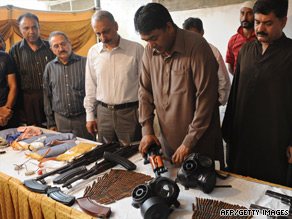 Pakistan security officials show seized weapons
and ammunition in Karachi on Sunday after
the arrest of seven alleged militantsPakistani authorities have launched a massive crackdown on terror groups that they say were planning numerous suicide attacks, including in the country's largest city of Karachi. At least 24 suspects were arrested Sunday and Monday, including three people carrying suicide jackets and explosives inside a bus station, a police official said. The three were seized early Monday after police raided a bus station in Sargodha, a city located about 190 kilometers (120 miles) south of Islamabad in Pakistan's Punjab province.The suspects were plotting to attack two Shiite mosques, police stations, and a Norwegian telecommunications company in Punjab, according to district police officer Usman Anwar. Three other suspects linked to the plot were arrested hours later in Sargodha, he said. The arrests come a day after the Pakistani Taliban's chief in Punjab was arrested, along with five others, according to Anwar. The Taliban in Punjab have direct ties to Baitullah Mehsud, the former head of the Pakistan Taliban, and have been accused of sectarian murders in Punjab. Pakistan and U.S. officials contend Mehsud was killed in an August 5 drone attack in Waziristan at his father-in-law's house. The Taliban claim Mehsud is alive but ill. Hakeemullah Mehsud has been selected as the new head of the Pakistani Taliban, a Taliban commander said Saturday. Pakistani authorities also said they thwarted planned attacks in the southern port city of Karachi, Pakistan's largest city and the capital of Sindh province. Five suspected members of the Pakistani Taliban were seized Sunday in Karachi, along with suicide vests and a large quantity of ammunition, according to the city's police superintendent Mohammed Fayyaz Khan. Read more here ... Source: CNN
 Hakimullah is said to be a powerful commander
who operates from the Orakzai tribal districtThe Pakistani Taliban have said that they had appointed Hakimullah Mehsud as the new chief of the movement. The announcement was made by Maulvi Faqir Mohammad, the deputy of Tehrik-e-Taliban Pakistan (TTP), or Pakistani Taliban Movement, on Saturday. Mohammad said that Hakimullah Mehsud had been unanimously appointed by the movement’s shura (council) as successor to Baitullah Mehsud at a meeting in north Pakistan on Friday. "The shura has appointed Hakimullah as successor to Baitullah Mehsud. The shura earlier had nominated me as the acting chief but now I will be again deputy chief," Mohammad was quoted as saying. "I shall continue to be ameer (chief) of TTP in Bajaur," he said. Read more here ... Source: Al Jazeera (English)
 |
|
|
Copyright Muslims Against Sharia 2008. All rights reserved.
E-mail: info AT ReformIslam.org
|
|
|


 A raid by a US drone in northwest Pakistan has killed at least 12 suspected opposition fighters, Pakistani officials have said.


 Posts


