 THE young woman killed during the June election protests in Tehran was an agent for the United States and Britain who faked her own death, says a documentary made by Iran state television. THE young woman killed during the June election protests in Tehran was an agent for the United States and Britain who faked her own death, says a documentary made by Iran state television. Neda Agha Soltan, 27, became a symbol of Iranian democratic resistance when her death was filmed on a mobile phone and then posted on YouTube, where it was watched by millions of people. It was then broadcast around the world by news organisations. Yet a documentary shown on Iranian state TV claims she wasn’t dying, but had simply poured blood on her face from a hidden bottle, reports Radio Free Europe/Radio Liberty, a group of journalists who cover 20 countries where a free press is banned or not established. "While Neda is (pretending) she is injured and is lying on the back seat of the car on their lap, they bring out a handgun from their pockets," the documentary's narrator says. "A handgun that they obtained from their Western and Iranian friends to water the tree of reforms and kill people and create divisions within society. "Neda, for a moment, realises their wicked plan and struggles to escape, but they quickly shoot her from behind." RFE/RL reports Iranian officials have repeatedly described her death as "suspicious" and a "premeditated scenario" to defame Iran. Dr Hejazi has denied being in the car, and told RFE/RD: “A young innocent woman was shot dead while protesting. Since her killing, until today, the Iranian government has been doing all it can to distance itself from it and throw the responsibility on others, instead of acting responsibly and dealing with those who are guilty." Dr Hejazi said Tehran kept changing its story about Neda's death. "Their first reaction was that she was alive," he said. "Then they said the footage was fake. "One day they said a BBC reporter killed her. Then they said it was the CIA. Then they said the (Mujahedin) Khalq Organisation was behind it. "The latest is this documentary." In June, tens of thousands of Opposition supporters rallied in Tehran in defiance of an official ban on protests over Mahmoud Ahmadinejad's presidential election win. At least 10 people were killed and more an 100 wounded when security forces cracked down on the protesters. Read more about this story of Neda's faked death at Radio Free Europe/Radio Liberty. The Australian
 A document has been published by Planet-Iran.com that, if genuine, was written by a Brigadier-General in the IRGC discussing plans for Ayatollah Khamenei and other high-level officials to escape to Russia if the regime falls and the inspection of his escape jet. A document has been published by Planet-Iran.com that, if genuine, was written by a Brigadier-General in the IRGC discussing plans for Ayatollah Khamenei and other high-level officials to escape to Russia if the regime falls and the inspection of his escape jet. And some news from our Iranian sources: - In Tehran, protestors are wearing the Kafan, which is the white sheet Muslims use to wrap bodies before they are buried. People are being shot at on Saadat Abad and Enghleb Streets. The regime has sent in armored vehicles.
- At 15:30, electric buses near the area were closed. At least one metro station in Tehran has also been closed.
- In the morning, a fire was started in the basement of the Ebne Sina building at Sharif Industrial University. The Basiji claims the students started it, but the students say the Basiji did it.
- Security forces are refusing to let buses stop at Tajrish Square, north of Tehran.
- At Vali-e-Asr/Motahiri, students clashed with security forces. When the regime operatives tried to arrest the protestors, people nearby intervened and enabled them to escape.
- One eyewitness who went to Neda’s grave at Behest-e Zahra cemetary in Tehran said that groups of two or free were visiting it at a time during the entire two-hour period he was in the area. Security forces filmed everyone that came, but this did not stop them.
 A BRITISH newspaper has named an Iranian woman shot dead during protests against her country's disputed June elections as its "person of the year". A BRITISH newspaper has named an Iranian woman shot dead during protests against her country's disputed June elections as its "person of the year". The Times said Neda Agha-Soltan became a "global symbol of opposition to tyranny" after images of her bleeding to death during the protests in Tehran were shown around the world. "Ms Soltan, 26, joined the protest because she was outraged at the way that the regime stole the presidential election," the newspaper said on its front page that included a photograph of protesters holding pictures of her. "She wanted to make a difference, she said. She had no idea quite what an impact she would have. Mobile phone footage of her bleeding to death on a pavement flashed around the world. "It tore the last shreds of legitimacy from the regime, made her a global symbol of opposition to tyranny, and inspired the Green Movement in a region where populations are all too easily cowed." Hundreds of thousands of opposition supporters poured into Iranian streets in week-long protests in June over the re-election of President Mahmoud Ahmadinejad, saying the vote was rigged. The demonstrations were suppressed following a call by supreme leader Ayatollah Ali Khamenei, who gave his strong backing to President Ahmadinejad and warned the opposition against continued street protests. The opposition movement has continued however to mount protests, with some members wearing the colour green in support of defeated rival presidential candidate Mir Hossein Mousavi. Iran last month reportedly denounced Oxford University after one of its colleges set up a scholarship in honour of Ms Soltan, accusing it of joining a "politically motivated" campaign. The Australian
 Can a deceased ayatollah offer in death what no one alive seems to be able to provide: a single, unifying figure for Iran's opposition? Can a deceased ayatollah offer in death what no one alive seems to be able to provide: a single, unifying figure for Iran's opposition? That's the central question that emerges from the weekend death of Grand Ayatollah Hossein Ali Montazeri, a towering figure in the history of Iran's revolutionary government. At the time of his death, he was perhaps the most credible face of the country's persistent opposition movement. The role Ayatollah Montazeri will play in death will come into clearer focus during the next two weeks. His admirers began to vent their sorrow Monday in funeral processions, at the outset of a 10-day religious holiday that figures to produce more public shows of opposition. Ayatollah Montazeri was a religious leader of considerable import -- indeed, he once was designated to become the nation's supreme religious leader -- but in the past six months was most noteworthy as the senior religious leader most openly sympathetic with the opposition movement that sprang up in Tehran's streets after June's disputed presidential election.
Yet at 87 years of age, in poor health, and restricted to the holy city of Qom, he was never likely to become the active leader of a movement opposing the regime of Supreme Leader Ayatollah Ali Khamenei and President Mahmoud Ahmadinejad. Indeed, one of the most serious shortcomings of the opposition movement, despite its resilience in the face of concerted government attempts to squelch it, has been the absence of a catalytic personality to serve as its heart and soul.
The logical leader should be Mir-Hossein Mousavi, the presidential candidate who appeared to be robbed of his chance at victory in that June election. But he is too reserved and cautious by nature, and too vulnerable to pressure from the government, to have really stepped into that role. Mehdi Karroubi, former speaker of the Iranian parliament, and Mohammad Khatami, the former Iranian president, both also have become champions of the reform movement. Yet they also are equally exposed to government pressure. In death, though, Ayatollah Montazeri will be immune from government pressure and intimidation. His withering criticisms of the regime are on the record, and can't be compromised. It isn't unusual for revolutionary and counter-revolutionary figures to provide inspiration from the grave. Indeed, the Iranian opposition already has, to some extent, one such figure, albeit of far less stature: Neda Agha-Soltan, the 26-year-old woman whose death at the hands of government agents trying to suppress a street protest was captured on video and galvanized government foes in and out of Iran. History offers other examples. Newspaper publisher Pedro Chamorro, murdered by enforcers for Nicaraguan dictator Anastasio Somoza Debayle in 1978, became the rallying figure for the Nicaraguan revolution in following years -- and, ultimately, the galvanizing figure for the counter-revolution that followed. Similarly, both the Cuban revolution led by Fidel Castro and the counter-revolutionaries that resisted him rallied around a deceased Cuban nationalist, Jos[eacute] Marti. The potential role for Ayatollah Montazeri as an opposition icon lies not just in his vocal dissents in the latter months of his life, but in the outsized role he played in his country's history over the past quarter-century. It's a role that may not be immediately apparent to those who don't follow Iranian politics closely. More at WSJ 
 By FARNAZ FASSIHI By FARNAZ FASSIHI At the height of Iran's bloody civil unrest this year, a young doctor named Ramin Pourandarjani defied his superiors. He refused to sign death certificates at a Tehran prison that he said were falsified to cover up murder. He testified to a parliamentary committee that jailers were torturing and raping protesters, his family says. He told friends and family he feared for his life. And on Nov. 10, the 26-year-old doctor was found dead in the military clinic where he lived and worked. The family of Dr. Pourandarjani, who occasionally treated prisoners in fulfillment of Iran's obligatory military service, says he was killed for his refusal to participate in a coverup at the notorious Kahrizak detention center, widely criticized for its unsanitary conditions. In a series of interviews over three weeks, Dr. Pourandarjani's family spoke in detail for the first time about their son's mysterious death. Iranian officials first blamed the doctor's death on a car accident, then a heart attack, then suicide and then poisoning, according to family members and government statements. The controversy over his fate is transforming the doctor into a martyr for the opposition movement challenging the legitimacy of Iran's rulers. In a sign of his mounting symbolic importance, on Dec. 8 Iran's national prosecutor, Gholam Hossein Mohseni-Ejei, was pressed by local reporters at a news conference for answers. He said the case remains under investigation. Mr. Mohseni-Ejei couldn't be reached for comment. A spokesman for the Iranian Mission to the United Nations said the case is being probed and declined to answer questions. "I sent off my young, healthy and beautiful son to military service, and I got his dead body back," says his mother, Ruhangiz Pourandarjani, who lives in the northwest city of Tabriz. "Anyone who says he committed suicide is lying and should be afraid of God." In Iran, protestors now carry the doctor's picture in street marches and chant his name along with that of Neda Agha Soltan, the young woman whose shooting death in June was captured on video and broadcast world-wide. A popular new slogan at some marches: "Our Neda is not dead, Our Ramin is not dead, it's the Supreme Leader who is dead," a reference to Iran's Ayatollah Ali Khamenei. Mothers of individuals killed in Iran's antigovernment protests this year have formed a support group, Grieving Mothers, who march silently Sunday afternoons at Laleh Park in Tehran holding pictures of their dead children. This month, security officials arrested 15 members. They were freed a few days later when crowds gathered near the jail, demanding their release. The opposition says more than 70 Iranians have been killed since June in a crackdown on the protests that erupted after the nation's disputed presidential election. The government says 17 people have died, including a dozen of its own security forces. Iran denies allegations that jailed protesters were tortured or raped and blames the deaths in Kahrizak on a meningitis outbreak. The prison has been closed in the wake of torture allegations there. An influential Iranian parliamentarian and former health minister, Masoud Pezeshkian, is pressing for a full investigation of Dr. Pourandarjani's death. The claim of a suicide by "someone who was a witness in Kahrizak, and has no background for mental illness, is suspicious," he told local news agencies. More at WSJ
 Yemen has renamed Iran Boulevard, a street in its country, to Neda Soltan Street, named after the young female protestor who was shot and killed in June on videotape that quickly spread around the world. Yemen has renamed Iran Boulevard, a street in its country, to Neda Soltan Street, named after the young female protestor who was shot and killed in June on videotape that quickly spread around the world. Her name has since become a rallying cry for Iranian opposition activists of all kinds and human rights advocates around the world. Yemen isn’t exactly a model for human rights, but they deserve applause for giving recognition to Neda and in so doing, giving the Iranian regime a much-needed slap. This move by Yemen came after Iran named a street in Tehran after the founder of the extremist Houthi rebels currently fighting the Yemeni and Saudi governments. World Threats
 Martin Fletcher The death of Neda Soltan in the protests that followed the Iranian presidential election touched the world, but what of the doctor who went to her aid?
As Arash Hejazi sat in an Oxford coffee bar, members of Iran's Basij militia in Tehran were demanding his extradition outside the British Embassy.The previous day the Iranian regime had sent an Oxford college a letter of protest over a scholarship given to honour Neda Soltan, the student killed during a huge demonstration against electoral fraud in Tehran in June. The letter also suggested that Dr Hejazi was responsible for her murder. For Dr Hejazi, who had tried to save Ms Soltan's life, that was the final straw. He decided that it was time to speak out. It was time to reveal how the regime has sought to vilify, punish and silence him ever since he told the world, immediately after Ms Soltan's death, how she had been shot by a government henchman for peacefully protesting against President Ahmadinejad's disputed re-election. Dr Hejazi is now living in exile in Britain, jobless and fearful, while back in Tehran the regime blackens his name and hounds his friends, family and colleagues. "I told the truth. I just did what I had to do, but there were dire consequences," he told The Times. In short, a quirk of fate - that he happened to be standing near Ms Soltan the moment that she was shot - has turned his entire life upside down and made him "another victim of tyranny". Dr Hejazi, 38, was doing a one-year postgraduate course in publishing at Oxford Brookes University at the time of the June 12 presidential election, and returned to Tehran on a business trip the following day. On June 20 he was caught up in a street protest when he heard a blast, looked around and saw blood gushing from the chest of the woman next to him. She collapsed. Dr Hejazi, who had trained as a doctor before switching to publishing, tried in vain to save her life. Within hours a video clip of that scene had flashed around the world, transforming Ms Soltan into a symbol of the regime's brutality and of the Iranian people's battle for freedom. So powerful were the pictures that Dr Hejazi, realising that the regime would try to suppress the truth, fled back to his wife and infant son in Britain. A few days later, in interviews with The Times and the BBC, he told how Ms Soltan was shot by a Basiji on a motorbike who was swiftly caught by other demonstrators. Dr Hejazi's troubles began almost immediately. His father, a university professor, was interrogated for hours and ordered to tell his son to shut up. Senior officials in the regime asserted that Ms Soltan had been killed by foreign intelligence agencies, and that Dr Hejazi was part of an international conspiracy to undermine the Islamic republic. He was denounced in the state-controlled media. Iran's police chief declared him a wanted man. Read more ...Source: The Australian
Latest recipient of The MASH Award

 Iran has protested to an Oxford University college over a scholarship in memory of the slain Iranian student who became an icon of mass street protests sparked by the disputed June election. Iran has protested to an Oxford University college over a scholarship in memory of the slain Iranian student who became an icon of mass street protests sparked by the disputed June election. In Tehran, a small group of hard-line women demonstrated Wednesday against the scholarship in front of the British Embassy. The women chanted "Death to Britain," the semi-official Fars news agency reported. Oxford's Queen's College established the Neda Agha Soltan Graduate Scholarship in Philosophy earlier this year, named for the 27-year-old student fatally shot on June 20 on the sidelines of a Tehran demonstration. Her dying moments were caught on a video viewed by millions on the Internet, and she became a potent symbol of the opposition's struggle. "It seems that the University of Oxford has stepped up involvement in a politically motivated campaign which is not only in sharp contrast with academic objectives" but also linked to British interference in Iran's post-election turmoil, Iran's Embassy in London said in a letter to the provost of the British university's college. Queen's College confirmed it had received the letter dated Tuesday. Iran has in the past accused Britain of playing a role in the protests following the June 12 presidential election and meddling in its internal affairs. The opposition said President Mahmoud Ahmadinejad won the election by fraud. But hard-liners have described the massive protests as a plot by Iran's enemies to overthrow the system of clerical rule through a 'velvet revolution.' The Iranian letter said Soltan's "suspicious death" is still a criminal case being investigated by the police at home.
It said she had been shot on an isolated street far from the protesters and her "murderers" had filmed her and her companions for 20 minutes before the killing. Read more here,,,, Source: FoxNews
 These events have been reported to World Threats. These events have been reported to World Threats. A large number of women participated in the Student’s Day protests of November Fourth. At Tehran University female students chained hands and stood in front of male students to keep the men from being beaten.
In an incident on Karimkand Zand St., a young lady clashed with plainclothes officers. It took a mass attack by Basij to arrest her. A large number of women were arrested during the protests. Reports from Tehran are that the demonstrations lasted until at least 8:30 PM.
Chants of “Khamenei is a murderer his leadership is invalid” and “death to the dictator” were heard after 9:00 PM. At least 400 of the residents of Tehran who were arrested on November Fourth have been transferred to Evin Prison. Three foreign reporters have been jailed. One Japanese and two Canadians were arrested because they didn’t have official permission to report on the events. Farhud Pooladi of Agence France Presse was also arrested. The gravestone of Neda Ahga Soltan was broken by SSF agents during a gathering of people at her grave site. A tear gas canister was fired directly at Karrobi during the November Fourth protests. He was prevented from entering Haft-e-Tir Square during the protests. The head of the Revolutionary Guards Corps has admitted the threat to the regime posed by the people. He said, “today RGC is ready to confront any threat against the Islamic Republic. The enemies of Islamic Republic by softly threatening the state are aiming at the beliefs of the Moslem Iranians and are spending high amount of money to reach this goal.” (Would that it were so.) Ayatollah Bayat Zanjani, a former parliamentary deputy, has said, “try to free all the detainees of the events after the revolution as soon as possible and know that keeping them in jail just like their detention is against canon law.” The regime is using hangings to attempt to intimidate the populace. Six prisoners were hanged recently: four in Kerman Prison, one in Zahedan and one in Borojerd. Source: World Threats
 These events have been reported to world Threats. University students continue their resistance to the Iranian government.
Students of the School of Human Sciences of Allameh Tabatebei University and students from Payame Noor Nniversity and the School of Law demonstrated on Oct. 25th. The students of Azad University in Tehran are distributing anti-regime leaflets nightly. In a Friday Sermon on October 24th, Mullah Sedighi began laying the foundation for a cultural revolution against the universities. He also supported the inhuman bill of Ghesas (eye for an eye) and called it a blessing. He said, “we have hired our law, psychology, sociology and other branches of Human Sciences from west.
Sometimes some of our professors are influenced by west and their knowledge is also influenced by west. This framework doesn’t match our society. Our religion is the most important issue and this framework doesn’t comply with it. Some jurists cannot even bear the Islamic laws of punishment or Islamic rights for women and other issues in their classes and they talk about this opposition too.” The government has installed additional satellite TV jammers in Tehran, Abadan, Ahvaz and Bushehr. Sunni clerics have been banned from leading Friday prayers in Kermanshah, Kurdistan. Labor protests at the Pipe Manufacturing company in Avaz continues. Labor unrest due to non-payment of wages has extended to the Alborz Chinaware Company in Alborz Industrial City. The official newspaper Jomhori in its editorial under the title of Nuclear Turnover, Never wrote, “These days we are witnessing events during the nuclear negotiation with the 5+1 group in our diplomacy that we must give them a second thought.
With a little negligence years of efforts of country’s managers and scientists will be in vein. So during the negotiations we shouldn’t surrender the efforts and struggle of our scientists as a gift to westerners. Our board of negotiation must be aware that we will never want to stop our enrichment and halt our nuclear progress.” After the United Kingdom Treasury Department put sanctions on the Bank Melat and its shipping company, Iran’s ambassador protested the sanctions in letters to the House of Commons and the House of Lords.
The ambassador said, “this inappropriate decision of the British Government will damage the interests of million of private shareholders and customers of the bank and shipping organization. It will also damage England’s legal system as well as the mutual relations between two countries. The government continues to threaten Mousavi. One hundred of 290 members of the Majlis have signed a letter of complaint against Mousavi. Then again, 190 didn’t sign the letter. At the International Exhibition of Media and News Agencies the Russian booth was closed. Nobody went to see it. And: These events have been reported to world Threats. Mullah Imani Kashani is no longer allowed to lead Friday Prayers in Tehran. That position is now filled by supporters of the current administration: Mullah Janati, Ahmed Khatami and Mullah Sedighi. Some residents of Tehran are putting flowers on the graves of martyrs nationwide. November fourth is Students Day. Might be an interesting day. Reports from Karaj Gohardasht Prison solitary confinement area rioted against the conditions of their incarceration. The riot lated until 9 PM when the prison authorities used tear gas and beatings to reestablish control. Young people are writing the name Neda on various traffic signs in the city of Yazd. Anti-government graffiti continues to appear around the nation of Iran. The graffiti says things like “Khamenei is a criminal. Death to Khamenei.”, “Death to dictator”, “Khamenei be ashamed and leave my country alone”, “Death to the leader. Death to Ahmadinejad”, “Neither Qaza (Gaza) nor Lebanon I sacrifice my life for Iran”. People are writing anti-regime slogans on the Iranian currency. The Kurdistan Province’s Department of Education has forced the principals of the schools to get signed pledges from parents that their students will not participate in demonstrations on Students day. Source: World Threats
By Gramfan According to the Merriam-Webster Dictionary Feminism is defined thus: Date: 1895 1 : the theory of the political, economic, and social equality of the sexes
2 : organized activity on behalf of women's rights and interests Who can ever forget the iconic cover of "The Female Eunuch", by Germaine Greer? It was everywhere when it was first published in 1970. It was virtually the next best thing that had happened to women since Emmeline Pankhurst and her Suffragettes worked to get women the vote. So we were told. And certainly you cannot deny the benefits and progress that have come from these two women, and the many others who have taken over the baton and changed the lives of millions. Many of today's other famous feminists are living very comfortably on self-earned wealth: fine with me, it's well-deserved. They have turned their politics and activism into income sources by working in journalism and other media. People listen to them. They have power, enormous power. Camille Paglia is but one of many whose opinions are highly respected, and it is easy to see why. Germaine Greer is still going on strongly about all kinds of issues. Gloria Steinem is another member of this esteemed crowd and there are also very many not-so-famous feminists. These feminists are in almost all professions from politics to pianists, parents and yes, prostitutes - the oldest "profession" of them all! Then of course there are the other women in the world who don't occupy this rarified space but who have decided, and yes, it is a decison now, to become home-makers and mothers. Some of them decide to resume successful careers and some chose not to. But I wonder if we all really received so many benefits from all these feminists? Some of us didn't. With all that is good and liberating in human progress there are often side effects and "unintended consequences". Sadly there are goals that have not, and will not be achieved. Certainly many of us get equal work for equal pay nowadays but not all of us. Then there are those who chose to be wives and mothers, who are often scorned, or looked down upon, for their choices. They had jobs, but feminists weren't satisfied; every other woman had to get one too. So they opened fire on homemakers with a savagery that still echoes throughout our culture. A housewife is a "parasite," [Betty] Frieden writes; such women are "less than fully human" insofar as they "have never known a commitment to an idea." And.... Housewives, not men, were the prey in feminism's sights when Kate Millett decreed in 1969 that the family must go. Feminists do not speak for traditional women. Men cannot know this, however, unless we tell them how we feel about them, our children, and our role in the home. Men must understand that our feelings towards them and our children are derided by feminists and have earned us their enmity. Whether or not this understanding garners men's support, traditional women must defend ourselves because the feminist offensive is, most essentially, a breach of solidarity with us, a disavowel of the obligation to honor the Women's Pact [that religious celibates, professional women, and homemakers respect each other] that women in the movement owed to us (Source). Oh yes, this site has more. Feminism today goes on and on, intellectualising and re-defining feminism to the extent where it is almost too difficult to follow, let alone comprehend. Quite frankly I am more interested in the practical day-to-day realities. I take the two definitions at face value and I note it doesn't specify any nationality,political allegiance or religion. 1 : the theory of the political, economic, and social equality of the sexes
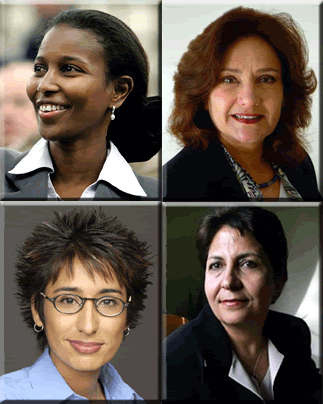
2 : organized activity on behalf of women's rights and interests It is true a lot of this has happened in the West but rather than have Greer et al espouse "intellectual yada yada" I would rather see these women get militant again and do something to help their long-suffering sisters who live in Islamic countries, and who can but only dream of the lifestyle many of their famous feminist sisters enjoy. All too often I see stories of honour killings, rape, female genital mutilation, subservience, domestic (and other) violence, forced marriage and utter discrimination perpetrated against women in Muslim countries and now also in the West. Some women are getting hymenoplasties and buying repair kits before they marry. Some are being recruited as homicide bombers. One is punished for drinking beer, others face lashings or stonings. An Australian Islamist tries to justify polygamy for everyone. There are women who suffer terribly from acid attacks quite frequently. Women in Gaza are not allowed to ride motorcycles, and Somali women are being scrutinised when wearing a bra! Where's Germaine when you need her, or would this make her happy I wonder? And recently we have the on-going case of Rifka Bary who, as a minor, cannot chose her religion, and could become a victim of honorcide for apostasy. If she is sent back to her parents her fate is unknown. If she is allowed to remain alive the Islamists can deny honorcide even exists. This is happening in the USA now. Yet in spite of these incidents feminists like Naomi Wolfe manage to defend discrimination towards women in Islam and it then takes a compassionate feminist, Phyllis Chesler, who has actually lived in a Muslim country, to sort it out for her! I know many feminists, and women in general, can be fearless fighters. Code Pink, for example, have gone to Iraq and Afghanistan. True, they are an anti-war movement, but perhaps, just perhaps, they could have drawn some attention to the women who live and suffer in the war zones they are so adamantly against. They could have easily added one more mission statement to what is on their website which mentions "social justice". Indeed, any other anti-war group could easily have done the same. I know they do not define themselves as feminists per se, but why not do more? Could they not have met with Malalai Joya and offered some help? Indeed, could not some of our famous feminists, female politicians and celebrities who spend so much time choking on their own venom over Sarah Palin have done the same? Are they afraid? Or are they simply not interested in the women's issues of today because they think it is another culture and therefore they shouldn't interfere. They know it isn't right but they can turn a blind eye to it, even as it happens under their noses, in their own countries. It's a cop-out. The improvement of the condition of women in Islam is, to me, a far loftier goal than getting to wear trousers, getting equal pay, getting an abortion on demand, and having a man treat a woman more like a man! This was definitely an "unintended consequence" for me: trivial as it may seem. I am much heartened by the fact that progress is being made, albeit in small steps. Kuwati women in parliament refuse to wear the veil. An Egyptian Cleric wants to ban burquas and other facial coverings. Honor killing or Honorcide is getting more attention. Lubna Hussein got a lot of media attention over her sentence for wearing trousers. Najwa Bin Laden and her son, Omar, wrote a book about their husband and father, Osama, and seem to be fearless about it. They have provided a fascinating insight into this man. I think the real "feminist"heroines now are the ones who have literally put their lives on the line, not only for women in Islam but for the world in general. Their goals and committment are what is truly deserving of our respect and support. I am referring to women like Dr Wafa Sultan, Ayaan Hirsi Ali, Nonie Darwish, Supna Zaidi, Irshad Manji and women like them. There is another one who would have possibly made it to this list: Neda Soltan. Tragically she cannot, but in spirit she can inspire so much. I feel she deserves a mention among these brave, dedicated and fascinating women. This is my challenge to todays feminists. Use your power again. I am "just a Mom". I do not have your platform and power. This is indeed a most worthy cause to support and fight for. ("Gramfan" has been 'blogging since 2002. She is "just a Mom" of two grown-up sons, and helps her husband of 38 years. She has occasionally written pieces for other 'blogs, and posts comments. She now writes exclusively for Muslims Against Sharia).
 These events have been reported to world Threats. Guidance Patrols have returned to Sharif Industrial University. These patrols consist of groups of three ladies in full black chador. They patrol the campus and warn female students who are not dressed in conformity with what they consider Islamic rules. The female students are forced to sign written promises not to enter the university without conforming to the current rules of Islamic dress. The mother of Neda Agha Soltan has rejected offers of support from the Foundation of Martyrs and demanded that the murderer of her daughter be identified. The Revolutionary Guards Corps is purging the Corps of its older members. The people being retired are mostly those who participated in the Iran-Iraq War. Those who retire will have their wages doubled. Mullah Janati, Secretary of the Guidance Council, has called the current revolution in Iran a “political earthquake”. He said, “as people learn how to pray they must learn political rules too.
They must learn in what status we are and what our duty is. As we know that when it is noon we must pray or where there is an earthquake we must pray. We must know what to do when there is apolitical earthquake. Speaking among the members of the so called Headquarters of the Decade of Dawn. “Supreme Leadership is one of the main pillars of the Islamic System. If the Supreme Leadership is taken away from us nothing is left.
Those who think of striking on the Islamic system, their main goal is to strike on the Supreme Leadership and its weakening. We have had reports from their private meetings that there will be no supreme leadership. They said they will not allow Khamenei to execute its power. Here the issue is weakening the Supreme Leadership. The Ahmadinejad Regime has attacked Rafsanjani for his plan to turn the position of Supreme Leader into a Leadership Council. The Security Commission of the Majlis (Parliament) has discussed has discussed trying Karrobi and Mousavi for the first time. The RGC has established new jamming systems to attempt to jam the Simaye Azadi television network. The Iranian supreme Court has approved the execution of Sohelia Ghadiri. Source: World Threats
 One dreadful day, the bullet of a henchman of tyranny pierced the young heart of Neda Agha Sultan, and she collapsed on the pavement, gasped for air as her crimson blood painted the black asphalt. Her music teacher along with a young doctor tried desperately to revive her. They kept frantically telling her not to be afraid, not to be afraid. The music teacher was witnessing the death of his young student and all he could do was to breathe encouragement in the vain hope of keeping her alive. Her mouth began to spurt blood and her eyes rolled to the side. As people crowded around her in screams and wails, she stared peacefully into the cell phone camera that captured the final moments of her life. Neda, the young and beautiful freedom-loving Iranian music student was slain in cold-blood by the current Islamic regime in Iran. Almost instantly, Neda became, not only the divine call of the Iranian revolution, but she symbolized the call for liberty around the world.
Like millions of people around the globe who were profoundly saddened by the untimely death of a young and innocent Iranian woman, the Master Sculptor, Paula Slater, was also deeply affected by the death of Neda on that graphic video. In fact, waves of human soul cried out loud for the injustice in Iran.
This was the moment of unity, people of all races, classes and nationalities became one people and one voice in expressing their revulsion at the barbarity of a murdering regime and its savage henchmen.
No sooner the final shovels of dirt covered the precious body of Neda that on the other side of the world Paula—a distinguished artist and daughter of humanity – devoted endless hours sculpting a bust of the murdered young woman.
No one commissioned this talented artist, no one even asked her to do the magnificent work of immortalizing Neda. The sensitive artist later reported: “My schedule was packed with Public Art commissions to complete, but I was so saddened by the tragic events in Iran that I needed to turn the pain I felt into art before I could proceed with my other sculpting projects.” Read more here ... Source: Amil Imani
Latest recipient of The MASH Award
 by Shirin Ebadi The post-election crackdown has not quelled our spirit: democracy will help us achieve equality. Iran today is a country where women are more educated than their male compatriots; more than 60% of university students are female, as are many university professors.
Iranian women obtained the right to vote and become members of parliament half a century ago – earlier than women in Switzerland, who achieved this right in 1971. Since that time at least a small number have been present in Iran's parliament.
Even the present parliament, which is monopolised by hardliners, has 13 women members. In governments, women have often held senior positions.
Even the health minister in Mahmoud Ahmadinejad's cabinet is a woman. All this is proof that women have managed to rise within the ranks of the fundamentalists. And yet despite the cultural, social and historical heritage of Iranian women, the Islamic Republic has imposed discriminatory regulations against them.
A man may marry up to four wives and divorce them whenever he desires. But mere will is not enough for a woman to divorce her husband. Similarly, according to Iranian law, the life of women is worth half of the man's life in terms of blood money. When drawing up compensation after an accident, women receive half the amount allocated to men. During a trial, a declaration by a man is worth twice that of a woman. Women also require their husband's permission to work, travel or leave the country. These laws run counter to the role of women within Iranian society. Should the health minister wish to attend a meeting of the World Health Organisation, she must receive her husband's assent. It remains unclear what would happen if her husband refused – Iran's seat at the WHO might remain vacant. The laws imposed on Iranian women are incompatible with their status and, consequently, the equality movement is very strong. Although lacking a leader, headquarters, or branches, the movement is located in the home of any Iranian who believes in equal rights for men and women. Read more here,,,, Source: The Guardian
 IRANIAN President Mahmoud Ahmadinejad has told US television that Tehran has no need of nuclear weapons, while expressing regret over protestors' deaths during violent demonstrations which erupted after June's disputed elections. IRANIAN President Mahmoud Ahmadinejad has told US television that Tehran has no need of nuclear weapons, while expressing regret over protestors' deaths during violent demonstrations which erupted after June's disputed elections.
Ahmadinejad made the remarks on NBC television ahead of Iran's scheduled meeting with the United States and five other powers on which are demanding that Tehran halt its disputed nuclear program.
"We have always believed in talking, in negotiation. That is our logic, nothing has changed,'' Ahmadinejad told NBC television.
"Nuclear arms, we believe they belong to the past and the past generation,'' he said through an interpreter. "We do not see any need for such weapons.''
Asked by NBC's Ann Curry if he could issue a clearer statement ruling out Iran's obtaining such weapons, he replied: "You can take from that whatever you want Madam.''
In the interview filmed on the grounds of the Presidential Compound in Tehran, Ahmadinejad said that he regretted the deaths of protestors killed during demonstrations over his re-election.
"All of us regret the fact that some people were killed,'' Ahmadinejad said, in excerpts of the interview which will air in full on Sunday.
The unrest officially left about 30 people dead - opposition groups claim 72 died - and isolated Iran even further from world powers who are threatening fresh sanctions over the country's suspect nuclear program.
The Iranian president added he had also been saddened by the death of a young woman, Neda Agha-Soltan, whose killing during a protest rally in Tehran generated an international outcry.
"I was saddened, as well all the Iranian people were saddened,'' he told NBC Thursday.
But he added: "We think that this incident is a suspicious death. We are treating it as a suspicious death. We are very sorry about this and I am sure that the truth will come to light.''
Neda, as she is more commonly known, became an icon for the opposition which is protesting Ahmadinejad's re-election, after an Internet video showing her final moments was seen around the world.
Ahmadinejad has already called for a probe into her death, saying there had been fabricated reports about the incident and "widespread propaganda'' by the foreign media.
The president went on to accuse the US and British governments of trying to "damage and hurt the Islamic Republic of Iran" by encouraging rioters.
"They were totally wrong in their assumption," Ahmadinejad said of statements of support for the protesters from President Barack Obama and British Prime Minister Gordon Brown. "What they did was heinous."
The post-election protests were not evidence that the election was tainted, Ahmadinejad said, but proof that "any person can express his or her point of view ... within the confines of the law."
Ahmadinejad also defended the legality of his re-election, saying that he didn't "see any problems" and that "the law prevails".
The interview was conducted a week before Ahmadinejad is scheduled to address the UN General Assembly and a fortnight before multilateral talks begin on Iran's nuclear program, the first involving Iran since 2008.
AP reported on Thursday the International Atomic Energy Agency concluded that Iran does have the ability to make a nuclear bomb, but the agency later issued a statement, saying it had "no concrete proof" of a nuclear weapons program.
The United States, which suspects Iran may be using its uranium enrichment program as a cover for building a nuclear weapon, wants more explicit answers from Iran in the upcoming talks.
Iran denies the charge, saying its program is for peaceful nuclear energy.
Secretary of State Hillary Clinton said Tuesday that Iran must answer "head on'' concerns about its nuclear program at the meeting even though Tehran has so far ignored such appeals.
Clinton said the point of the meeting between Iran and the United States, Russia, China, Britain, France and Germany is to test Tehran's readiness to discuss such concerns.
Washington will be taking its dual track, or carrot-and-stick, approach to the meeting, Clinton added.
The UN Security Council has imposed three sets of sanctions against Iran over its refusal to freeze its uranium enrichment activities and Washington has threatened to push for new sanctions if engagement with Iran fails.
The six powers are offering diplomatic, trade and other benefits if Iran cooperates.
The six powers - which represent the five veto-wielding permanent members of the UN Security Council plus Germany - had called for urgent talks with Iran after it handed over the proposals last week.
Washington expressed disappointment with the package, saying it was "not really responsive to our greatest concern,'' which is the nuclear issue, but Moscow said it offered "something to dig into.''
According to a copy of the proposals obtained and published by US non-profit investigative journalism group, Pro Publica, Iran said it was prepared to hold "comprehensive, all-encompassing and constructive negotiations.''
 Abbas Kargar Javid, as identified on his ID card posted on the Abbas Kargar Javid, as identified on his ID card posted on the
internet, has been accused of killing Neda Soltan. August 19 The man accused of killing Neda Soltan has been identified as Abbas Kargar Javid, a pro-government militiaman, after photographs of the Basiji’s ID cards appeared on the internet. The identification challenges the Iranian regime’s claim that foreign agents shot the young woman, who became a global symbol of resistance to the Government of President Ahmadinejad. Soltan's June 20 shooting shocked the conscience of world leaders and millions more who watched videos posted online that showed her slowly bleeding to death. One picture of Javid appears on his Basij identification card, which was taken off him by the crowd that stopped him briefly when he fled the murder scene during a massive demonstration against electoral fraud on June 20. Photographs of that card and another that was issued by the Interior Ministry have been posted on the internet, and Arash Hejazi, the doctor who tried to save Soltan as she lay dying on a Tehran pavement, has confirmed that they show the man who was stopped. Hejazi said that he had checked with others who witnessed Javid’s detention and they, too, had confirmed that it was the same man.
He expressed disgust that a regime that had detained, tortured and killed so many peaceful demonstrators in the past ten weeks had — as far as he knew — taken no action against Javid. Source: Fox News
 The Iranian people are calling for help and much of the world either turns a deaf ear or feels it has its own priorities to worry about. Then, the horrors keep playing out, unabated, in the streets, prisons and dungeons of the Islamic Republic of Iran. A reality check. A 19-year old beautiful Taraneh was not shot with a single bullet to her chest as was the case with Neda Soltani. There were no bystanders in the dungeon with a cell phone to capture the prolonged torture, rape, and sodomy of this teen-ager. According to reports, as well as testimony on the House floor from the honorable U.S. Congressman McCotter, on June 28, 2009, Taraneh Mousavi, a young Iranian woman, was literally scooped off the streets without any provocation on her part and with no arrest warrant. This young woman was taken to one of the Islamists torture chambers where she was repeatedly brutalized, raped, and sodomized by Ahmadinejad’s agents and with the consent of the “supreme leader” Ali Khamenei.
Near death from repeated beating, raping and sodomizing, the fragile young woman, bleeding profusely from her rectum and womb, was transferred to a hospital in Karaj near Tehran. Eventually, an anonymous person notified Taraneh’s family that she had had an “accident” and had to be taken to the hospital.
The devastated family rushed to the hospital only to find no trace of their beloved daughter because, the gang of Islamic thugs, the foot-soldiers of Allah’s “divine representative” Ali Khamenei, decided to eliminate all traces of their savagery. These beasts of Allah removed the dying woman from the hospital before the family’s arrival, burned it beyond recognition and dumped her charred remains on the side of the road. Read more here ... Source: Amil Imani
John Lyons | August 06IRANIANS play politics hard.When the Shah of Iran died in exile in Egypt in 1980, the Islamic regime announced the news on radio with words that, it's fair to say, showed something of a bias: "The bloodsucker of the century is dead."Today, Iranians are playing it just as hard, except this time it's the Islamic regime of the ayatollahs that is facing wrath from within its ranks. Iran is unravelling; the regime is splitting open. The present course -- with the regime clinging to power by using its security apparatus to crush gatherings in the streets while foreign capital flees -- is unsustainable.
Even the most carefully scripted set-pieces are starting to go wrong. The awkwardness was clear this week as Iran's Supreme Leader Ayatollah Ali Khamenei congratulated President Mahmoud Ahmadinejad on his second term. Compared with the same event four years ago -- when Ahmadinejad kissed his leader's hand and Khamenei hugged him -- this time neither man seemed to want to show too much affection. Both men are fighting for survival and may need to cut the other loose very shortly. The obvious discomfort comes amid a titanic struggle at the top of Iran's regime. Iran appears to be moving inexorably towards another crisis. The ayatollahs appear to be doomed: the broad support for people who want to choose their government rather than have a fundamentalist regime imposed on them is compelling. And when cemeteries become venues for protest, you know a regime is in trouble. A few days ago, hundreds gathered at the graveside of Neda Agha Soltan, who was captured on video dying, blood spilling from her nose and mouth, after being shot from a nearby building on June 20. At the cemetery there were reportedly chants of "Neda is alive, Ahmadinejad is dead!" as police tried to disperse the crowd. Given the regime's policy of using live ammunition at protests, those seeking change are using events such as services at graveyards to avoid mass shootings. After the June election the government succeeded in blasting the middle class off the street.
However, the regime appears fatally wounded: there are now too many influential people trying to bring it down from the inside. Read more here.... Source: The Australian
 Using technology to topple the Islamic dictatorship of Iran Radio Neda: Could it be the voice of freedom for Iran?By Dr. Arash Irandoost In reaction to Islamic Republic's media crackdown, I have been discussing the merits of establishing shortwave radio broadcasting with media experts and those interested in over throwing the Islamic Dictatorship of Iran. The idea has received wide acceptance as a viable tool. I have decided to share it with the people of the world and ask them for their input and financial support, as they have been most generous and supportive allies of this pro-movement, absent and silent: many world leaders and international organizations. Taken into consideration that the Islamic Republic has systematically attempted to cut off communication links to accomplish its inhumane and bloody massacre of the peaceful demonstrators who within the confines of the ever- restrictive Islamic Republic's laws rose up and demanded an accurate vote count, then, establishing reliable communication between Iran and the people of the world is essential and of utmost urgency. Read more ... Source: FSM
By Amir Taheri Serving notice that the fight for the future of Iran was far from over, multitudes throughout the country yesterday defied a government ban to attend ceremonies marking the 40th day since the death of pro-democracy protesters in Tehran. The ceremonies, known as "Chelleh" (quarantine), are part of a tradition with pre-Islamic roots sanctioned by the Shiite version of Islam. But a show of force by the authorities prevented the formation of massive crowds. Police also prevented Mir Hussein Mousavi, the officially defeated candidate in June's presidential election, and other prominent opposition leaders from reaching the Behesht-Zahra graveyard in Tehran. Read more ...Source: FSMAlireza Eftekhari
Amir Javadi-Far
Hussein Akbari
Massoud Hashemzadeh
Mohsen Ruhalamini
Neda Agha Soltan
Sohrab Aaarabi
Latest recipients of The MASH Award
 |
|
|
Copyright Muslims Against Sharia 2008. All rights reserved.
E-mail: info AT ReformIslam.org
|
|
|


 THE young woman killed during the June election protests in Tehran was an agent for the United States and Britain who faked her own death, says a documentary made by Iran state television.




 Posts
Posts


