 There is of course a great deal of talk about reforming Islam these days, and just about anyone from Tariq Ramadan to the Saudi King, to people who actually see what is wrong with Islam and want to reform it, can legitimately claim the title of the reformer of Islam. There is of course a great deal of talk about reforming Islam these days, and just about anyone from Tariq Ramadan to the Saudi King, to people who actually see what is wrong with Islam and want to reform it, can legitimately claim the title of the reformer of Islam. But that is because the question of what exactly "Reforming Islam" means remains open. To begin with "Reforming Islam" means one thing to Western audiences and another thing entirely to Muslims. To Westerners "Reforming Islam" means bringing it into compliance with civilized norms of conduct. To Muslims it means stripping away the corruption of later eras and returning it to the pure Islam of Mohammed. The most successful reformers of Islam within the Muslim world are not Wafa Sultan, Ali Sina or Irshad Manji... but Muhammad ibn Abd-al-Wahhab who created Wahhabism, Hassan al Banna who founded the Muslim Brotherhood and Osama bin Laden. And while that may seem insane or absurd from a Western perspective, after all three men inspired orgies of mass murder and horrifying brutality-- they did indubitably try to bring Islam closer to its roots. The problem is that Islam's roots are more rotten and darker than its branches. From the Islamic perspective, reforming Islam requires a purer Islam. From the Western perspective, reforming Islam actually requires a less pure Islam that is capable of implementing such foreign to it ideas as tolerance and co-existence. By contrast Muslims believe that whatever problems there are in Islam are the result of human corruption and innovations added to Islam over the centuries. A pure Islam is their final solution for ending the constant corruption in Muslim countries and creating a Caliphate run under Islamic law. The question then comes down to just what is it about Islam that needs reforming. From the Western point of view, Islam's expansiveness, aggression, violence and intolerance are what need reforming. From the Islamist point of view, they are the hallmarks of what a pure Islam should be, intolerant of any intellectual miscegenation and unwilling to accept anything less than absolute dominance in the name of Allah. There is talk that Islam needs its own Martin Luther, but that is exactly what Islam does not need. Islam already had its own Martin Luther in the 18th century and the Salafist bloodshed that was unleashed then still echoes in the suicide bombings today. Nor does that kind of religious reform usher in peace, so much as more war. And Islam certainly does not need to move any closer to its roots when Mohammed's bandits pillaged, looted and raped their way across what is modern day Saudi Arabia in pursuit of anyone who did not believe in Islam, or in the exact same form of Islam as they did. No reform of Islam that leaves in place the absolutism of Islamic law will be at all helpful to the Muslim and non-Muslim world. And it is precisely Islam's claim on temporal power by way of Sharia that is at the root of the Islamic problem. Because there is no such thing as a private Islam, only a collective Islam. The Islam of the Ummah. A Muslim alone either assimilates for a time or goes insane, both of which can be seen from the interrogator's logs of captured Al Queda terrorists. Islam is not a private faith, but a public one. Its piety is in its outward displays of obeisance to Islamic law hide private corruption that is against the law. Because of its claim to temporal power, Islam is in constant conflict with both the Muslim and the non-Muslim world. Its scholars ever present themselves as candidates for revolution, their fatwas key for legitimizing murder or tyranny. Wars, rebellions and brutal crackdowns are all routinely provided with the imprimatur of Islam, with a Fatwa or two to legitimize the notion that a ruler or a rebel or a terrorist is acting in order to impose Islamic law on whoever he happens to be killing at the moment. While devout Muslims insist that corruption in the Muslim world is produced by a lack of Islam-- in fact it is produced by a surplus of Islam. Islamic law, reformed or otherwise, is not the solution to their problems, and polishing the codex down to the naked edge of a blade that Mohammed would supposedly approve of, and then slitting the throats of everyone who disagrees will solve nothing. Religious law is not the solution to human corruption, political transparency and democracy will always work much better than a dozen Imams poring over the Hadiths at checking corruption. More Muslims were murdered in the name of reforming Islam, than were ever killed by American or Israeli warplanes. And each attempt at reforming Islam only perpetuates that mad cycle. As the Saudi promoters of Wahhabism and the Islamist terrorists of Hamas have been declared inadequately pure in turn by Al Queda, so too Al Queda and the Taliban can and will be judged impure by other Muslim reformers still believing that the key to paradise is a bomb belt and a truly pure Islam.To truly reform Islam... Muslim clerics must do the impossible. They must give up power in the name of true purity. As long as Islam is tied to temporal power, it will remain innately corrupt, as will any institution that attempts to exercise power. When Mosque becomes detached from State, then Islam will cease to become a political tool and can actually be purified. But it is precisely because Islam is a useful political tool for claiming temporal power, back to its roots in the desert when Mohammed built an empire by claiming to have received prophecies from an angel, that it can never be reformed and remains intermingled with violence. Only if Muslims were forced to choose between participation in the civilized world and Sharia, could Islam ever truly be reformed.
 Shohreh Aghdashloo will be presented today with the Humanitarian Award from The Women's International Film & Television Showcase (WIFTS) Foundation for her Outstanding Contribution to the Women's Rights Movement. Shohreh Aghdashloo will be presented today with the Humanitarian Award from The Women's International Film & Television Showcase (WIFTS) Foundation for her Outstanding Contribution to the Women's Rights Movement. This award follows a litany of other achievements including an Oscar nomination for her performance in "The House of Sand and Fog" and a 2009 Emmy Award for her supporting role on the HBO original miniseries, "House of Saddam." "The Stoning of Soraya M," released last summer, was shown the night before in honor of TheWIFTS Foundation's Humanitarian Award winner. The film, directed by Cyrus Nowrasteh and written by Betsy Nowrasteh, is based on a true story about how a village persecuted an innocent woman. The screening was followed by a Q and A with Shohreh, the Nowrastehs and Irshad Manji, director of the Moral Courage Project. Proceeds from the screening will go to The Moral Courage Project ( www.irshadmanji.com) and TheWIFTS Foundation ( www.thewifts.com). Shohreh's commitment to the Nowrasteh film led her to speak out about the plight of women in Iran. This speech connected her with organizations such as Vital Voices and Moral Courage. BNet
 Allegations that a former Pakistani military officer was closely involved in a suspected terrorist plot with a Canadian are raising new concerns about where Pakistan stands in global counterterrorism efforts. Allegations that a former Pakistani military officer was closely involved in a suspected terrorist plot with a Canadian are raising new concerns about where Pakistan stands in global counterterrorism efforts. Indian officials have long suspected that Pakistan was somehow connected to attacks in Mumbai in 2008 that killed 166 people and wounded hundreds more. The New York Times reported this week that a previously unidentified player is a recently retired high-ranking Pakistani military officer. The report is expected to put further strain on Pakistan's relations with India, but also with the United States. "It's an excellent illustration of how deep the Islamist sympathies run in the Pakistani military," said Professor Tristan Mabry, an expert on India-Pakistan relations with the U.S. Naval Postgraduate School in Monterey, Calif. Prof. Mabry estimates that the United States gives Pakistan about $1.5-billion in economic aid each year plus $1.5-billion in military funding. This infuriates India, he said, which sees itself as a victim of Pakistani-supported terrorism. An FBI affidavit unsealed this month makes repeat references to someone it identifies only as "Individual B." Citing sources, The New York Times reported that the individual is an ex-military officer, but did not give a name. The affidavit was filed after the arrests of Tahawwur Rana, a Pakistani-born Canadian who has lived the past 10 years in Chicago, and his boyhood friend David Headley, who was known as Daood Gilani until three years ago. None of the allegations against the two men has been proven in court. Based on intercepts of phone calls and e-mail exchanges - primarily between Mr. Rana, Mr. Headley, the ex-Pakistani military official and two men listed by the U.S. as senior terrorism figures - the FBI arrested Mr. Rana and Mr. Headley last month under suspicion of planning a terrorist attack. The FBI's case focused primarily on claims the two men planned to attack the offices of the Denmark newspaper Jyllands-Posten over cartoons of the prophet Mohammed that infuriated many Muslims. The FBI's affidavit notes, however, that the plot appeared to shift this fall to an attack in India. New information about Mr. Headley surfaced this week in a profile by the Philadelphia Examiner. The paper had interviewed Mr. Headley's mother, Serrill Headley, in 1974. According to that 35-year-old interview, Ms. Headley, who grew up in the Philadelphia suburb of Bryn Mawr, said she married a Pakistani diplomat and lived in Pakistan for 10 years, but the marriage fell apart and she lost custody of her children. In 1977, she brought her son to Philadelphia, but she said he had a hard time accepting that she ran a bar because of his Muslim upbringing. In recent years, Mr. Headley and Mr. Rana both posted regular messages on a Yahoo message group for former students of a military school in Hasan Abdal, Pakistan, according to the FBI. In one 2008 post, Mr. Headley wrote that Islam should not be mocked, and that he was "disposed toward violence" against the Danish cartoonists and authors Sherry Jones and Irshad Manji, a Canadian. Globe and Mail 
 They were just five words, but they swept through the Muslim world like a brush fire nearly four years ago, launching a scorching backlash that endures to this day. “Be quiet. It’s my turn,” the Syrian-born American, Wafa Sultan, said in February 2006 to a Muslim cleric she was debating on Al Jazeera. They were just five words, but they swept through the Muslim world like a brush fire nearly four years ago, launching a scorching backlash that endures to this day. “Be quiet. It’s my turn,” the Syrian-born American, Wafa Sultan, said in February 2006 to a Muslim cleric she was debating on Al Jazeera. A woman interrupting a man? In public? In Islamic societies, particular in the Arab world, a Muslim woman could be killed for such behavior, for it challenges the very nature of relations between the sexes. Nor can such a woman, even a highly educated psychiatrist like Sultan, live in safety just by escaping the Middle East. Today, facing death threats, Sultan lives in hiding in the United States. The drive behind Sultan’s outburst, and the years-long anger that fueled it, is chronicled in her controversial new book, A God Who Hates.
In it, she tells her life story of professional success but personal humiliation in an Islamic society, and she describes Islam as an inherently destructive ideology, that keeps its adherents in backwardness and its women and children in slave-like conditions. Her book is not only riveting but important, for it forces attention on an issue of great debate – what is the essential nature of Islam, and how should the West respond to terrorism and the ideologies that drive it? On one side are those who believe that Islam is a moderate, mainstream religion, little different from Judaism and Christianity, one that can live in peace with, and thrive within, modern Western society. Key adherents of this view include Irshad Manji, who lives as an openly gay and feminist Muslim in Canada, lectures and writes widely, runs the Moral Courage Project at New York University and is author of the provocative book, What’s Wrong with Islam Today; M. Zuhdi Jasser, a physician who earned his medical degree on a Navy scholarship and is founder and president of the American Islamic Forum for Democracy; and Zainab Al-Suwaij, a women’s rights advocate who is co-founder and executive director of the American Islamic Congress. On the other side are those who believe that Islam is inherently aggressive and anti-Western, that it demands anti-Jewish and anti-Christian violence and that it’s not really a religion at all but a political ideology. Along with Sultan, leading subscribers to this view include Ayaan Hirsi Ali, the Somali native who fled to the West, served in the Dutch Parliament, now serves as a visiting fellow at the American Enterprise Institute, requires round-the-clock protection, and is the author of two heartrending books about her life, The Caged Virgin and Infidel; and Brigitte Gabriel, the Lebanese-American journalist, founder and president of the American Congress for Truth and author of two books that urge the West to confront Islam, Why They Hate and They Must be Stopped. This unresolved debate over Islam shapes the disjointed response of Western governments to attacks on their people and property that seem motivated by religion. Some officials blame Islam, some blame a radical perversion of an otherwise peaceful religion and some studiously avoid any notion that Islam has connections to violence, pointing instead to social pathologies or the personal demons of the perpetrators. It’s a debate that has played out this year over, for instance, the Fort Hood massacre, allegedly perpetrated by a Muslim Army psychiatrist who praised suicide bombings and ranted about the U.S. wars in Iraq and Afghanistan; the ongoing saga of Rifqa Bary, the 17-year-old Ohio daughter of Muslim immigrants who converted to Christianity and fled her family out of fear that they would have her killed for abandoning Islam; and the recent beheading in Buffalo of a Muslim woman allegedly by her husband, a prominent local Muslim leader from whom she had filed for divorce. This debate over Islam is tough and explosive, and I admit to uncertainty about which way to lean. The Koranic verses, the “hadiths” (sayings) of the Prophet Mohammad, and the “fatwas” (opinions) of Islamic scholars that Sultan and others cite in tying Islam to violence are compelling. So, too, are the Islam-based justifications for death and destruction by terrorists around the world. But, equally compelling are the examples that Manji, Jasser and Al-Suwaij have set in reconciling Islam with modernity, peace and human rights and in confronting the perpetrators of violence in the name of Islam. It is a debate in which the West must engage more openly, however uncomfortable that might be. To put it bluntly, only if we know what we’re facing will we be able to confront it effectively. North Star National
By Gramfan According to the Merriam-Webster Dictionary Feminism is defined thus: Date: 1895 1 : the theory of the political, economic, and social equality of the sexes
2 : organized activity on behalf of women's rights and interests Who can ever forget the iconic cover of "The Female Eunuch", by Germaine Greer? It was everywhere when it was first published in 1970. It was virtually the next best thing that had happened to women since Emmeline Pankhurst and her Suffragettes worked to get women the vote. So we were told. And certainly you cannot deny the benefits and progress that have come from these two women, and the many others who have taken over the baton and changed the lives of millions. Many of today's other famous feminists are living very comfortably on self-earned wealth: fine with me, it's well-deserved. They have turned their politics and activism into income sources by working in journalism and other media. People listen to them. They have power, enormous power. Camille Paglia is but one of many whose opinions are highly respected, and it is easy to see why. Germaine Greer is still going on strongly about all kinds of issues. Gloria Steinem is another member of this esteemed crowd and there are also very many not-so-famous feminists. These feminists are in almost all professions from politics to pianists, parents and yes, prostitutes - the oldest "profession" of them all! Then of course there are the other women in the world who don't occupy this rarified space but who have decided, and yes, it is a decison now, to become home-makers and mothers. Some of them decide to resume successful careers and some chose not to. But I wonder if we all really received so many benefits from all these feminists? Some of us didn't. With all that is good and liberating in human progress there are often side effects and "unintended consequences". Sadly there are goals that have not, and will not be achieved. Certainly many of us get equal work for equal pay nowadays but not all of us. Then there are those who chose to be wives and mothers, who are often scorned, or looked down upon, for their choices. They had jobs, but feminists weren't satisfied; every other woman had to get one too. So they opened fire on homemakers with a savagery that still echoes throughout our culture. A housewife is a "parasite," [Betty] Frieden writes; such women are "less than fully human" insofar as they "have never known a commitment to an idea." And.... Housewives, not men, were the prey in feminism's sights when Kate Millett decreed in 1969 that the family must go. Feminists do not speak for traditional women. Men cannot know this, however, unless we tell them how we feel about them, our children, and our role in the home. Men must understand that our feelings towards them and our children are derided by feminists and have earned us their enmity. Whether or not this understanding garners men's support, traditional women must defend ourselves because the feminist offensive is, most essentially, a breach of solidarity with us, a disavowel of the obligation to honor the Women's Pact [that religious celibates, professional women, and homemakers respect each other] that women in the movement owed to us (Source). Oh yes, this site has more. Feminism today goes on and on, intellectualising and re-defining feminism to the extent where it is almost too difficult to follow, let alone comprehend. Quite frankly I am more interested in the practical day-to-day realities. I take the two definitions at face value and I note it doesn't specify any nationality,political allegiance or religion. 1 : the theory of the political, economic, and social equality of the sexes
2 : organized activity on behalf of women's rights and interests It is true a lot of this has happened in the West but rather than have Greer et al espouse "intellectual yada yada" I would rather see these women get militant again and do something to help their long-suffering sisters who live in Islamic countries, and who can but only dream of the lifestyle many of their famous feminist sisters enjoy. All too often I see stories of honour killings, rape, female genital mutilation, subservience, domestic (and other) violence, forced marriage and utter discrimination perpetrated against women in Muslim countries and now also in the West. Some women are getting hymenoplasties and buying repair kits before they marry. Some are being recruited as homicide bombers. One is punished for drinking beer, others face lashings or stonings. An Australian Islamist tries to justify polygamy for everyone. There are women who suffer terribly from acid attacks quite frequently. Women in Gaza are not allowed to ride motorcycles, and Somali women are being scrutinised when wearing a bra! Where's Germaine when you need her, or would this make her happy I wonder? And recently we have the on-going case of Rifka Bary who, as a minor, cannot chose her religion, and could become a victim of honorcide for apostasy. If she is sent back to her parents her fate is unknown. If she is allowed to remain alive the Islamists can deny honorcide even exists. This is happening in the USA now. Yet in spite of these incidents feminists like Naomi Wolfe manage to defend discrimination towards women in Islam and it then takes a compassionate feminist, Phyllis Chesler, who has actually lived in a Muslim country, to sort it out for her! I know many feminists, and women in general, can be fearless fighters. Code Pink, for example, have gone to Iraq and Afghanistan. True, they are an anti-war movement, but perhaps, just perhaps, they could have drawn some attention to the women who live and suffer in the war zones they are so adamantly against. They could have easily added one more mission statement to what is on their website which mentions "social justice". Indeed, any other anti-war group could easily have done the same. I know they do not define themselves as feminists per se, but why not do more? Could they not have met with Malalai Joya and offered some help? Indeed, could not some of our famous feminists, female politicians and celebrities who spend so much time choking on their own venom over Sarah Palin have done the same? Are they afraid? Or are they simply not interested in the women's issues of today because they think it is another culture and therefore they shouldn't interfere. They know it isn't right but they can turn a blind eye to it, even as it happens under their noses, in their own countries. It's a cop-out. The improvement of the condition of women in Islam is, to me, a far loftier goal than getting to wear trousers, getting equal pay, getting an abortion on demand, and having a man treat a woman more like a man! This was definitely an "unintended consequence" for me: trivial as it may seem. I am much heartened by the fact that progress is being made, albeit in small steps. Kuwati women in parliament refuse to wear the veil. An Egyptian Cleric wants to ban burquas and other facial coverings. Honor killing or Honorcide is getting more attention. Lubna Hussein got a lot of media attention over her sentence for wearing trousers. Najwa Bin Laden and her son, Omar, wrote a book about their husband and father, Osama, and seem to be fearless about it. They have provided a fascinating insight into this man. I think the real "feminist"heroines now are the ones who have literally put their lives on the line, not only for women in Islam but for the world in general. Their goals and committment are what is truly deserving of our respect and support. I am referring to women like Dr Wafa Sultan, Ayaan Hirsi Ali, Nonie Darwish, Supna Zaidi, Irshad Manji and women like them. There is another one who would have possibly made it to this list: Neda Soltan. Tragically she cannot, but in spirit she can inspire so much. I feel she deserves a mention among these brave, dedicated and fascinating women. This is my challenge to todays feminists. Use your power again. I am "just a Mom". I do not have your platform and power. This is indeed a most worthy cause to support and fight for. ("Gramfan" has been 'blogging since 2002. She is "just a Mom" of two grown-up sons, and helps her husband of 38 years. She has occasionally written pieces for other 'blogs, and posts comments. She now writes exclusively for Muslims Against Sharia).
Irshad Manji How will Obama reach out to Muslims while looking over his shoulder at his authoritarian Egyptian hosts? Barack Obama has speech problems. True, he delivers a message mellifluously. But even before giving a major address to the Muslim world this Thursday, America's communicator-in-chief sounds confused. Consider his choice of setting. Cairo, according to White House press secretary Robert Gibbs, “in many ways represents the heart of the Arab world.” Confusion No. 1: Arabs and Muslims are interchangeable. They're not. Fewer than 20 per cent of Muslims live in the Middle East. Cairo is no more the heart of the Muslim world than Jakarta is. Indeed, Indonesia would have been far richer soil for this occasion. It's the most populous Muslim country, boasting as many believers as the entire Arab region. It's a crucible of religious moderation; a national election in April affirmed the upper hand of secular parties. And, despite Mr. Obama's early childhood in Jakarta, Indonesia remains peripheral in the world's imagination. That could have been fixed. Isn't inclusion - making the marginal mainstream - what the Obama presidency is all about? Maybe this missed opportunity will be compensated by content. But what could Mr. Obama say that would show respect to his authoritarian Egyptian hosts while reflecting the challenges he issued to Muslim dictators only months ago? In his inaugural speech on Jan. 20, the President all but named Egypt's Hosni Mubarak when enunciating this line: “To those who cling to power through corruption and deceit and the silencing of dissent, know that you are on the wrong side of history ...” To be sure, Mr. Obama immediately added that “we will extend a hand if you unclench your fist.” Presumably, he meant that governing thugs must loosen the vice-grip on their own populations if they're to enjoy America's favour. If so, Mr. Obama's outreach is that much more confused. In recent years, Cairo has become ground zero for vicious crackdowns on young democracy activists. I've witnessed village boys, recruited by the Mubarak regime, idling in mammoth green patrol wagons as they await cues from Cairo police. Their job? To assault demonstrators who are peacefully demanding political reform. Last year, an Egyptian protester wrote me in desperation. “Do you know,” he reported, “that a girl was arrested because she made a group on Facebook, calling for a strike, and a famous journalist was jailed because he said that Mubarak might be ill since he didn't show up at a ceremony? Sometimes I dare to ask, while I am hiding in the dark, is there hope for us?” Only two weeks ago, a similar e-mail appeared in my inbox from a student at Cairo's Al-Azhar University, which is playing co-host to Mr. Obama and his speech. “No one here [is] using his mind,” the student of sharia lamented. “I can't say what I think, feel or want.” These voices capture a spirit of openness that Mr. Obama claims to embrace. Yet, he's repudiating them in a final gesture associated with Thursday's speech: En route to Egypt, Mr. Obama will stop in Saudi Arabia, where another coterie of criminals “cling to power” through the “silencing of dissent.” Obama-bashers may quip that he wants to perfect his bow to the Saudi king, having swooned for His Highness at the G20 summit. But I don't give a fig how the President greets the al-Saud clan as long as he speaks truth to power about his supposedly signature issue: human rights. “Don't hold your breath,” a friend of the White House recently suggested to me. “I don't see human rights anywhere on the agenda.” Despite being a supporter of the President and a confidante to one of his top aides, he appeared befuddled. I am, too. Perhaps all will be clear after the speech. Perhaps the alchemy of a silver tongue and sturdy teleprompter will bring into sharp relief the strategy crafted by a shrewd disciple of diplomacy. Perhaps. I would simply remind Mr. Obama that his speech comes at the same time as the 200th anniversary of Thomas Paine's death. This British-born American revolutionary foresaw that human dignity is universal. “He that would make his own liberty secure,” Paine noted, “must guard even his enemy from oppression; for if he violates this duty he establishes a precedent that will reach to himself.” Translation: Double standards protect no one. Mr. Obama has already picked up on that point by announcing the end of Guantanamo. Doubtless, he'll emphasize that decision on Thursday. But will he hold his Muslim counterparts to the same standards of accountability that he expects from America? He must, if human rights are, in fact, human and not political. On this, there can be no confusion. Irshad Manji is director of the Moral Courage Project, a global leadership program with New York University and the European Foundation for Democracy. Source: Globe and Mail
 By Irshad Manji America's 44th President will not need any 3 a.m. phone calls to keep him awake. Figuring out how to restore the United States' moral authority in the Islamic world —while encouraging Muslims to reform themselves—would stop anyone from sleeping soundly. The solution will require more than success in Iraq or the Palestinian territories. After all, most Muslims live outside the Middle East, and Washington must learn to acknowledge their worth. Doing so demands a foreign-policy rethink. Instead of being driven strictly by counterterrorism, the United States' approach to Muslims should be complemented by a universal human-rights thrust—a cooperative strategy that recognizes ordinary Muslims, especially women, to be immediate targets of jihadism, as well as indispensable partners in the fight against it. Such a foreign policy would not only improve the United States' global image, it would also allow Americans to form smart alliances and make even smarter use of tools like microcredit. And it would intensify the U.S. pursuit of rights-abusing thugs—those who bomb, behead, bury alive or beat up civilians. Not coincidentally, these are often the same criminals who threaten U.S. security. A textbook example is the Iranian government, which makes everyday Muslims its first victims. Last year the regime arrested Zohreh and Azar Kabiri, 20-something mothers, on charges of adultery. The sisters got 99 lashes each before being sentenced to be draped in white sheets, lowered into dirt pits and stoned to death with fist-size rocks. Read more ...Source: Newsweek
First Place (4 points):
Dr. M. Zuhdi Jasser
Second Place (3 points):
Robert Spencer
Fourth Place (2 points):
Brigitte Gabriel / Clarion Fund / Rep. Frank Wolf / Irshad Manji / Paul J. Ruff / Sadiq Khan / Rep. Sue Myrick / Supna Zaidi / Tarek Heggy / United American Committee / US Airways Source: Muslims Against Sharia Blog
 Let’s play a game: Would you rather be a Muslim after 9/11 or a lesbian after Proposition 8? Irshad Manji, a so-called Islamic reformer and journalist, has had the luxury of being both of those things from the comfort of Canada, where same-sex marriage is legal and the percentage population of Muslims is estimated to be something like five times what it is here. That doesn’t mean she’s gotten fat and complacent. The 40-year-old has dedicated a good deal of her life to speaking out against many aspects of modern-day Islam she believes contradict the Koran and make life miserable for millions of practicing members. And because of that, some people are interested in making her life particularly miserable as well. “Consider this message, sent to me just last week under the subject line: ‘You are a Terrorist!’” Manji wrote recently on her blog. “'Stop terrorizing the Muslim Ummah, you kaffir-loving lesbian whore… You probably never were a Muslim, just a brown dyke bitch.’” And that’s warm milk compared to the death threats. Despite the hate that fills her email inbox, the promises of bodily harm and even the pleas of her own mother, Manji travels the world arguing against the inferior position of women in Islam, Jew-bashing and what she describes as an uncritical acceptance of anything supposedly done in the name of Allah. “I appreciate that every faith has its share of literalists,” she writes. “Only in Islam today is literalism mainstream. Which means that when abuse happens under the banner of Islam, most Muslims have no clue how to dissent, debate, or reform ourselves.” Read more ...Source: SantaCruz.comIrshad Manji
Latest recipient of The MASH Award

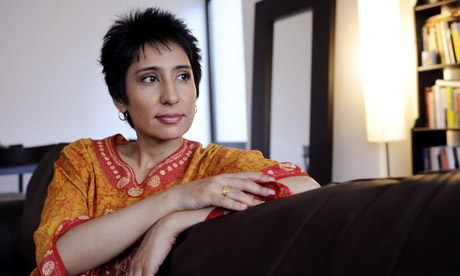 By Geraldine Bedell She is a lesbian feminist Muslim whose ambition is nothing less than to reform Islam. She has been compared by the New York Times to Martin Luther; by others to Alexander Solzhenitsyn, Salman Rushdie, Gloria Steinem and Betty Friedan and, when I met her, casually, by herself, to Vaclav Havel. Irshad Manji, a spiky - haired, opinionated, mouthy Canadian Muslim, lives in New York behind bulletproof glass and doesn't use a mobile phone because it would make finding her too easy. She has a lot of enemies: her book, The Trouble With Islam Today, is banned across much of the Middle East. But it is also a bestseller in many countries, including the US, and has been downloaded in its Arabic, Farsi and Urdu translations more than half-a-million times. In the last couple of weeks, she has been in Washington advising Democrats on Capitol Hill about a potential Obama administration's policy towards the Muslim world and reminding the National Organisation for Women to speak out against human-rights abuses perpetrated under cover of religion. Her recent documentary, Faith Without Fear, has just been nominated for an Emmy. Read more ...Source: The Observer
Irshad Manji, a lesbian feminist Muslim and, say many, one of the bravest women alive, has revealed the horrors of the first time it sunk in how barbaric her own religion could be: she was aged 10 and her father was chasing her through the house with a kitchen knife. Manji, who has received numerous death threats as a result of her campaign to highlight how Islam oppresses millions of its followers, had threatened to report her father to the police for the way he regularly beat his wife. Born in 1968 in Idi Amin's Uganda, but living in Canada when the attack happened, Manji escaped to a hiding place on the roof. There, she tells the Observer, she had an epiphany. "I realised I was grateful because there were people I could go to, talk to, whereas if we'd still been in East Africa that may not have been the case. Read more ...Source: The First PostIrshad Manji
Latest recipient of The MASH Award
 By BARRY GEWEN Ayaan Hirsi Ali and Irshad Manji are two of the most prominent and outspoken critics of what they and others see as “mainstream Islam.” Brilliant, dynamic women — the overused word “charismatic” is not inappropriate for either one — they have each rebelled against a Muslim upbringing to become public figures with large and devoted followings. Both are successful authors: Ms. Hirsi Ali’s autobiography, “Infidel,” was a New York Times best seller; Ms. Manji’s combination memoir-polemic, “The Trouble With Islam Today,” has been published in almost 30 countries. They are firm and unyielding in their support for the West, feminism, reason, freedom — and they have paid a price: both have been targets of death threats and have required protection; in Ms. Hirsi Ali’s case, around-the-clock protection. Yet though they are allies on one level, their approaches to Islam are strikingly different, with one working outside the religion and one within. Neither one can be considered a spokeswoman for a significant Muslim constituency in the Middle East. (Indeed, their most sympathetic audiences are probably Western.) But their differences have implications for all the big issues the West grapples with in considering the Muslim world. How much popular support do terrorists have? Is a secular Middle East possible, and what’s the best way to promote it? Is Islam itself an enemy of the West? Ms. Hirsi Ali is an avowed atheist whose criticisms can be seen as attacks not only on radical Islamism but on the religion of Islam over all. George W. Bush was wrong, she says, when he announced that Islam was being held hostage by a terrorist minority: “Islam is being held hostage by itself.” About the 9/11 attacks, she declared: “This is Islam,” and “not just Islam, this was the core of Islam.” The attacks forced her to decide “which side was I on?” she writes in “Infidel.” And further, “Where did I stand on Islam?” Her book is the story of how she chose the West. For Ms. Manji, there has been no such either-or choice. She is a practicing Muslim who — though she can be as caustic about her coreligionists as Ms. Hirsi Ali — seeks to change her faith from within. As founder and director of the Moral Courage Project at New York University, she assists other maverick writers and scholars who dissent within their communities. “What I want,” Ms. Manji has said, “is an Islamic Reformation,” and in contrast to Ms. Hirsi Ali, she adds, there is “no need to choose between Islam and the West.” Christopher Hitchens, who wrote the foreword to the paperback edition of “Infidel,” says the positions of the two women “can’t possibly be reconciled.” Both Ms. Hirsi Ali and Ms. Manji come from non-Arab Muslim backgrounds. By itself, this may be one reason for their opposition to Islamic orthodoxy, which they see as inherently Arab, or Arab-dominated. Ms. Hirsi Ali was born in 1969 in Somalia, and lived in Saudi Arabia, Ethiopia and Kenya before fleeing to the Netherlands when she was 22 to avoid an arranged marriage. When her family was in Saudi Arabia, she remembers her father’s complaining that the Saudis had perverted the true Islam. “He hated Saudi judges and Saudi law,” she writes. “He thought it was all barbaric, all Arab desert culture.” Ms. Manji was born in 1968 in Uganda, but her family, part Egyptian and part Indian, moved to Canada when she was 4 to escape Idi Amin. She is even more insistent than Ms. Hirsi Ali in drawing a distinction between Islam and Arab tribal culture, its “dictatorship from the desert.” Who elected the Saudi monarch “to be Islam’s steward?” she asks. “We’re not in the Saudi sand dunes anymore.” Ms. Manji has a broader and more flexible idea than Ms. Hirsi Ali of what Islam is and can be. Ms. Hirsi Ali says, “Saudi Arabia is the source of Islam and its quintessence.” Ms. Manji, on the other hand, is convinced that her religion can escape what she sees as its Arab domination. “We need a take-no-prisoners debate about Saudi Arabia, a cauldron of duplicity.” The writer Paul Berman suggests that the difference between them may be due to the fact that Ms. Manji was raised in the warm, liberal, welcoming precincts of British Columbia, where religion could be a comfort rather than a burden, where pluralism was an assumption, a fact of life. (Ms. Manji was kicked out of her Islamic religious school for asking too many questions, but before that she had been cared for at a Baptist church, and at age 8 even won its Most Promising Christian of the Year award.) Ms. Hirsi Ali’s early years, by contrast, consisted of dictatorship, war, patriarchy, genital cutting, confinement and beatings so severe that she once ended up in a hospital with a fractured skull. Ms. Manji offers her own support for Mr. Berman’s conjecture: “Had I grown up in a Muslim country, I’d probably be an atheist in my heart.” No element more thoroughly informs the work of both women than feminism; its influence on their thinking can hardly be overstated, and in this sense they might be considered crown jewels in the history of the modern women’s movement. Yet because they are risking their lives for their beliefs — constantly, every day — they may have more in common with antitotalitarian dissidents like Dietrich Bonhoeffer and Aleksandr I. Solzhenitsyn than with Gloria Steinem and Betty Friedan. As feminists, Ms. Hirsi Ali and Ms. Manji are demanding more than equality; they are very self-consciously challenging the foundations of an entire way of life. “The most important explanation for the mental and material backlog we Muslims find ourselves in,” Ms. Hirsi Ali has said, “should probably be sought in the sexual morality that we were force-fed from birth.” Her first book, a collection of essays, was entitled “The Caged Virgin: An Emancipation Proclamation for Women and Islam.” In the Netherlands, she devoted herself to helping Muslim women, in her words, “develop the vocabulary of resistance,” and she continues the fight from the American Enterprise Institute in Washington, where she is a resident fellow. Ms. Manji, too, sees feminism as the linchpin for Islamic reform. “Empowering women,” she says, “is the way to awaken the Muslim world.” But she is not only a committed feminist (bad enough in the eyes of Muslim conservatives). She is also an open lesbian — a rebel twice over. The difference between them “really is between those outside of a faith and those still within it,” says Ms. Manji’s friend the writer Andrew Sullivan. “Hirsi Ali has abandoned faith for atheism. Irshad has taken the harder path, I believe.” The two women have known each other for four years, since Ms. Hirsi Ali interviewed Ms. Manji for a Dutch newspaper, and they discussed their continuing relationship in e-mail interviews. They immediately bonded — understandably enough. “I could not believe she was not an atheist,” Ms. Hirsi Ali says, “and she could not believe that I had become one.” When Time magazine named Ms. Hirsi Ali one of its “100 most influential people” for 2005, it was Ms. Manji who wrote the comment on her. Ms. Manji admires Ms. Hirsi Ali’s determination to speak truth to power, saying that “Ayaan’s defiant distrust of Muslim authorities can help generate debates that move us closer to honesty.” But, inevitably, the differences between them create tensions since, in their eyes, what is at stake is nothing less than the future of Islam. Ms. Hirsi Ali says, “Irshad is the most admirable person I know who is trying to achieve change from within,” but she agrees with Mr. Hitchens that “from an intellectual, logical perspective,” Ms. Manji’s religious faith and her own secularism can’t be reconciled. Mr. Hitchens himself believes that it’s a self-defeating exercise for a declared lesbian to try to bring about an Islamic Reformation. Ms. Manji detects a certain incoherence in Ms. Hirsi Ali’s views: “She wants Muslims to reform, but she also seems to believe that Islam is inherently retrograde.” Ms. Manji says her own position “is that Muslims can reform while remaining faithful precisely because the Koran has the raw materials to be thoughtful and humane. It’s we Muslims who must develop the courage to change.” For her part, Ms. Hirsi Ali replies, “I make a distinction between Islam and Muslims.” That is, “I picture the defeat of Islam as large swaths of Muslims crossing the line and accepting the value system of secular humanism. This is not a matter of one religion defeating another, it’s a matter of value systems which cannot coexist.” Clearly, this is a debate of importance not only to Muslims but to non-Muslims as well, and for a Westerner listening in, the best way to understand it may be to translate it into the language of European history. Irshad Manji sees herself as moving Islam into the 16th century; Ayaan Hirsi Ali wants to move it into the 18th. It’s as if Luther and Voltaire were living at the same time. Source: The New York Times H/T: AC
 |
|
|
Copyright Muslims Against Sharia 2008. All rights reserved.
E-mail: info AT ReformIslam.org
|
|
|


 There is of course a great deal of talk about reforming Islam these days, and just about anyone from Tariq Ramadan to the Saudi King, to people who actually see what is wrong with Islam and want to reform it, can legitimately claim the title of the reformer of Islam.




 Posts
Posts


