HUMAN RIGHTS ABUSES OF WOMEN IN IRAN SPOTLIGHTED NEAR THE U.N. BY: FERN SIDMAN Graphic depictions of the most egregious forms of human rights abuses against women in Iran took center stage at a special seminar in New York City on March 3rd. Sponsored by "Iran180", an organization dedicated to spotlighting the litany of human rights abuses that take place on a daily basis in Iran, the seminar was entitled, "Securing Gender Equality: Iran and the CSW". Held at 777 UN Plaza, a building directly across the street from the United Nations, the objectives of the gathering included raising awareness of Iran's violations of women's rights and the staging of symbolic protests against the welcoming of the Islamic Republic of Iran as the newest member of the UN Commission on the Status of Women at its 56th session. Among the speakers were the Honorable David Kilgour, J.D., co-chair of the Canadian Friends of a Democratic Iran - Shabnam Assadollaki, host and producer of Hamseda Persian Radio in Canada - Fakhteh Luna Zamani, CEO and co-founder of the Association for the Defense of Azerbaijani Political Prisoners in Iran - Renee Redman of the Iran Human Rights Documentation Center - Reza Khalil, former Iranian Revolutionary Guard member and author of "A Time To Betray", winner of the 2010 National Best Books Award - Fariba Davoodi, a formerly imprisoned Iranian women's rights activist, and Mertash Rastegar, an Iranian blogger and international law expert. Quoting the findings of exiled Iranian lawyer, Zohreh Arshadi, Mr. David Kilgour, co-chair of the Canadian Friends of a Democratic Iran intoned, "the Iranian penal system is a principal means of sustaining inequality of genders. Its ludicrous premise is that women are deficient in abilities." He added that Arshadi stresses that Iranian women, "have managed to achieve equality in one field only: equal right to imprisonment, exile, torture, being killed and now being slaughtered..." Speaking of the many Iranian women who are unjustly imprisoned, tortured and often sentenced to death for crimes they did not commit, Mr. Kilgour relayed the narrative of Sakineh Ashtiani, a mother of Turkic descent (a minority known to be targeted for human rights abuses, especially in Teheran) who did not speak Farsi or understand her charge of alleged adultery. "She was incarcerated and beaten, then humiliated in front of her family by a public lashing. Her plight and narrow escape from death by stoning became a successful test case for the global community's response to the regime's misogyny," he said. Mr. Kilgour also spoke of Irwin Cotler, a Canadian member of parliament and chair of the Inernational Responsibility to Protect Coalition who recently warned that Iran is on an "execution binge", while engaging in a "wholesale assault on the rights of its own people." He added that, "in 2011 alone, the Iranian regime has already executed at least 120 people. It now leads the world in per capita executions, many of which are in secret, taking place after arrests, detentions, beatings, torture, kidnappings, disappearances, and brief trials in which no evidence is presented." Calling for the disqualification of Iran's membership in the UN Commission on the Status of Women, Mr. Kilgour suggested that the CSW convene a special session to discuss women's rights in Iran and act in its capacity to stop the repression of women. "It is our responsibility to act in robust solidarity with the struggle for women's rights everywhere across Iran," he concluded. Addressing the issues facing ethnic minority women in Iran, Fakhteh Zamani of the Association for the Defense of Azerbaijani Political Prisoners in Iran (ADAPP) said, "In Iran, as throughout the world, women are victims of violence on a daily basis but Iran's justice system provides little or no remedy to the obstacles and violence facing women and girls." She noted that women are not encouraged to bring complaints against their attackers for fear of bringing, "dishonor" on the family as well as reprisals from the attacker and relatives. Quoting the UN Special Rapporteur on violence against women, Ms. Zamani said, "discriminatory law in both the civil and penal codes in Iran play a major role in enpowering men and aggravating women's vulnerability to violence. In particular, discriminatory provisions in the civil code relating to the areas of marriage, child custody, freedom of movement and inheritance may lead to, perpetuate or legitimize violence against women perpetrated by private actors." Highlighting the ubiquitous phenomenon of trafficking in or girls and women, Ms. Zamani said that the UN Special Rapporteur reported that, "most of the trafficking is said to occur in the eastern provinces, which are mainly Baluchi areas, where women are kidnapped, bought or entered into temporary marriage in order to be sold into sexual slavery in other countries." Concluding with an oft quoted phrase used amongst Iran's women human rights defenders, she said, "We are both women and minorities; so, in the Islamic Republic of Iran, we are doubly accused." "I am absolutely opposed to the imposition of Sharia law," declared Shabnam Assadollahi, the producer and host of the Canadian based Hamseda Persian radio program. "Sharia law tells us that female hair has evil energy and those women's rights activists in Iran who refused to wear head coverings were beaten and tortured while their children watched," she said. She detailed gruesome accounts of torture of women in Iran saying, "young girls and virgins were raped prior to being executed and after execution their bodies were burned and electrocuted." Fulminating at the decision to include the Islamic Republic of Iran on the UN Commission on the Status of Women, Ms. Assadollahi said, "There is no place for Iran on this commission. Just think about the arrogance of this regime to judge others concerning gender equality and human rights." Speaking in her native Farsi with an interpreter, Fariba Davoodi, an Iranian women's rights activist told of her incarceration in Iran and the barbaric tortures that were inflicted upon her by her captors. "It is the common aspiration of all Iranian women to be free", she said. "When the regime came to arrest me for my activism on behalf of women's rights, they beat me up in front of my children and brought me to their notorious prison where I was kept in solitary confinement in a tiny cell where I was interrogated for long periods of time; where tey kept the lights on all the time and forced me to shower in front of them." "The fear that women's rights advocates in Iran have is not only from the repressive government but from male family members including husbands, fathers and brothers," she said. Trying to remain optimistic about the future of Iran as it pertains to women's rights is a daunting challenge for women such as Ms. Davoodi. "We hope that very soon we will live in a free and democratic Iran, but so long as the regime stays in power, our hopes will not be realized," she said.
 Qur'an 4:34: "Men are in charge of women, because Allah hath made the one of them to excel the other, and because they spend of their property (for the support of women). So good women are the obedient, guarding in secret that which Allah hath guarded. As for those from whom ye fear rebellion, admonish them and banish them to beds apart, and scourge them." Qur'an 4:34: "Men are in charge of women, because Allah hath made the one of them to excel the other, and because they spend of their property (for the support of women). So good women are the obedient, guarding in secret that which Allah hath guarded. As for those from whom ye fear rebellion, admonish them and banish them to beds apart, and scourge them." No matter how apologists attempt to spin the beatings as a last resort (as if it would be acceptable then), the bottom line is that Allah says a man can hit the women under his control. These are the consequences of the letter and spirit of the law. "Report: 77% of Gaza women face violence," by Rachel Kliger for The Media Line, December 29
The vast majority of women in Gaza face violence of varying types, a new survey has found. The study, by the Gaza-based Palestinian Women's Information and Media Center, found that violence against women in Gaza has increased since Hamas took over the Gaza Strip in the June 2007 coup and Israel subsequently imposed restrictions on the coastal enclave. The study found that 77.1% of Gazan women have experienced violence of various sorts, with almost half experiencing violence of more than one type. A quarter of the women said they do not feel safe in their own homes because of violence and more than a third said they were unable to fight back as they had more urgent priorities to deal with. 7% of the women surveyed said they had encountered verbal violence, 71% mental violence, 52% physical violence and more than 14% sexual violence. "I think the levels [of violence] are higher than they were in the Gaza Strip in previous years and compared to other countries, the rates are certainly higher," Huda Hamouda, Director of the PWIC told The Media Line. "It's hard to imagine a family living in dignity when seven family members are living on less than three dollars a day." "Many say they suffer from disrespect and deprecation," Hamouda said. "There's also domestic violence, which is committed by relatives such as the father, the brother or the husband." Even this, Hamouda tries to pin on Israel. But it wasn't Israel who put verse 4:34 in the Qur'an; there are also similar statistics for domestic abuse elsewhere in the Muslim world. Did Israel do that, too? With thanks to JihadWatch 
 Jim Hoft Jim Hoft America’s worst president attacked Catholics and Southern Baptists for the abuse of women in a speech he gave in Australia. He even blamed these traditional religious groups for female genital mutilation. Lifesite News reported: In an address to a gathering sponsored by the World Parliament of Religions (PWR) last Friday, former US President Jimmy Carter has once again blamed traditional religion, particularly Southern Baptists and Roman Catholics, for “creating an environment where violations against women are justified.” …In opposition to the vast majority of authentic scholars and historians, Carter asserted: “It’s clear that during the early Christian era women served as deacons, priests, bishops, apostles, teachers and prophets.” He added: “It wasn’t until the 4th century or the 3rd at the earliest that dominant Christian leaders, all men, twisted and distorted Holy Scriptures to perpetuate their ascendant position within the religious hierarchy.” Contrary to the theorizing of Carter, Pope John Paul II taught, “The Lord Jesus chose men to form the college of the twelve apostles, and the apostles did the same when they chose collaborators to succeed them in their ministry.” He added: “the Church recognizes herself to be bound by this choice made by the Lord himself. For this reason the ordination of women is not possible.” (Catechism of the Catholic Church; 1577) Carter singled out the Southern Baptist Convention and Roman Catholic Church, claiming that they “view that the Almighty considers women to be inferior to men.”
However, both Christian faiths hold to the Scriptural truth that God created men and women equal. “Their continuing choice provides a foundation or justification for much of the pervasive persecution and abuse of women throughout the world,” said Carter.
Carter goes on to list horrific violations against women such as rape, genital mutilation, abortion of female embryos and spousal battery. Responding to Carter’s nearly identical points in July, John Paul Meenan, Professor of Theology at Our Lady Seat of Wisdom Academy in Barry’s Bay, Ontario characterized Carter’s points as “ridiculous,” noting that there was no evidence of the ordination of women in the early Church. Last I checked it was the Muslims who performed female genital mutilation.
But, Jimmy Carter would never have the guts to single out Muslims like that.
With thanks to Gateway Pundit
For many women trapped in abusive marriages in Afghanistan, death can seem like the only way out. In the northwestern province of Herat, doctors this year have treated at least seventy women who attempted to take their own lives by setting themselves on fire. More than 40 of them died, in what doctors describe as a lingering and painful process. Al Jazeera's David Chater reports from Herat where he speaks to one woman who said she saw self-immolation as a means to escape a lifetime of abuse. Al Jazeera
 PARIS - She managed to leave Sudan hidden beneath a niqab. The journalist who was put in jail in her country, Lubna Ahmed al-Hussein, for dearing to wear "indecent" pants arrived in Paris with a "courageousness that is important for Arab and African women", underlined French Foreign Minister, Bernard Kouchner, who received her on the eve of the World Day against Violence Against Women. PARIS - She managed to leave Sudan hidden beneath a niqab. The journalist who was put in jail in her country, Lubna Ahmed al-Hussein, for dearing to wear "indecent" pants arrived in Paris with a "courageousness that is important for Arab and African women", underlined French Foreign Minister, Bernard Kouchner, who received her on the eve of the World Day against Violence Against Women.
"The article of the penal code, which according to the judges that sentenced me, bans women from wearing pants does not exist, it exists only in their heads," underlined the journalist who was put in jail in July together with other women who were wearing pants. Since they pled guilty, the women were whipped as punishment. Lubna refused and ended up in jail.
She was released from jail on parole and in the meantime wrote a book, "40 coups de fouet pour un pantalon" (40 lashes for a pair of pants) published by Plon, which will presented tomorrow morning to Cape, the foreign press association in Paris, for the initiative of the Arab press club and the association for the defence of women, Ni Putes Ni Soumises (neither whores nor subjects).
In the book, in addition to telling her story, Lubna writes about the condition of women in her country where sharia law is applied.
 An Australian is trapped with her children in Saudi Arabia while her husband languishes in jail, both victims of a campaign by her former husband. Rick Feneley and Tim Elliott report. An Australian is trapped with her children in Saudi Arabia while her husband languishes in jail, both victims of a campaign by her former husband. Rick Feneley and Tim Elliott report. At first glance Jennifer Birrell is a free woman living a privileged life in the Saudi capital, Riyadh. "It's a weird prison," she concedes. "A big house with a pool and a nice new car, all behind massive concrete walls that no one can see inside of. That's the prison. So I live here with my maid and my kids and my driver." But here the 33-year-old Muslim convert is trapped, unable to obtain an exit visa to return to Australia, and with no right to visit her husband, Mohammed Ahmed Nagi, in jail. Also 33, he has been held in the Malaz prison for more than 15 months. He has another 21 months to serve. He has endured 200 lashes, 50 at a time, and will be subjected to 100 more. Why? The couple's hellish predicament – detailed in Birrell's pleading letter to the Saudi king – rests on several flimsy pieces of paper, all wielded by her abusive former husband.
This is the Yemeni man she married in Australia in 1998 and who fathered three of her children, all Australian citizens.
They moved to Saudi Arabia in 2004, but she fled from him two years and three months ago, fearing for her life, after he allegedly threatened to kill her and bashed her three times with a candle stick, caving in her forehead. Among his pieces of paper was an old mobile phone bill. He had her account redirected to him while they were separated, and he took the bill to police in July last year, five months after he granted her a divorce in court. By now Birrell's colleague Mohammed Nagi had offered to become her guardian, or mahram.
In accordance with Muslim custom, he had asked her father's permission and they married in June last year, in accordance with Sharia law, at the Egyptian embassy in Riyadh.
Their marriage certificate was legalised in the Saudi Ministry of Foreign Affairs and the Saudi Ministry of Justice. After all, the law in the kingdom requires a woman have a male guardian. Read more at SMH H/T: David F.
 It seems that most, if not all, of these rapes were committed by African asylum-seekers. It seems that most, if not all, of these rapes were committed by African asylum-seekers.
16 of the 17 aggravated rapes and rape attempts in Stavanger (Norway) in the past two years were committed by men of non-Western background.
Of the 18 men involved, only one was ethnic Norwegian. The violent rapes included six 'taxi rapes' [ed: these caused the police to advise women not to get into taxis alone].
Police sergeant Tor Erik Riska Thorsen of the Rogaland police district specializes in investigating sexual attacks. He thinks the explanation for why non-Western men are overrepresented in the statistics is simple: An primitive attitude towards women and little openness for sexuality.
Many of the immigrants in Rogaland come from remote areas where a prehistoric attitude towards women is still alive and well, explains Thorsen. This attitude is carried by the men to other countries.
"When a lightly dressed, intoxicated woman gets in alone into a taxi, the starting point is that she's already sinned. A Muslim woman can't do that.
Those who attacked and raped women in the street thought that they were within their rights. They saw an intoxicated woman without an escort.
She's then considered fair game in some Muslim communities. And by their own perception, the men think that women have no value as witnesses in a criminal case," says Thorsen.
Source: VG (Norwegian)
See also: Oslo: Rapes are the fault of Norwegian girls With thanks to Islam in Europe
 In Islamic Bangladesh, rife with sexual violation and rape of women, being beautiful for a women is rather a curse than blessing, more so when she belongs to a minority community. In Islamic Bangladesh, rife with sexual violation and rape of women, being beautiful for a women is rather a curse than blessing, more so when she belongs to a minority community.
Some people might say that beauty becomes a curse for a woman, because she is often targeted for rape. I disagree with the idea that the woman's physical beauty is a curse.
It is not beauty of the woman that causes sexual violence, but the beast inside the rapist. Not all of the women or girls, who get raped, have great physical beauty either.
Rapists generally spare their mothers, sisters or daughters, even if beautiful, from sexual violence, but go out and rape unrelated women or girls, not necessarily beautiful at all? If it is the religious teachings that prevent rapists from abusing their own, then the same religious norms also fail to stop them from sexually abusing someone else.
In Bangladesh, if you look at the newspapers on a morning, you will see news about various forms of sexual violence against females. There have been reports of such violence upon two-year-old girls to elderly grandmothers.
There are stories about girls raped by strangers, by relatives, by teachers in schools, or even by clerics in religious institutions. The victims may go to the police for justice, but often fail to get justice. There are also cases of women getting raped by policemen, when they go to police stations for reporting sexual crimes against them.
We talk about educating about violence against women in Bangladesh, but in some cases, teachers harass female students in schools, from the Mohila Madrasa (Islamic Girls School) to well-known institutions of higher education. On May 14, 2009, the Bangladesh High Court pronounced a judgment to prevent sexual abuse of women at offices, educational institutions and all types of governmental, non-governmental and other organizations.
Especially for minority girls and women, Bangladesh is an extremely fearful place.
As soon as a girl is born into a minority family, they have to worry about her being victim of sexual violence by Muslim thugs, and how they can protect her from such a fate. While not all minority girls and women are raped, but the number of victims of rape, especially in Bangladesh's Hindu community, are quite high.
At dawn each day, there is another story about a minority woman or girl, raped, maybe even murdered, or she has committed suicide out of shame after rape.
It must be noted that it’s not the men, perpetrators of the odious crime, who commit suicide out of shame, but the victim. Famous U.S. author, educator and theorist Freda Adler had rightly said: “Rape is the only crime, in which the victim becomes the accused.”
All the major religions, practiced here in Bangladesh, are male-dominated organizations. In the holy book of Islam, the dominant religion, creation begins with a man, “Adam”, for whose pleasure and consort, “Eve”, the first a woman, was created. The Abrahamic faiths differ from one another in many things, but are united in this beginning story, thus creating male-dominated paradigm of human history, which ends in today's daily-life practices. From Adam to Prophet Mohammed, all prophets were male.
Bangladesh has a vast population practicing and following Islam in their lives. Islam initially controls their way of life. In Islam, Prophet Mohammed left an example by having sexual relations with many women, including little girl Aisha, whom he married at the age of six and consummated at nine. At his death, he left behind thirteen wives and concubines.
Different religions, being generally male-dictated, have created institutions of marriage to suit men, normally polygamist by nature. Especially the Prophet of Islam, who maintained about a dozen wives and concubines during his best days, has set an example for Islam’s followers to be polygamist forever.
The Roman philosopher Seneca said: “Injustice never rules forever.”
The injustice that is going on in Bangladesh against women can be stopped if we can dig out and discredit the rotten teachings of religions, especially of Islam. Islam makes it followers to be extreme male chauvinist, dominant over women and polygamist, and, thus, foster deprivation of women of their basic rights and dignity by making them dependents of men. And this male-dominance is also responsible for engendering the horrible culture of sexual violence and rapes of women in Bangladesh.
We must work toward achieving equally between men and women, when beauty will not be a curse, will not rouse men to rape, but be an object of appreciation. William Gomes is a former Muslim, freelance Journalist and Human Rights Activist. Source: Islam Watch
 Wafa Issa The head of the Dubai Foundation for Women and Children yesterday appealed to the police to ensure victims of domestic violence and human trafficking were dealt with by female officers.
Afra al Basti made the call to Dubai Police at a two-day workshop aimed at giving officers the skills to spot and help victims of abuse, both women and children.
She said it was vital to have female officers present when victims were interviewed and called on the force to have more policewomen in place to do so.
“To have female officers is essential in the context of domestic abuse and human trafficking, because these women need to talk about very sensitive issues,” said Ms al Basti.
She said many female victims would be further traumatised by having to reveal details of abuse to a male officer, and that the fear of having to do so could even discourage them from seeking help in the first place.
This, said Ms al Basti, was especially true in UAE society where “women are not used to recounting details of their lives to men”.
Having female officers handle cases of domestic violence and human trafficking would encourage victims to contact the police more readily, Ms al Basti said.
She added that the environment within police stations themselves needed to appear less threatening, so victims seeking help would not be put off.
Read more here,,,, Source: The National
By Gramfan According to the Merriam-Webster Dictionary Feminism is defined thus: Date: 1895 1 : the theory of the political, economic, and social equality of the sexes
2 : organized activity on behalf of women's rights and interests Who can ever forget the iconic cover of "The Female Eunuch", by Germaine Greer? It was everywhere when it was first published in 1970. It was virtually the next best thing that had happened to women since Emmeline Pankhurst and her Suffragettes worked to get women the vote. So we were told. And certainly you cannot deny the benefits and progress that have come from these two women, and the many others who have taken over the baton and changed the lives of millions. Many of today's other famous feminists are living very comfortably on self-earned wealth: fine with me, it's well-deserved. They have turned their politics and activism into income sources by working in journalism and other media. People listen to them. They have power, enormous power. Camille Paglia is but one of many whose opinions are highly respected, and it is easy to see why. Germaine Greer is still going on strongly about all kinds of issues. Gloria Steinem is another member of this esteemed crowd and there are also very many not-so-famous feminists. These feminists are in almost all professions from politics to pianists, parents and yes, prostitutes - the oldest "profession" of them all! Then of course there are the other women in the world who don't occupy this rarified space but who have decided, and yes, it is a decison now, to become home-makers and mothers. Some of them decide to resume successful careers and some chose not to. But I wonder if we all really received so many benefits from all these feminists? Some of us didn't. With all that is good and liberating in human progress there are often side effects and "unintended consequences". Sadly there are goals that have not, and will not be achieved. Certainly many of us get equal work for equal pay nowadays but not all of us. Then there are those who chose to be wives and mothers, who are often scorned, or looked down upon, for their choices. They had jobs, but feminists weren't satisfied; every other woman had to get one too. So they opened fire on homemakers with a savagery that still echoes throughout our culture. A housewife is a "parasite," [Betty] Frieden writes; such women are "less than fully human" insofar as they "have never known a commitment to an idea." And.... Housewives, not men, were the prey in feminism's sights when Kate Millett decreed in 1969 that the family must go. Feminists do not speak for traditional women. Men cannot know this, however, unless we tell them how we feel about them, our children, and our role in the home. Men must understand that our feelings towards them and our children are derided by feminists and have earned us their enmity. Whether or not this understanding garners men's support, traditional women must defend ourselves because the feminist offensive is, most essentially, a breach of solidarity with us, a disavowel of the obligation to honor the Women's Pact [that religious celibates, professional women, and homemakers respect each other] that women in the movement owed to us (Source). Oh yes, this site has more. Feminism today goes on and on, intellectualising and re-defining feminism to the extent where it is almost too difficult to follow, let alone comprehend. Quite frankly I am more interested in the practical day-to-day realities. I take the two definitions at face value and I note it doesn't specify any nationality,political allegiance or religion. 1 : the theory of the political, economic, and social equality of the sexes
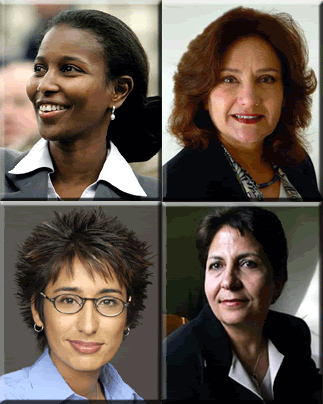
2 : organized activity on behalf of women's rights and interests It is true a lot of this has happened in the West but rather than have Greer et al espouse "intellectual yada yada" I would rather see these women get militant again and do something to help their long-suffering sisters who live in Islamic countries, and who can but only dream of the lifestyle many of their famous feminist sisters enjoy. All too often I see stories of honour killings, rape, female genital mutilation, subservience, domestic (and other) violence, forced marriage and utter discrimination perpetrated against women in Muslim countries and now also in the West. Some women are getting hymenoplasties and buying repair kits before they marry. Some are being recruited as homicide bombers. One is punished for drinking beer, others face lashings or stonings. An Australian Islamist tries to justify polygamy for everyone. There are women who suffer terribly from acid attacks quite frequently. Women in Gaza are not allowed to ride motorcycles, and Somali women are being scrutinised when wearing a bra! Where's Germaine when you need her, or would this make her happy I wonder? And recently we have the on-going case of Rifka Bary who, as a minor, cannot chose her religion, and could become a victim of honorcide for apostasy. If she is sent back to her parents her fate is unknown. If she is allowed to remain alive the Islamists can deny honorcide even exists. This is happening in the USA now. Yet in spite of these incidents feminists like Naomi Wolfe manage to defend discrimination towards women in Islam and it then takes a compassionate feminist, Phyllis Chesler, who has actually lived in a Muslim country, to sort it out for her! I know many feminists, and women in general, can be fearless fighters. Code Pink, for example, have gone to Iraq and Afghanistan. True, they are an anti-war movement, but perhaps, just perhaps, they could have drawn some attention to the women who live and suffer in the war zones they are so adamantly against. They could have easily added one more mission statement to what is on their website which mentions "social justice". Indeed, any other anti-war group could easily have done the same. I know they do not define themselves as feminists per se, but why not do more? Could they not have met with Malalai Joya and offered some help? Indeed, could not some of our famous feminists, female politicians and celebrities who spend so much time choking on their own venom over Sarah Palin have done the same? Are they afraid? Or are they simply not interested in the women's issues of today because they think it is another culture and therefore they shouldn't interfere. They know it isn't right but they can turn a blind eye to it, even as it happens under their noses, in their own countries. It's a cop-out. The improvement of the condition of women in Islam is, to me, a far loftier goal than getting to wear trousers, getting equal pay, getting an abortion on demand, and having a man treat a woman more like a man! This was definitely an "unintended consequence" for me: trivial as it may seem. I am much heartened by the fact that progress is being made, albeit in small steps. Kuwati women in parliament refuse to wear the veil. An Egyptian Cleric wants to ban burquas and other facial coverings. Honor killing or Honorcide is getting more attention. Lubna Hussein got a lot of media attention over her sentence for wearing trousers. Najwa Bin Laden and her son, Omar, wrote a book about their husband and father, Osama, and seem to be fearless about it. They have provided a fascinating insight into this man. I think the real "feminist"heroines now are the ones who have literally put their lives on the line, not only for women in Islam but for the world in general. Their goals and committment are what is truly deserving of our respect and support. I am referring to women like Dr Wafa Sultan, Ayaan Hirsi Ali, Nonie Darwish, Supna Zaidi, Irshad Manji and women like them. There is another one who would have possibly made it to this list: Neda Soltan. Tragically she cannot, but in spirit she can inspire so much. I feel she deserves a mention among these brave, dedicated and fascinating women. This is my challenge to todays feminists. Use your power again. I am "just a Mom". I do not have your platform and power. This is indeed a most worthy cause to support and fight for. ("Gramfan" has been 'blogging since 2002. She is "just a Mom" of two grown-up sons, and helps her husband of 38 years. She has occasionally written pieces for other 'blogs, and posts comments. She now writes exclusively for Muslims Against Sharia).
 A Somalian Islamic group reportedly has started whipping women in public for wearing bras that violate Islam, the Daily Mail reports. A Somalian Islamic group reportedly has started whipping women in public for wearing bras that violate Islam, the Daily Mail reports.
Residents claim insurgent group Al Shabaab sent gunmen into the streets to round up women who appeared to have a firm bust.
The women are inspected to see if their suspected firmness is natural or from a bra. Officials reportedly make the women shake their breasts after removing their bras.
"Al Shabaab forced us to wear their type of full veil and now they order us to shake our breasts," a resident, Halima, told Reuters, adding that her daughters had been whipped on Thursday.
The new bra rule adds to the long list of religious restrictions in Somalia, including a ban on movies, musical cell phone ring tones, dancing at weddings and playing soccer. Source: FoxNews
 Rome - The scourge of violence suffered by Afghan women is a grave problem that requires decisive action, according to one of the country's magistrates. Rome - The scourge of violence suffered by Afghan women is a grave problem that requires decisive action, according to one of the country's magistrates.Marzia Basel expressed her views at an international conference on violence against women held in Rome this week.
"Violence suffered by women in Afghanistan is a dramatic problem that should be tackled in a serious way," Basel told the conference at the Italian foreign ministry on Thursday.
The G8 International Conference on Violence Against Women was hosted by Italy, which is the current president of the G8 group of the world's seven most industrialised nations plus Russia.
Basel said she was "surprised" by a law signed last Sunday by Afghan president Hamid Karzai, aimed at preventing violence against women in the country.
But she described it as "an important step forward by the government to defend Afghan women."
"At last, penal sanctions have been enacted against those who commit crimes against women," said Basel.
Drafting of the law began two years ago.
It is based on articles of the Afghan constitution which enshrine the duty of the state to respect and protect the "inviolable" liberty and dignity of all of its citizens", and "ensure physical and psychological well-being of a family, especially of child and mother, upbringing of children and elimination of traditions contrary to the provisions of Islam."
 By Charles Stratford By Charles Stratford Every year thousands of women arrive in the Gulf to take up jobs as domestic workers. The majority of them leave behind their families on a huge financial gamble to try to earn enough in remittances. But behind closed doors, in the homes of their employers, some find themselves trapped in a cycle of horrific abuse. Al Jazeera's Charles Stratford spoke to one housemaid, Mary, who suffered two years of abuse in the United Arab Emirates. Two and a half years ago, Mary left her family in East Africa to work as a maid in a private house in the Middle East. "The beatings started on the second day," she said. "No day passed without beatings. If she didn't beat me in the day she would beat me at night." One day she was ordered to have sex with another maid. When she refused, her employer threatened her with more beatings. "She said the law was in her favour. Not in mine," Mary said. Simel Esim, a specialist in domestic worker abuse at the International Labour Organisation (ILO), said the workers are simply not protected by labour laws. "Domestic workers ... are excluded from unionising and organising around the globe," she said. "[This] kind of economic infrastructure [in the Gulf] has created a huge inflow of labour migration that requires immediate and urgent attention. "The sponsorship system ... The way it is set up, it is bound to fail. "You are attaching a person's legal status, visa status and employment to one person as the employer and also the provider of housing, food and health care. "It creates total dependency and total dependency means total vulnerability and opens the door wide for abuse and exploitation." Mary left her country determined to earn money for her family. But two years later, she is horrified at the prospect of her family knowing about her suffering. "How can I go back home with this body? My mother is sick," she said. "If she sees me like this she will die of shock. I am so ashamed to see my friends. Even now I feel shame." Source: Al Jazeera (English)
 by Valentina ColomboResearch Fellow, IMT Lucca The great irony of the recent International Conference on Violence Against Women hosted by the Italian Ministry for Equal Opportunities, is that if the Convention on the Elimination of All Forms of Violence Against Women (CEDAW), ratified by 185 countries, or over 90% of the United Nations, were implemented, there would be no need for this conference.
One if the main problems is the distance between laws, international conventions and treaties - and their implementation.
In Islamic countries, for example, although 46 out of 57 members of the Organization of Islamic Conference (OIC) ratified it, they did so with “reservations.”
It seems there are Muslim intellectuals and human rights defenders who are still ambivalent about pursuing engagement ....
 by Valentina ColomboResearch Fellow, IMT Lucca Last September 15th Sanaa Dafani, an 18 year old girl of Moroccan origin, was killed by her father because she loved a 31 years old Italian.
The father was immediately arrested while the mother tried to find a reason for his act: “My husband loved Sanaa. Maybe she was wrong. I could forgive my husband. Yes, I could. He is my husband, my sons’ father. Sanaa dressed and ate in a proper way, but he did not want her to go out in the evening with bad boys or friends. My husband loved Sanaa. Maybe she was wrong. He always sent her messages: come back home. He wanted her beside him.” Almost the same words were pronounced by Hina Saleem’s mother three years ago. On August 11th 2006 Hina, a 21 year old girl of Pakistani origin, was slain by her father because she wanted to live like a Westerner and had decided to go and live with a non-Muslim man. On April 7th 2007, Du’a al-Aswad, a 17 year old Kurdish girl of Yazidi faith, was stoned by a raging crowd in Iraq because apparently she had offended her family’s honor.
In Turkey, almost 200 honor killings are committed every year, in Syria, between 200 and 300. In Pakistan there are between 800 and 1000 honor killings every year. These numbers are sad and worrisome. The problem of honor killings is known;
GRENOBLE : UNE JEUNE FEMME ASPERGÉE D’ACIDE
01/07/2009
Une jeune femme de 29 ans a été aspergée hier d’un produit corrosif, dans une cité sensible de Grenoble, « probablement de l’acide », selon la police. Brûlée à la lèvre et à la main, la jeune femme d’origine maghrébine était chez elle lors de l’agression. La sonnette a retenti et lorsqu’elle a ouvert la porte, « un homme lui a lancé un liquide » reporte l’AFP. L’agresseur a pris la fuite avant d’avoir pu être identifié. Selon les premiers éléments de l’enquête, la jalousie pourrait être la cause de cette agression. La victime a été transportée d’urgence au CHU de Grenoble. J.DLR. Source: http://www.elle.fr/elle/societe/news/grenoble-une-jeune-femme-aspergee-d-acide/(gid)/918814
H/T: http://scettico72.blogspot.com
Married girl’s murder in cold blood: Family shuttles between offices of RPO, CPO for justice * Victim’s mother appeals to CJP, Punjab CM for justice * Says they are called to police station in the dead of night and pressurized to reconcile with the accused By Imran Asghar RAWALPINDI: The family of a young girl killed in cold blood by her husband and mother-in-law has been shuttling between the offices of Regional Police Officer (RPO) Nasir Khan Durrani and City Police Officer (CPO) Rao Muhammad Iqbal for justice for over two months but of no avail.Blinking back his tears, Usman Ali, the brother of ill-fated Saba Sehar, 22, told Daily Times in a choked voice that his sister was married to Azhar Aziz, a resident of Adiala Road, last year. He said in February this year Azhar in assistance with his mother, Azizun Nisa, beat his sister in revenge for not giving the hand of their youngest sister to his younger brother. They beat Saba black and blue, and when she collapsed on the floor from torture and demanded water, Azhar poured acid in her mouth.Usman said that his family shifted Saba to Benazir Bhutto Shaheed Hospital (BBSH) where she succumbed to injuries on March 13. Suspended between life and death, the victim narrated the entire episode to the investigation officer of Saddar Bairooni police. The police registered a case under Section 302/34 against Azhar and his mother and sent the former to Adiala Jail on judicial remand. However, his mother being co-accused was not arrested despite registration of an FIR. In her death statement registered by the police, Saba said, “My mother-in-law grabbed me by hair, while my husband punched and kicked me, making me almost unconscious. When I fell down on the ground and was in a daze, I called for water. But my husband poured a glassful of acid in my mouth.”Usman said that the accused were politically influential and pressurizing his family through different tactics to make a compromise with them. Appeal to CJP: Saba’s octogenarian mother Razia Begum told Daily Times that they were often called to the police station in the dead of the night and pressurized to patch things up with the accused. With tears rolling down her cheeks, she passionately appealed to Chief Justice of Pakistan (CJP) Iftikhar Muhammad Chaudhry and Punjab Chief Minister Mian Shahbaz Sharif to come to her rescue, as she was too old to shuttle between the offices of RPO and CPO and tolerate the pressuring tactics of police officials.“I just want that all those who tortured my beloved daughter to death be brought to justice.” She said a lot of their hard-earned money had gone down the drain visiting the offices of RPO and CPO but they won’t move beyond their verbal assurances of delivering them justice. “What if I died nursing a wish that my daughter’s killers were brought to justice?” Razia begum said that she could meet Senior Superintendent of Police (SSP), Operations, Yasin Farooq on one occasion only. “SSP Yasin marked our application and directed the investigation officer (IO) to arrest the accused but the IO is treating them as criminals,” she said. Police cliché: A police spokesperson told Daily Times that the police would ‘mobilize all their resources’ to arrest the co-accused. He said the CPO was busy in meetings that’s way the applicants could not be produced before him.He suggested that the applicants lodge their complaint with the CPO in an open court, which, he said, would be ‘fruitful’. Source: http://www.dailytimes.com.pk/default.asp?page=2009\05\17\story_17-5-2009_pg11_1
Source: Pakistan.docTranslated into Italian by FFFFF
'This is not what we want for Pakistan'Ayeshah Alam, V-Day activist Renowned social activist Ayeshah Alam speaks out against the recent flogging of a teenage girl by Taliban fighters. The violence was captured on a mobile phone and spread throughout the internet, highlighting militant brutality in the once-peaceful district, a sign of Taliban influence spreading deeper into the country of Pakistan.
When Samar Minallah first forwarded me the video of a young 17-year-old girl being flogged in public I was stunned. These were images that one had gotten used to seeing come out of Afghanistan but not my country. For years on my morning radio show and then later on my morning television show. I had been saying, “we are ignoring what's really happening in our tribal areas.” Hushed stories had been filtered through and my pathan friends kept going on about how the government was ignoring the gradual growing strength of extremist elements. We failed. As a society. When we could see the warning signs, they weren't in our faces and perhaps that's why it was easier to brush them aside...but we failed and today the flogging of our 17 year old sister...daughter is because we kept quiet then and didn't make a loud enough noise to say NO.... this is not what we want for Pakistan.
Today I am proud to see so many men and women stand up for the little girl and tell the people who did this...YOU WILL NOT DO THIS ANYMORE. I was even more pleasantly surprised to see clergymen, different political parties, all come together with one voice and say NO. Yet there are still the men in those areas, which are not under the write of the government who continue to have their beliefs and are making the women of that territory miserable. Some were cynical and said it was fake. Clearly Chaand Bibi's screams for help and mercy were not enough proof for them. Today we don't know where Chaand Bibi is. We don't know if she is still alive. The courts have asked for the victim to be produced but the family will never come forward as it "dishonors" the family name. That today in the year 2009, these events and ideas are still alive is a shameful thing. Yes governments have their role to play, but even as individuals, we can all contribute in making a change of opinions and ideas and ways of living and thinking, if only in the slightest way. We have a saying in Urdu that says "katray katray say durya bunta hai" which means “ a river can be created drop by drop,” or, as Margaret Mead liked to say "Never doubt a small group of people can change the world... it never happened any other way."
Thank you for your work in challenging accepted norms... lets keep challenging and changing so the Chaand Bibis' of the world don't have to scream helplessly anymore. - Ayeshah
Ayeshah Alam is a blogger, filmmaker and radio host based in Pakistan.Source: http://newsite.vday.org/vmoment/alamHumaira Awais Shahid: Fighting Forced MarriagesBy Tekla Szymanski - From the January 2004 issue of World Press Review A Pakistani legislator fights unspeakable women’s rights abuses—with surprising success. The acid burns the hair off their heads, fuses lips, melts breasts, and leaves the victims blind, in agony, unrecognizable, and scarred for life. According to the independent Human Rights Commission of Pakistan (HRCP), at least 211 women were killed in 2002 and countless others maimed when their husbands threw acid in their faces to punish them for disobedience. In Urdu, the acid is called tez ab—sharp water. Some victims say that it is worse than dying. Humaira Awais Shahid, 32, a former investigative journalist turned legislator at the Punjab Assembly, is lobbying to treat this "ruthless tribal custom" as attempted murder. On Aug. 5, 2003, the Assembly passed her resolution to treat it as a crime and prosecute the men who commit it. According to HRCP, an estimated 70-90 percent of Pakistani women have suffered some form of domestic violence—ranging from beatings and rape to maiming and murder. Shahid became aware of these practices while researching forced marriages for the Lahore-based daily Khabrain. The so-called "blood marriages" (vinni, from the Pashto word for blood) are forced unions between rival clan members in parts of northwestern Pakistan. They settle disputes, restore honor, win forgiveness, and turn mostly minor girls—some as young as 5 years old—into servant-mistresses. Tribal jirgas, or assemblies, order the unions. One girl above the age of 7 or two girls younger than that are an acceptable compensation for, say, murder. The girls become the property of the victim's family. According to Junaid Bahadur of Karachi's Dawn, "The girl's parents usually pray for her death so the period of their disgrace is shortened." During her research, Shahid came across the account of the forced marriages of a 17-year-old girl and her 8-year-old sister. Shahid challenged the local jirga: The marriages were dissolved and a monetary settlement between the families was worked out. Though part of the political establishment, Shahid, too, is a victim of prejudice. "To my horror, most of the time, [we] aren't allowed to speak up in debates," she says. "It's like we are just there to amuse the male legislators." Nevertheless, in February 2003, Shahid's resolution to outlaw vinni passed unanimously. "Women's issues...will never totally disappear from the agenda of the [Assembly]," says Shahid, "but they will only be touched upon and never debated. Women's empowerment is a fashionable discourse." Source: http://www.tekla-szymanski.com/englpeople2004.html
 |
|
|
Copyright Muslims Against Sharia 2008. All rights reserved.
E-mail: info AT ReformIslam.org
|
|
|




 Posts
Posts


